Before you reach for one more syringe under that eye
In my chair, the line I hear most often is some version of this: "I've had my tear trough filled several times — why is it still not flat? And this patch right next to it is only getting puffier and harder." The under-eye ring is, by a wide margin, what I see most in the FILLER REVISION clinic — roughly seven to eight out of every ten filler-revision cases have their problem right here. The reason isn't hard to grasp: the under-eye is the thinnest skin on the whole face, with little room, a dense web of vessels and nerves, and orbital fat and the tear-trough ligament sitting just beneath. The smallest pooling, migration or water uptake of product gets magnified into visible puffiness, a bluish tint, asymmetry or a palpable lump.
And here is what most people are never told: an under-eye problem is almost never "not enough volume" — it's that the product is in the wrong place, or went the wrong direction from the start. The tear trough is a ligament tethering the skin down, not a missing pocket of filler; so the more you fill, the more that groove can deepen and the area beside it swell. After all those injections, has any doctor ever scanned you with ultrasound first, before deciding the next step? The answer isn't one more syringe — it's to look clearly first, then decide whether to dissolve, to remove, or whether it should never have been injected. You're not stuck filling forever; there is a more complete path.
So the question we hear most often is really just one: "Something I had injected under my eye has gone wrong — should I dissolve it, or have it taken out? Or… should I never have had it injected in the first place?" Those three questions have different answers, and the answer turns on three things: what material was injected, which sub-area it sits in, and whether your under-eye problem was ever suited to filler at all. This article isn't about a single technique. It hands you a decision map so you can first work out which box you fall into, then find the matching approach.
One table first: under-eye area × material × which path to take
← Swipe to see more →
| Sub-area | Commonly injected | What "gone wrong" looks like | General direction |
|---|---|---|---|
| Tear trough | Hyaluronic acid | Puffiness, bluish tint (Tyndall effect), pseudo eye-bags | HA, not yet encapsulated → dissolution can be assessed; won't dissolve cleanly or already encapsulated → removal |
| Tear trough | Fat grafting / collagen stimulators | Nodules, unevenness, long-standing lumps | Can't be dissolved, only precise extraction |
| Aegyo-sal | Hyaluronic acid | A swollen "caterpillar," bunching up when you smile, side-to-side asymmetry | HA → dissolve first, then reassess; fibrosis / migration → removal |
| Eye-bag zone | Migrated hyaluronic acid | Can't tell aging eye bags from displaced filler | First tell them apart on ultrasound, then decide dissolve or remove |
| Dark circles | Hyaluronic acid | No improvement after injecting, or even puffier and darker | First work out which type of dark circle — some types should never be injected |
Key takeaway: Same "under-eye problem," yet every box in this table points in a different direction. The most common mistake is treating every under-eye issue as "dissolve it again" or "inject it again" — and so what should have been removed gets dissolved, and what should never have been injected gets topped up once more. The problem only snowballs.
First fork: was it hyaluronic acid or not?
This is the single most important watershed on the whole map, because it decides whether the material can be dissolved at all.
Hyaluronic acid (HA) — dissolvable in theory, but "how cleanly it dissolves" is another matter. HA can be broken down with hyaluronidase (hyaluronidase is used only after in-person physician assessment). But the honest clinical truth is this: once HA has encapsulated, or has been sitting under the eye for several years, or persists after repeated dissolving, hyaluronidase often can't clear it cleanly. The under-eye is also an extremely thin zone, and hyaluronidase spreads and affects the surrounding tissue. So HA is never simply "dissolve it and you're done" — you first have to see whether it has encapsulated and how long it has been in place. There's a full account in Dissolve hyaluronic acid or remove it directly?.
Fat grafting and collagen stimulators (Ellansé, AestheFill, Sculptra and the like) — there is no antidote that dissolves them. Once these materials form a nodule or lump under the eye, hyaluronidase does nothing to them. There is only one direction: under ultrasound guidance, extract the material precisely. The under-eye space is tiny — which is exactly why this area needs you to "see it before you go in."
Second fork: where exactly under the eye?
Even with hyaluronic acid, injecting into different sub-areas changes both the difficulty and the strategy.
- Tear trough: The thinnest, least forgiving zone on the whole face — 0.1 ml of excess can already cause obvious puffiness or a bluish tint. Tear-trough HA also draws water and spreads slowly over months to years, which is often the hidden reason something "injected long ago is only swelling now."
- Aegyo-sal: Very superficial — it is the ridge of the orbicularis oculi muscle, not the tear trough. Overfill it and you get a swollen horizontal bulge that bunches into a clump when you smile. Dissolvable HA goes down the "dissolve first, then revise" path; but where it has been injected too many times for too long and has already fibrosed or migrated, the route is removal.
- Eye-bag zone: The easiest to confuse with true aging eye bags. Filler that has migrated into the eye-bag zone creates "pseudo eye-bags" — it looks like aging when it is really displaced material. The key in this box is not to rush in, but to first use ultrasound to tell fat from filler — mistake the direction and operate on an "eye bag" and you'll meet filler you didn't expect.
- Dark circles: The most particular box of all, because "should it have been injected at all" is itself open to question (see the next section).
Third fork: was your under-eye problem ever suited to filler?
This is the most easily skipped question, and the one that should be thought through first. Many people go in for tear-trough filler carrying the hope of "making my dark circles lighter," only for it to do nothing — or leave them puffier and darker — because dark circles are not one thing. They split into three completely different causes: vascular, pigmented and structural.
- Structural (a genuine hollow): The type that suits filler — but in small, precise amounts.
- Pigmented (a color problem): Filler does nothing for "color." Injecting only lifts the hollow; the darkness stays.
- Vascular (thin skin with vessels showing through): Filler helps only marginally; inject too shallow and too much, and a bluish tint becomes more likely, not less.
In other words, the right answer for some under-eye problems is not "inject it more precisely" but "it should never have been treated with filler in the first place." The full method, with step-by-step self-assessment, is in The three types of dark circle and filler candidacy.
There is an even earlier choice: even if assessment shows you genuinely do need a little volume, getting the material right is what keeps it from becoming a separate problem down the road. The under-eye is one of the most mobile areas of the whole face, and collagen stimulators (Ellansé, AestheFill, Sculptra and the like) placed here get worked on again and again by the expression muscles and keep proliferating — once they clump, there is no antidote that dissolves them; they can only be removed. That is exactly why under-eye collagen-stimulator lump extractions are a constant in clinic. So if volume really is needed, I lean toward materials that don't keep proliferating and are easier to control: a small amount of small-molecule hyaluronic acid, say (and if it isn't ideal, hyaluronidase is still a fallback), or autologous fat where the conditions suit it — and away from putting collagen stimulators under the eye. Filler isn't off-limits; it just has to be the right material in the right place.
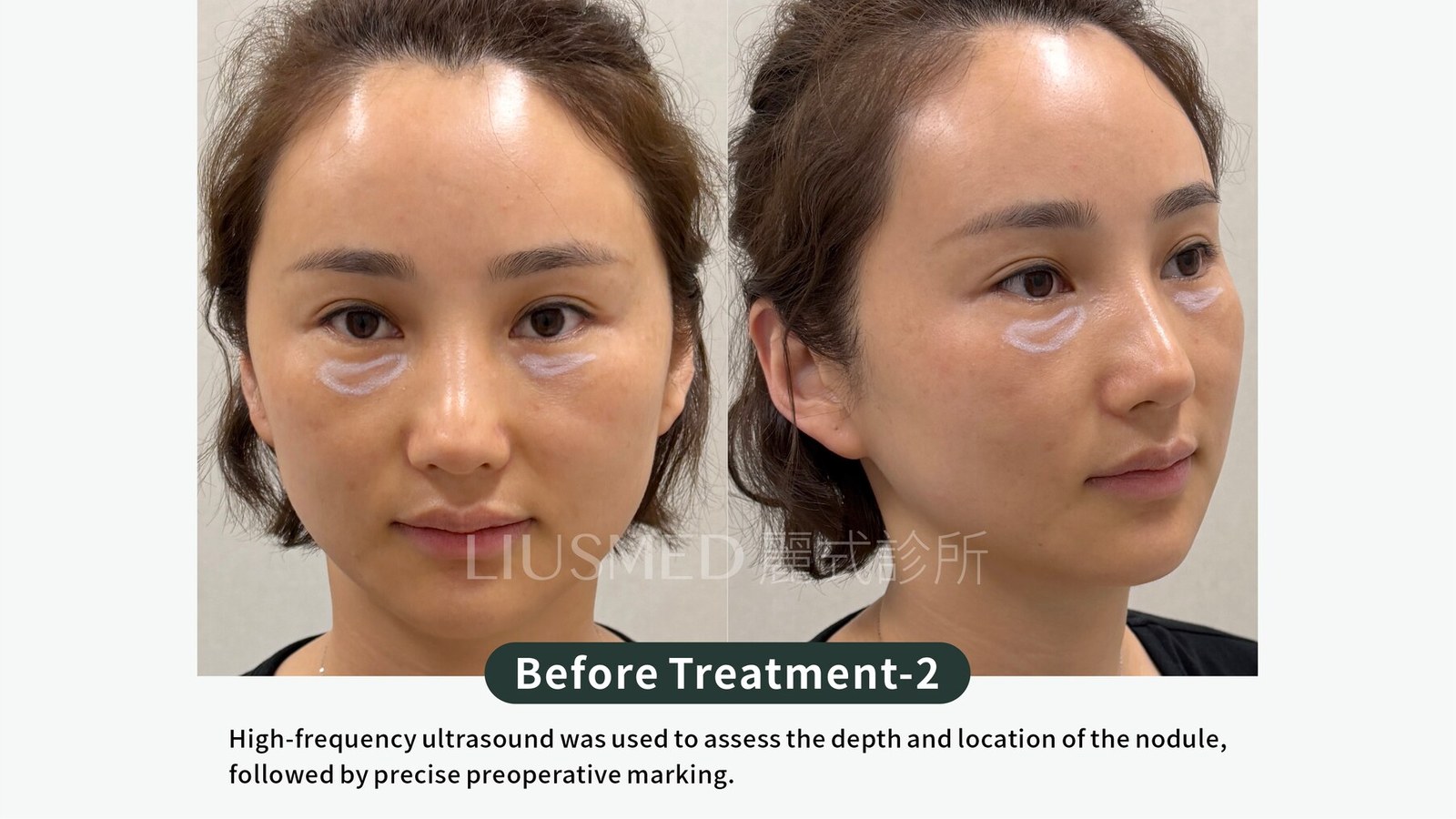
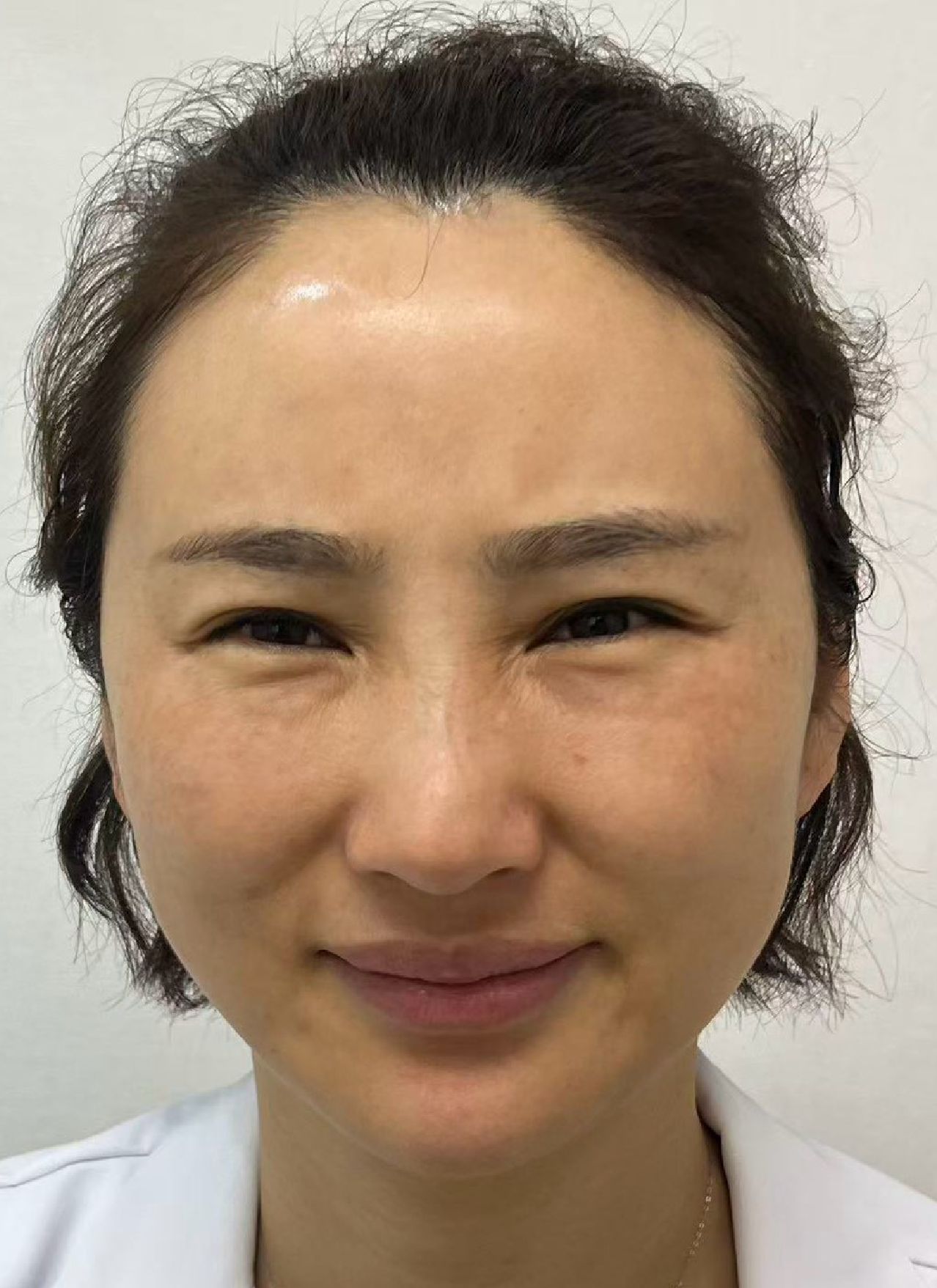
There is an exception to add here, and it comes straight out of clinic. Autologous fat placed under the eye clumps too — and it has no antidote either. One patient had fat grafted under her eye to fill a tear trough; it did not settle evenly and consolidated into a palpable bulge. To "cover it flat," she then had a collagen stimulator injected into the hollow beside it — and the result was not a flat under-eye but two lumps. Both sat there for over five years, visible at rest and pushed into sharper relief whenever the orbicularis contracted in a smile, until high-frequency ultrasound mapped their depth and layering and each was removed separately through a pinhole. The four stages for this patient — before, ultrasound mapping, what came out, and three months on are on her case page, and the removal itself is documented at our sister clinic MinimalCutSurgery. So the line above — "autologous fat where the conditions suit it" — needs one more caveat under the eye: fat is not hyaluronic acid, and it has no way back out either. The real watershed is not what gets injected, but whether anyone looked at what was already in there before injecting it — and whether you could live with it if removal turned out to be the only road left.
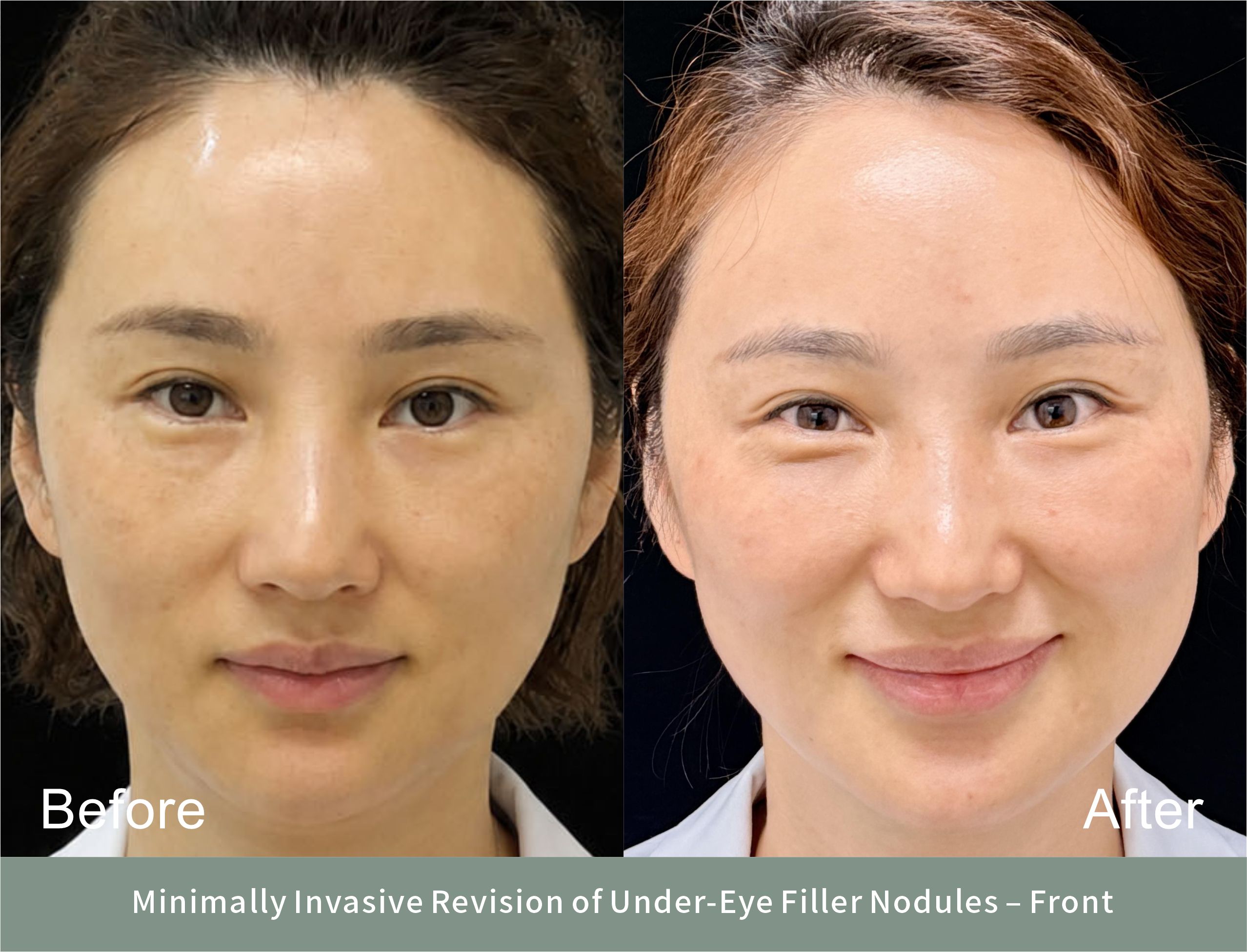
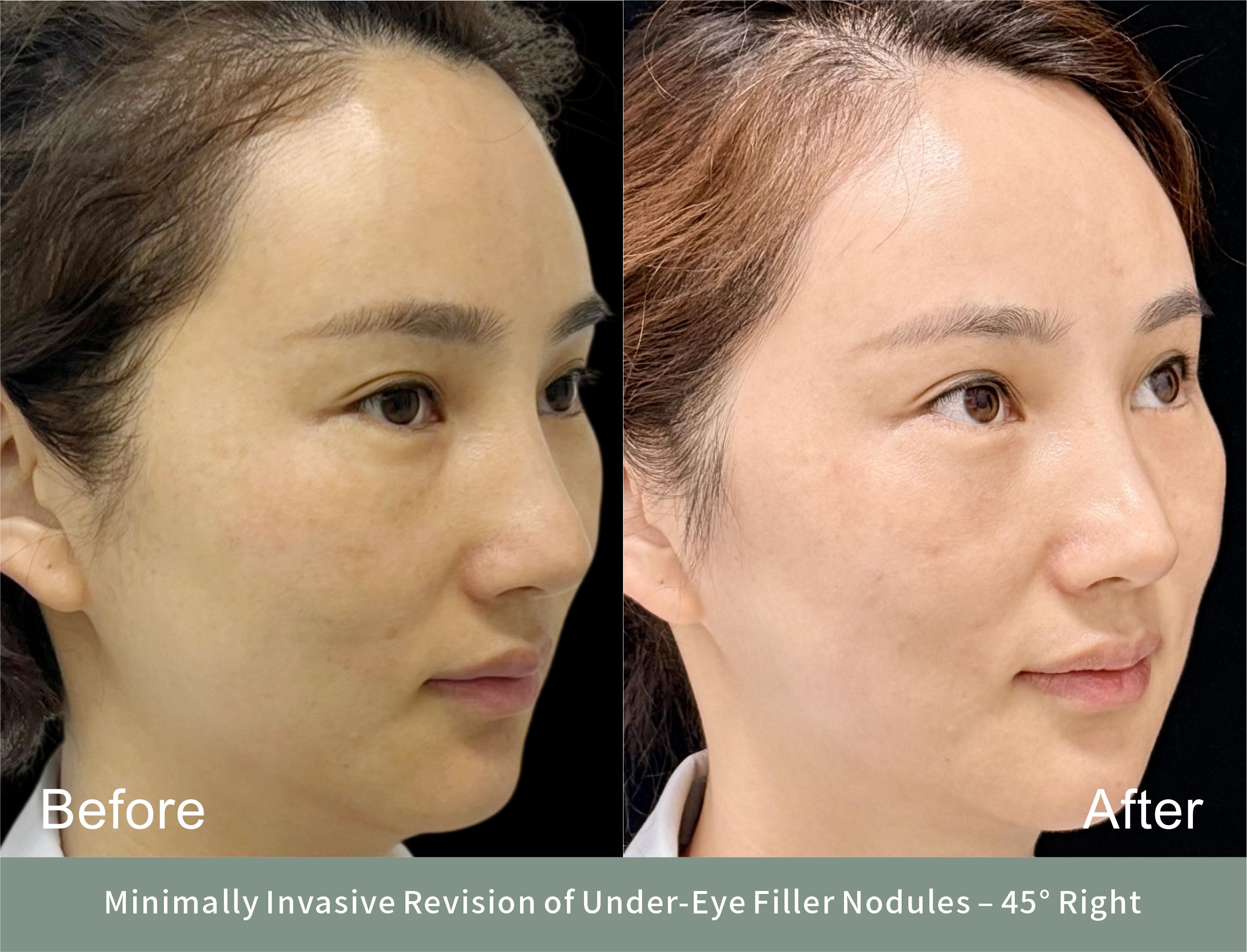
Key takeaway: At FILLER REVISION, the thing we spend the most time on is not "deciding how to remove it" but "first confirming the direction is right." Repeatedly piling more HA onto a pigmented dark circle is a very common — and very regrettable — wrong turn we see in clinic.
Why under-eye treatment always starts with ultrasound
Naked-eye judgment under the eye is highly unreliable — the "swelling" you feel could be fat, could be edema, could be filler; all three look alike yet are handled in completely different ways. About ten minutes of ultrasound under the eye can distinguish:
- Orbital fat vs. deposited filler (the echo patterns are completely different)
- Hyaluronic acid vs. non-HA material (different materials each have their own ultrasound appearance)
- The depth and extent of the material, and its position relative to vessels and nerves
This is what "you can only treat safely what you can see" means. The peri-orbital region is dense with nerves and vessels; only once we have seen clearly what is actually inside and in which layer can we use single-pinhole physical extraction to take out the material that needs to come out without harming the fine structures around it. The standard we hold to is not just "getting the thing out," but taking it out cleanly and leaving the surface even — so the under-eye contour stays natural, with no new dips or bumps. To be honest about it: material that has lingered for a long time can adhere to the tissue, and removal is usually done in stages (the first session typically takes out about 30–50%, and two or three sessions usually remove about 80–90%, not a guaranteed 100%).
The back-end extraction of the eye area: our sister site has a deeper set
If your situation is already settled as "won't dissolve, can only be removed," or it involves more surgically oriented work — upper-lid hollowing, volume repair after eye-bag surgery, peri-orbital thread complications — our sister site "Minimal-Cut Surgery" has assembled a full set of peri-orbital deep-dives. You can read on through their overview of peri-orbital filler complications and repair. This site handles the front-end decision of "dissolve or remove"; how the back-end extraction is done cleanly and evenly — the two sites read more completely together.
One map, three roads
Boiling the above down to the simplest judgment:
- It's hyaluronic acid, not yet encapsulated, not in place long → dissolution can be assessed (hyaluronidase only after in-person assessment).
- It's hyaluronic acid but already encapsulated / persisting after repeated dissolving, or it's fat grafting or a collagen stimulator → it won't dissolve; go for ultrasound-guided extraction.
- The problem was never suited to filler in the first place (e.g. a pigmented dark circle) → neither dissolve nor remove, but stop topping up and reassess the direction.
Not being sure which box you fall into is, in fact, perfectly normal — this is exactly what the ultrasound is for. If you've had something injected under your eye and now have puffiness, a bluish tint, lumps or asymmetry, and have been given wildly conflicting accounts by different doctors, you are welcome to use an online case-by-case assessment or to book an in-person consultation, where Dr. Ta-Ju Liu will use ultrasound to help you confirm what is actually under your eye and the most suitable direction.
Frequently asked questions
Does hyaluronic acid under the eye always have to be dissolved?
Not necessarily. If it is HA that was injected recently, has not yet encapsulated and is small in amount, dissolving is a reasonable option. But if it has already encapsulated, has been in place for several years, or persists after repeated dissolving, continuing to inject hyaluronidase often won't clear it cleanly, and it will spread and affect this very thin layer of under-eye tissue. In that situation, ultrasound-guided physical extraction is actually more direct. Looking clearly at the state on ultrasound first, then deciding to dissolve or remove, is safer than always dissolving or always removing.
My fat graft under the eye went wrong — can hyaluronidase dissolve it?
No. Hyaluronidase works only on hyaluronic acid; it does nothing to autologous fat or collagen stimulators (Ellansé, AestheFill, Sculptra and so on). When these materials form a nodule or unevenness under the eye, the direction is precise extraction under ultrasound guidance — not the injection of any dissolving agent.
My dark circles didn't improve after tear-trough filler — is that the doctor's technique?
Not necessarily a technique problem; more likely a direction problem. Dark circles split into vascular, pigmented and structural, and only the structural type — the one with a genuine hollow — is suited to improvement with filler. If your dark circles are mainly pigmentation, lifting the hollow with filler still won't change the color — and at that point, more injections and larger amounts give only limited benefit. The advice is to first work out which type you are, then decide whether to use filler at all.
Related reading
- Dissolve hyaluronic acid or remove it directly?
- The three types of dark circle and filler candidacy: which type benefits, which type gets worse
- Aegyo-sal overfilled or asymmetric? "Dissolve first, then revise" for dissolvable HA
- Is under-eye puffiness aging or filler migration?
- The Tyndall effect: the bluish-tint trouble of tear-trough filler