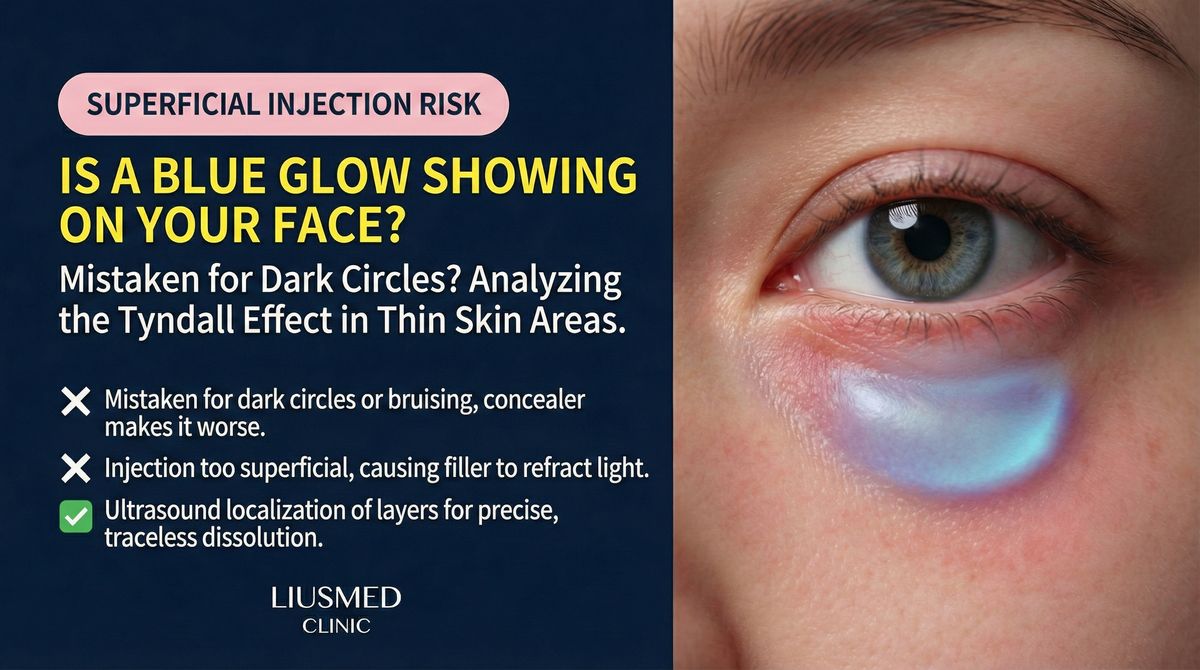
The important part first: the blue is not necessarily the filler
"Ever since I had tear trough filler, my under-eyes have been blue."
For most people the next step is hyaluronidase. And the sentence I hear most often afterwards is — "I dissolved it, and it is still blue."
The reason is simple. Blue under-eyes have three possible sources. They look alike, and they are treated in opposite ways.
← Swipe to see more →
| Source of the blue | What it actually is | Does hyaluronidase help? |
|---|---|---|
| Tyndall effect | HA placed too superficially; light scatters in the gel and reflects back blue | Yes — but only if this is genuinely what it is |
| Vascular (veins showing through) | Under-eye skin was always thin, and the venous plexus beneath shows through | No. Dissolving only thins the skin further and makes the veins clearer |
| Pigmentary (dark circles) | Pigment in the epidermis or dermis. Nothing to do with filler | No — and you lose your own tissue for nothing |
There is also the awkward combination: someone with vascular under-eyes who then had filler. The filler stretched the skin, made it thinner, and the faint veins became obvious. Now the blue has two causes stacked — dissolve half of it and the other half is still there.
So the first step is never "dissolve or not". It is working out which kind of blue you have — and neither your eyes nor your fingers can tell. That takes imaging.
The three scenarios behind "dissolved, still blue"
If hyaluronidase has already been tried and the blue remains, it is usually one of these:
Scenario one: the blue was never the filler. The commonest. The filler simply went into a place that was already showing blue, and made it more obvious. Dissolve the filler and the vessels or pigment underneath are still there.
Scenario two: it did not fully dissolve. The filler is wrapped in a fibrous capsule and the enzyme never reaches inside (encapsulation). Each round dissolves the healthy tissue around it while the capsule's contents sit untouched.
Scenario three: it dissolved, but the skin is already thin. The filler had been holding the skin stretched for a while, and the skin thinned to match. Take the material away and the thinned skin does not spring back — what you are looking at now is the vessels underneath.
Three scenarios, three different answers. More hyaluronidase is only meaningful in scenario two, and even then it has to be placed precisely.
A fourth scenario: the bruise from the injection never fully faded
If the dark patch began as a bruise from the injection, has dragged on for months without clearing, and reads brown or grey-brown rather than blue, it is more likely retained pigment than a Tyndall effect.
A bruise is blood that has leaked into the tissue. The red cells break down, the breakdown products of haemoglobin (haemosiderin) stay behind in the dermis, and immune cells carry them out a little at a time. Under-eye skin is thin, so that brown layer sits close to the surface and looks like a shadow that will not wash off. If filler is still occupying the same spot, the clearing goes slower.
A retrospective case series published in 2026 in Clinical, Cosmetic and Investigational Dermatology (PMID 41869420) collected seven cases of bruising that persisted for months after liquid PCL (GOURI) injection: five infraorbital, one at a zygomatic entry point, one in the upper arm. On mechanism the abstract offers two parallel hypotheses, joined by the word "or" — that a dense liquid-PCL scaffold traps pigment molecules, or that what is being seen is a Tyndall effect. The paper does not choose between them. Two things belong in the same reading: seven cases, retrospective, no control group; and three of the thirteen authors are members of the manufacturer's (Dexlevo) own medical research team, which the paper discloses itself. Evidence at that level is enough to raise a possibility, not enough to settle one. Whether what you had was PCL at all, and which PCL it was, is sorted out in "liquid PCL" means two products.
Time is what separates the two. A Tyndall effect does not change with time; retained pigment does fade, only slowly. The same paper puts it plainly: the Tyndall effect "often resembles a mild, deep bruise and is frequently mistaken for one; however, unlike general bruising, it remains unchanged over time unless the material is degraded or physically removed". Pigment clears in months rather than weeks. So lining up photographs from three and six months ago beats studying the mirror: if the colour is lighter, it points to pigment; if a year has gone by and nothing has moved, it points to material still sitting in a superficial plane.
Getting this one right saves an unnecessary round of dissolving. With retained pigment the thing to be treated is the pigment, not the filler, and hyaluronidase will not lighten brown. The under-eye has no "let us just try dissolving" to begin with (the next section explains why), and the trade here is your own tissue for a colour that was never going to change because of it. If what you had was GOURI (liquid PCL), the approved indication and the full decision path are set out in bruising under the eye after GOURI.
The under-eye is not the cheek: there is no "let's just try dissolving"
In the cheek there is enough subcutaneous tissue to absorb a little over-dissolving. The under-eye has none to spare.
Under-eye skin is a fraction of a millimetre thick — the thinnest on the face. Hyaluronidase cannot tell filler HA from the HA in your own tissue, and in a place this thin, dissolving a little too much writes itself onto your face immediately: looser skin, a hollower trough, vessels showing through more clearly — so it looks bluer than before.
That is why so many people say "I dissolved it three or four times and it kept getting worse." They were not unlucky. Each round was taking away tissue there was never much of.
Dr. Ta-Ju Liu: "When someone comes in with blue under-eyes, I do not start by asking whether to dissolve. I ask — when did the blue start? Did it appear after the filler, or was it always there and the filler made it obvious? Get that question wrong and everything after it is wasted, and each attempt leaves less to work with."
The decision: what to dissolve, what must be removed, what to leave alone
Worth considering dissolving: it is definitely HA, the blue definitely comes from the filler, the volume is modest, and it was not placed long ago. Precise, small-volume dissolving is reasonable here.
Must be physically removed: it has encapsulated (enzyme cannot reach it), the material was never HA to begin with (a collagen product or a stimulator placed under the eye), or there is enough of it to form a defined mass. That calls for locating it on ultrasound and taking it out through a very small entry — not for putting more enzyme in.
Where I would tell you to leave it alone:
- The blue is mainly vascular or pigmentary — treating the filler will not improve it and may leave the under-eye thinner.
- The skin is already thin and the volume is small — the cost of intervening outweighs the small difference you want to correct.
- What you want is "under-eyes with no dark circles" — under-eye colour is a product of inherited structure, ageing and pigment. Removing filler can only remove the part the filler caused. If that is not said plainly first, the procedure simply becomes the next disappointment.
Only one thing needs settling before anything is done
Ultrasound has to establish three things: which plane the filler is in, how much is left, and how thin the skin has become.
The first decides whether it is really the cause of the blue. The second decides dissolve-or-remove. The third decides whether you will be hollower afterwards — the item most often skipped under the eye, and the one that most determines the result.
Injecting hyaluronidase under the eye without imaging is doing subtraction, blindfolded, in the thinnest place on the face.
Confirmed it is the filler, and decided to treat it?
This article is about the discrimination that comes before the decision.
If the blue is confirmed to come from the filler and it needs treating, the indications and limits of dissolving versus removing under the eye are here: under-eye filler — dissolve, remove, or should it never have been injected?.
If what you feel is a defined lump rather than a colour problem, that is a different road: removing under-eye filler granulomas.
To work out which type of dark circle you have, and whether filler was ever the right answer: the three types of dark circles — which respond to filler and which get worse.
Frequently asked questions
Does hyaluronidase fix blue under-eyes?
It depends on what is causing the blue. If it is HA placed too superficially — a genuine Tyndall effect — precise, small-volume dissolving helps. If the blue comes from veins or pigment underneath, dissolving not only fails, it thins the skin and makes the blue more obvious.
I've dissolved it several times. Why is it still blue?
Three possibilities: the blue was never the filler; the filler has encapsulated and the enzyme cannot reach it; or the filler is gone but the skin it stretched is now thin enough to show the vessels beneath. More enzyme will not change the first two, and it makes the third worse.
Does the Tyndall effect go away on its own?
Not while the filler causing the scatter is still sitting in that superficial plane. It does not fade like a bruise — this is not a question of time, it is a question of position.
My under-eye filler was placed years ago. Can it still be treated?
Time is not the deciding variable. What decides it is the plane, whether it has encapsulated, whether ultrasound can see it, and how much skin thickness you have left. Long-standing cases are often still workable. What genuinely narrows the options is tissue already thinned by repeated dissolving.
Will the under-eye look hollow afterwards?
That depends on how much of the volume being held open was filler, and how much the skin thinned around it. Estimating this on ultrasound beforehand is exactly why we do it. Where a large volume has been in place for years, the tissue needs time to settle afterwards — a conversation to have before, not after.
My bruise from filler has not faded for months. Is that normal?
It is uncommon, but it has been described. Most injection bruises clear within about two weeks, and the ones that run for months are a minority: a 2026 retrospective case series (PMID 41869420) gathered seven of them, all after liquid PCL injection, and all eventually resolved. A patch that is brown and slowly lightening usually means retained pigment; one that stays blue-grey and does not move points to scatter from the filler itself. If nothing has changed after a month, it is worth being seen, partly to rule out anything else.
How do I tell a Tyndall effect from retained pigment under the eye?
Watch whether it lightens over time. Retained pigment is haemoglobin breakdown product that has not been cleared yet, and it fades over months. A Tyndall effect is superficial filler scattering light, and the colour does not change on its own until the material is degraded or removed. Comparing old photographs is the easiest first step; confirming it means ultrasound, to see which plane the filler is in and how much is left.
A closing thought
The most expensive mistake with blue under-eyes is not having had the filler. It is dissolving before finding out where the blue comes from.
Answer three questions first: did the blue appear after the filler? What does ultrasound show — which plane, how much is left? And how much skin thickness do you still have?
With those answers, whether to dissolve, remove or leave it alone stops being a guess.