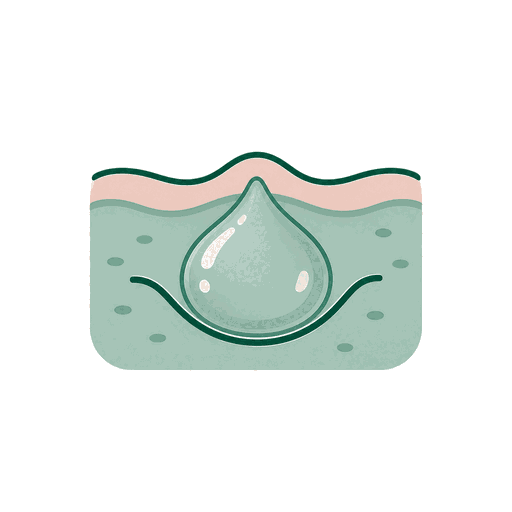
Hyaluronic Acid (HA) Fillers — Juvederm, Restylane, Belotero Brands & Removal
Juvederm · Restylane · Belotero · Teosyal · Revanesse
The most commonly used dermal filler worldwide. HA is a naturally occurring substance in the body, making it generally safe and dissolvable with hyaluronidase.

Composition
Cross-linked hyaluronic acid gel, various particle sizes depending on brand and product line. Taiwan currently holds two Revanesse licences (nicknamed the "planet needle" locally), both manufactured by Prollenium Medical Technologies in Aurora, Ontario, Canada and imported by Emergo Taiwan: Revanesse Ultra+ (TFDA 038552, issued 2025-11-25) and Revanesse Shape+ (TFDA 038357, issued 2025-10-09), both Class III, both categorised as hyaluronic acid implants, neither withdrawn. Two details are worth carrying into any removal consultation. First, the official Chinese product name of both licences states that they contain lidocaine, a local anaesthetic — anyone with a lidocaine allergy needs to say so before treatment. Second, the TFDA record gives no approved indication and no composition: the efficacy field reads "see the approved Chinese insert" and the active-ingredient field is blank. So the treatment areas and the cross-linking figures circulating in marketing material are not sourced from TFDA, and should not be treated as approved indications.
Common Complications
Migration, Tyndall effect, overcorrection, granuloma (rare), vascular occlusion (rare but serious). Long-standing HA often becomes encapsulated and resistant to hyaluronidase.
Extraction / Removal Method
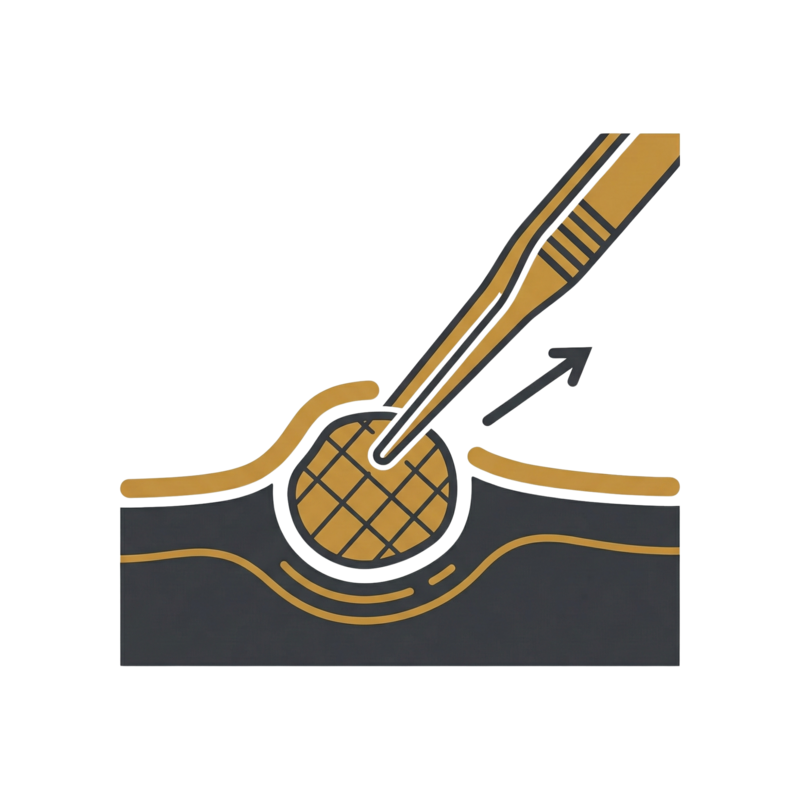
Hyaluronidase dissolution for fresh cases. For long-standing or encapsulated HA, ultrasound-guided micro-extraction removes as much as can be safely removed (not a 100% guarantee).
Top 10 Patient Complaints

1Abnormal Water Absorption
HA molecules grab many times their volume in water. Over-injection in tight areas (under-eye, apple cheek) causes persistent unnatural puffiness.
2Filler Migration
Muscle movement pushes high-cohesivity HA away from injection site. Migrates to nasolabial folds or under orbital rim.
3Tyndall Effect (Blue Under-Eyes)
Superficially injected transparent HA causes Rayleigh scattering of blue light, creating eerie blue discoloration.
4Enzyme Resistance — Encapsulation
Long-standing HA encapsulated by fibrous tissue. Hyaluronidase cannot penetrate the capsule wall.
5Palpable Lumps and Nodules
Uneven BDDE cross-linker distribution or excessive single-point injection creates visible/palpable round lumps.
6Loss of Dynamic Expression
Gel-like mass across multiple layers obstructs expression muscle sliding. "Face feels like plastic."
7Delayed Biofilm Reactions
Months/years later: sudden redness, swelling triggered by illness or vaccination. Dormant biofilm on filler surface activates.
8Spongy Texture — No Definition
Overfilled face looks like a water-soaked sponge. No bone structure visibility. Sags when filler degrades.
9Cumulative Overfilling from Top-Ups
Patients believe HA fully absorbs. Repeated "maintenance" creates accumulation. Mid-face overcrowded, jaw appears receded.
10Doctor Refusal
Complex encapsulated cases get rejected by other clinics. High-risk, low-reward revision discourages doctors.

Why Traditional Methods Fail
Hyaluronidase is marketed as the "antidote" but fails in chronic/encapsulated cases. Massage displaces material. Steroid injections for inflammation cause tissue atrophy. Adding more filler to "balance" only increases total volume.

The Liusmed Repair Strategy
Liusmed's "Capsule-Breaking + Precision Micro-Extraction" protocol. Pre-op high-res ultrasound (HA appears anechoic/dark) maps exact depth, volume, and capsule thickness. Through 1-2mm pinhole, specialized instruments physically rupture the fibrous capsule wall, then drain/scrape encapsulated HA. Fundamentally solves the enzyme penetration barrier. Near-invisible scarring.
Dr. Liu's Clinical Perspective
"HA has an antidote — theoretically. In practice, many of our patients tried hyaluronidase 2-3 times before coming to us. The filler was encapsulated, invisible to the naked eye but clearly visible on ultrasound. We stopped believing in enzyme-only approaches years ago."

Recovery Timeline
The pinhole is small, but this is an extraction, so swelling and bruising are expected. Swelling and bruising usually settle in about 2–3 weeks, the pinhole heals in about 2 weeks, and the final result takes about 3 months, varying from person to person.
FAQ
Does HA filler fully absorb over time?
Contrary to popular belief, studies show that HA filler can persist for years, especially cross-linked products. MRI studies have found residual filler 10+ years after injection.
HA vs collagen stimulator: what dissolves vs what doesn't?
HA fillers (Juvederm, Restylane, Belotero, Teosyal) can be dissolved by hyaluronidase in fresh, non-encapsulated cases. Collagen stimulators (Sculptra/PLLA, Ellansé/PCL, Radiesse/CaHA) have no dissolution agent — they stimulate your own collagen, which no enzyme can break down. For both categories, once encapsulation or granuloma forms, physical extraction becomes the practical removal route.
Why does Restylane / Juvederm sometimes resist hyaluronidase?
Different HA brands use different cross-linking technologies (BDDE concentration, NASHA vs Vycross vs Cohesive Polydensified Matrix). Heavily cross-linked products like Juvederm Voluma or Restylane Lyft form denser gels that resist enzymatic breakdown. When fibrous encapsulation develops around them, even sequential hyaluronidase sessions cannot penetrate. Ultrasound-guided extraction bypasses this barrier by physically removing the capsule plus contents.
What is the Taiwanese nickname "planet needle" (星球針)? Can it be dissolved?
"Planet needle" is a Taiwanese nickname for Revanesse (Prollenium, Canada), a cross-linked hyaluronic acid; the product lines seen most often in Taiwan are Shape+ and Ultra+. Because the material is HA it belongs on this page, and hyaluronidase is in principle available — unlike collagen stimulators (Sculptra, Ellanse, AestheFill), which have no enzyme antidote at all. But "it is HA" does not mean "it will come out easily": product that has been in place for years, an encapsulated nodule, or deep scattered placement often defeat enzyme alone, which is the same mechanism as the Restylane / Juvederm question above. A nickname is also a weak guide to material — the same nickname can point to different products in different clinics or regions. We confirm the actual material and where it sits with history plus ultrasound before deciding on any approach.
Real patient questions
Questions from the patient Q&A forum, answered by Dr. Liu.
Ask your own question in the forum

Related Symptoms
References
- Rohrich RJ, et al. Plast Reconstr Surg. 2009;123(6):1842-1863
- DeLorenzi C. Aesthet Surg J. 2013;33(3):440-447
- Beleznay K, et al. Dermatol Surg. 2015;41 Suppl 1:S307-S320
This information is for educational purposes only. Treatment options depend on individual circumstances. Consult a qualified physician.

Read next: when this material goes wrong
Case-by-case decisions, written by Dr. Ta-Ju Liu
Encapsulation: Why Dissolvers Failed to Fix Your Filler Problem
Why your body builds a wall around filler that dissolvers cannot penetrate — and how ultrasound-guided extraction goes directly at the capsule.
Hyaluronic Acid Filler Revision vs Simple Dissolution: When Hyaluronidase Fails
Dr. Ta-Ju Liu explains seven scenarios where hyaluronidase fails, why dissolving displaced HA worsens asymmetry, and when physical extraction fits better.
Cross-Linked HA Persistence: Why Your 'Absorbable' Filler Outlasted Its Label
The polymer chemistry that makes HA fillers persist years beyond their labeled duration — and why this science matters for anyone seeking revision.
The Myth of Complete HA Absorption: Why Your 'Temporary' Filler Is Still There
Why HA fillers can persist for years despite being called 'temporary' — and how science-based revision addresses filler that refuses to dissolve.