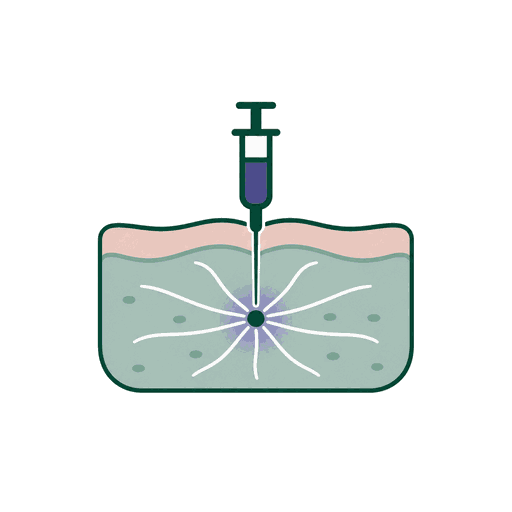
Ellanse (Polycaprolactone / PCL) — Nodules, S/M/L Variants & Removal
Ellanse S · Ellanse M · Ellanse L · Ellanse E · Gouri
A semi-permanent collagen stimulator sold in versions whose stated durations rise with the length of the PCL polymer chain (S 1 year, M 2 years, L 3 years, E 4 years). It pairs immediate volume from the carrier gel with long-term collagen stimulation from the microspheres. Worth knowing before those numbers are used to choose between versions: only S and M were actually trialled, and the 3- and 4-year figures are extrapolations that the source literature labels as such. Taiwan has approved two of them, S and M. The specification field of the licence (026659) enumerates only ELLANSE-S, and M sits inside the one specification-addition entry there whose contents are not itemised; the approved Chinese labelling stamped on 2023-06-13 carries a sealed ELLANSE-M (1ml) label and insert, and the national UDI database registers two device identifiers under this licence, one S and one M. L and E are absent from every official layer. The two approved sites are one place written two ways, the licence saying nasolabial folds for S and the M insert saying laugh lines. Both inserts warn against the eyelids, the under-eye area, the lateral canthal lines and the glabella, because of the risk of ocular ischaemia and vision loss. On long-term use the licence says safety and effectiveness beyond two years have not been demonstrated, and the M insert says long-term safety and effectiveness have not been demonstrated at all.
Composition
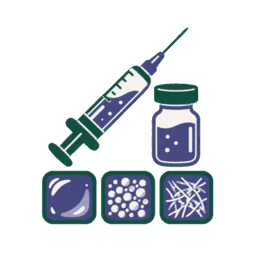
Polycaprolactone (PCL) microspheres 25-50 microns across, about 30% of the syringe by volume, suspended in a carrier gel (the other 70% by volume) made of phosphate buffer, glycerin and carboxymethylcellulose (CMC). The carrier gel is what fills on day one and is resorbed within weeks; the microspheres are what keep stimulating collagen afterwards. A common error is to describe the carrier as "70% CMC" — CMC is one of three carrier ingredients, and the 30:70 split is microsphere-to-gel by volume, not a CMC concentration. Liquid PCL (Gouri) is the same polymer in a different physical form: no microspheres at all, 210 mg of PCL in a 1.0 mL prefilled syringe, present as chains below a tenth of a micron. Sources do not agree on whether that is genuinely a solution or a fine dispersion, and the approved Taiwanese labelling does not list the carrier.
Common Complications
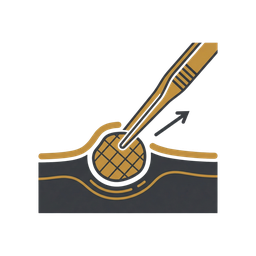
Nodule formation, delayed inflammatory reaction, overcorrection (especially with L and E variants), tissue fibrosis.
Extraction / Removal Method
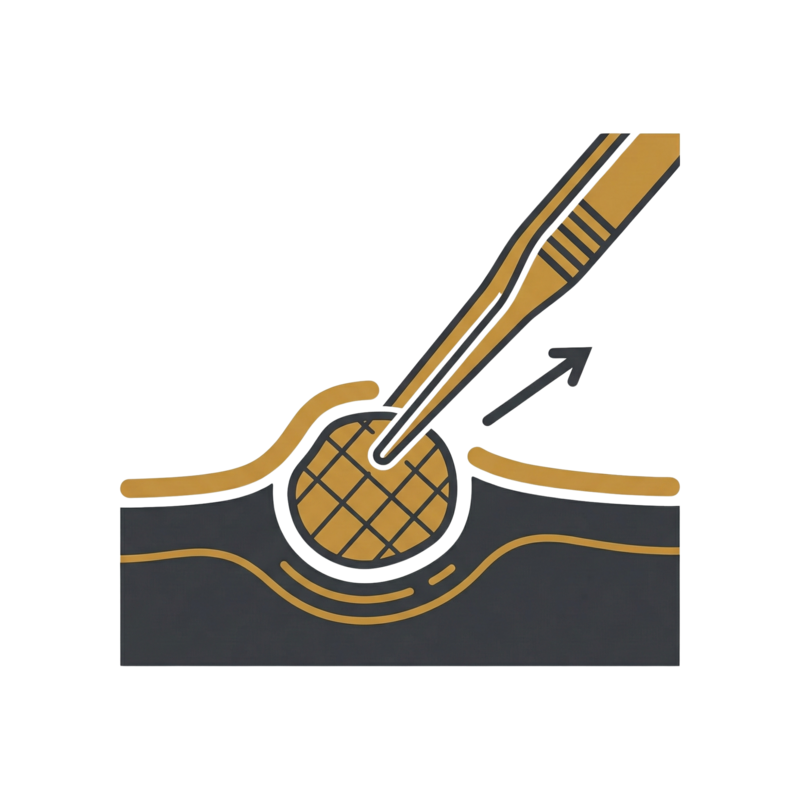
Ultrasound-guided micro-extraction. Longer-lasting variants (L, E) are more challenging due to deeper tissue integration.
Top 5 Patient Complaints

1Delayed Onset Inflammation (Months Later)
CMC carrier absorbs, PCL kicks in. Immune rejection can strike months after injection when patient thought everything was fine.
2Progressive Hardening That Won't Stop
More fibrotic tissue forms week by week around PCL microspheres. What started soft becomes stone-hard.
3Steroid Treatment Backfire
Steroids temporarily reduce swelling but cause fat atrophy around the nodule, making it MORE visible and prominent.
4S/M/L Duration = S/M/L Risk
Longer-lasting Ellansé variants (M, L) have higher complication rates because PCL persists longer, extending the immune provocation window.
5Told to "Just Wait It Out"
Doctors say PCL will eventually degrade. But waiting means months/years of growing, hardening nodules and escalating tissue damage.
Why Traditional Methods Fail
"Wait and see" lets nodules grow larger and harder. Steroids cause surrounding fat collapse. No dissolution agent for PCL. By the time patients seek revision, the fibrosis is often more severe than if treated early.

The Liusmed Repair Strategy
Same tissue dissection + particle clearance approach. Must remove PCL microspheres along with surrounding granulomatous tissue. For extensive cases, multi-session staged extraction to minimize trauma.
Dr. Liu's Clinical Perspective
"Ellansé patients often say 'it was fine for 6 months, then suddenly...' That's the PCL timeline. The carrier gel kept it calm, but once it dissolved, the PCL microspheres were exposed to your immune system without a buffer. Early intervention produces the best outcomes."

Recovery Timeline
The pinhole is small, but this is an extraction, so swelling and bruising are expected. Swelling and bruising usually settle in about 2–3 weeks, the pinhole heals in about 2 weeks, and the final result takes about 3 months, varying from person to person. Intervening earlier, rather than waiting years, generally keeps the fibrosis smaller and the extraction simpler.
FAQ
Can Ellanse be removed?
Yes, but it requires specialized ultrasound-guided extraction. Ellanse cannot be dissolved like HA fillers. The S variant is easier to extract than L or E due to shorter tissue integration time.
Real patient questions
Questions from the patient Q&A forum, answered by Dr. Liu.
Ask your own question in the forum

Related Symptoms
References
- Moers-Carpi M, et al. J Cosmet Dermatol. 2013;12(4):306-313
- Kim JA, et al. J Cosmet Laser Ther. 2018;20(1):25-28
This information is for educational purposes only. Treatment options depend on individual circumstances. Consult a qualified physician.

Read next: when this material goes wrong
Case-by-case decisions, written by Dr. Ta-Ju Liu
Can Ellansé Be Dissolved? How Long PCL Really Stays, and When It Can Be Taken Out
Ellansé cannot be dissolved — hyaluronidase does nothing to PCL. How long it really stays, what decides whether it can be taken out, and when to act.
Ellansé S vs M Lumps: Which Type Is Harder to Remove? (Plus L and E)
Ellansé L or E complications proving harder to treat? FILLER REVISION provides formulation-specific extraction strategies for every PCL variant.
Can Collagenase Dissolve Ellansé (PCL)? Contested Evidence
Can collagenase dissolve Ellansé nodules? A 2025 study claims so but has just 3 patients and was questioned by peers. Why extraction stays predictable.
Radiesse vs Ellansé Removal: What Is Actually Possible?
Radiesse (CaHA) calcified nodules and Ellansé (PCL) both have no dissolving enzyme. What is realistically achievable, and how the two materials compare.