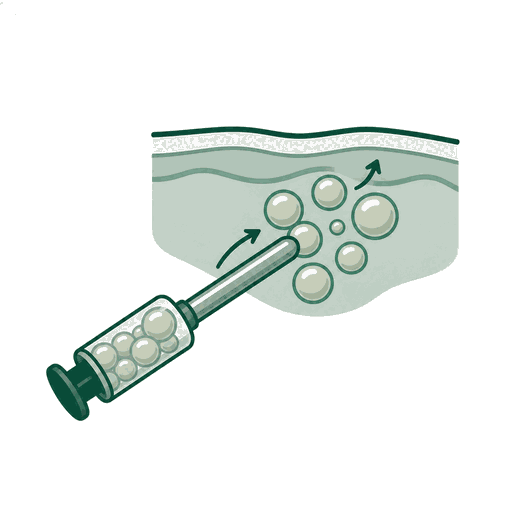
Autologous Fat Grafting
Uses the patient's own fat harvested from another body area. Considered "natural" but carries unique risks including calcification and unpredictable survival rates.
Composition
Patient's own adipose tissue, processed and reinjected.
Common Complications
Calcification, hardening, asymmetry, overcorrection, oil cysts, fat necrosis. Calcified fat can be extremely difficult to treat.
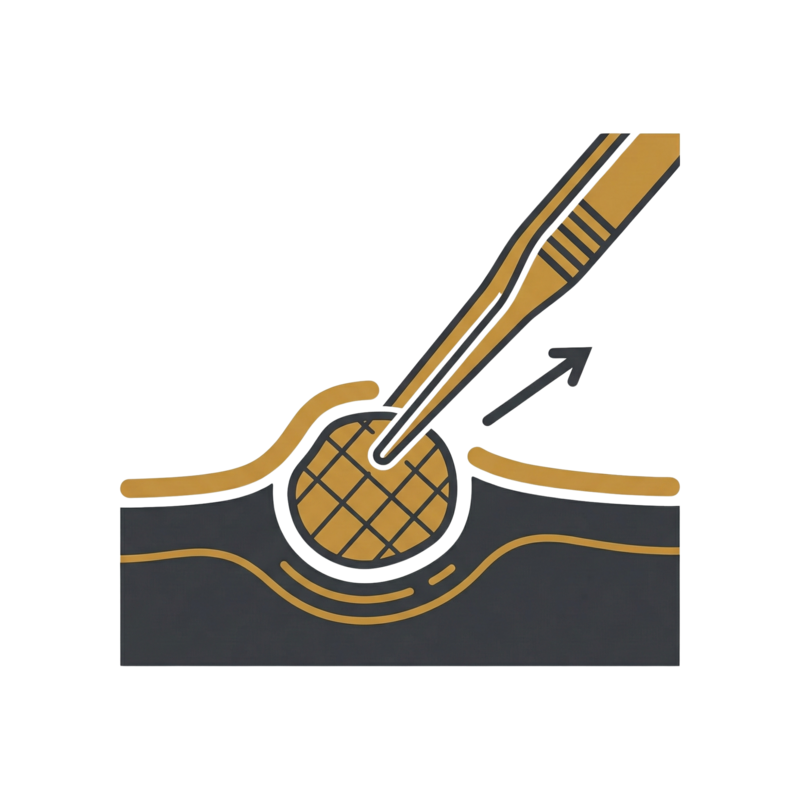
Extraction / Removal Method
Ultrasound-guided extraction for soft fat deposits. Calcified fat is fragmented first and removed through the same pinhole of about 2 mm; we do not perform surgical excision. Larger or deeper deposits are treated zone by zone over several sessions.
Top 10 Patient Complaints

1Severe Over-Engraftment (Pillow Face)
Doctor over-corrected, high survival rate → face inflates like a bread bun. Uncontrollable final volume.
2Fat Necrosis and Liquefaction
Large bolus injection → core cells die → severe inflammatory reaction.
3Oil Cysts
Dead fat releases lipids → fibrous encapsulation → squishy, sliding lumps that persist for years.
4Calcified Stone-Like Lumps
Fat necrosis + calcium saponification → rock-hard mineralized nodules visible on X-ray.
5Surface Irregularities and Waviness
Uneven layer control or patchy survival → visible bumps and valleys. Devastating in profile.
6Weight-Linked Facial Expansion
Transplanted fat retains donor-site (thigh/abdomen) genetic memory. Weight gain = disproportionate facial obesity.
7Severe Asymmetry
Left/right blood circulation differs → uneven absorption/survival → different-sized cheeks.
8Heaviness and Accelerated Sagging
Fat has physical weight. Large volume in mid-face increases gravitational load → accelerated descent, deepened nasolabial folds.
9Prolonged Recovery Torture
Weeks-months of severe swelling and bruising. Far worse than injectable fillers. Major impact on social and work life.
10Donor Site Complications
Thigh/abdomen: pain, skin laxity, permanent contour irregularities, nerve numbness at liposuction sites.
Why Traditional Methods Fail
No enzyme dissolves fat. Deoxycholic acid (Kybella) is for double chins, not facial fat grafts — too destructive and unpredictable on face. Traditional liposuction is too aggressive for delicate facial fat. Waiting doesn't reverse survived fat or calcified masses.

The Liusmed Repair Strategy
Dual strategy — 1) For diffuse overfilling: VASER-like precision micro-liposuction under ultrasound to selectively remove excess while preserving natural contours. 2) For oil cysts and calcified masses: pinhole puncture, crushing, and extraction. Post-extraction: may integrate RF/ultrasound skin tightening for laxity. Micro-fat supplementation for localized depressions after stabilization.
Dr. Liu's Clinical Perspective
"Fat grafting failures are uniquely cruel because the marketing promised 'natural, permanent, rejection-free.' The reality is unpredictable survival rates, calcification, and faces that get fatter when you gain weight. We approach fat revision like a sculptor — removing excess, smoothing surfaces, restoring proportion."

Recovery Timeline
The pinhole is small, but this is an extraction, so swelling and bruising are expected. Swelling and bruising usually settle in about 2–3 weeks, the pinhole heals in about 2 weeks, and the final result takes about 3 months, varying from person to person. Depending on the extent and depth, it may need to be done zone by zone, in stages, or over more than one session.
FAQ
Can overfilled fat graft be removed?
Yes. Excess fat can be extracted using ultrasound guidance. However, if the fat has calcified, removal becomes more complex and may require micro-surgical techniques.
Real patient questions
Questions from the patient Q&A forum, answered by Dr. Liu.
Ask your own question in the forum
Related Symptoms
References
- Coleman SR, Saboeiro AP. Plast Reconstr Surg. 2015;135(5):1369-1377
- Yoshimura K, et al. Aesthet Surg J. 2008;28(3):311-321
- Delay E, et al. Plast Reconstr Surg. 2009;124(4):1118-1129
This information is for educational purposes only. Treatment options depend on individual circumstances. Consult a qualified physician.

Read next: when this material goes wrong
Case-by-case decisions, written by Dr. Ta-Ju Liu
Failed Fat Grafting Revision: Telling Grafted Fat from Native Tissue Before Extraction
An ultrasound-guided technique tackles the hardest fat grafting problem: telling grafted fat from native tissue for precise extraction without damage.
Fat Graft Calcification: Why Hard Lumps Form After 'Natural' Fat Transfer
Why fat grafting can lead to calcification and hard lumps when grafted fat fails to survive, and why these complications have no pharmaceutical solution.
Fat Transfer to Face Gone Wrong? Pillow Face Correction & Botched Fat Grafting Repair
Fat transfer to the face gone wrong? How pillow face happens, why dissolving can't fix overfilled fat, and how minimally invasive removal restores contour.
AlloDerm Hardening & Fat Graft Calcification: FILLER REVISION Extraction Guide
AlloDerm hardening or fat graft calcification won't resolve on its own? FILLER REVISION offers ultrasound-guided extraction for biological filler complications.