Forehead and Temples: Why They Are the Hardest Area of the Whole Face to Smooth
"Doctor, why does my forehead look bumpy after filler — you can see it the moment the light hits it at an angle?" "I had my temples filled, and now it looks like it's moved over to my eyebrows?" I hear these two lines in clinic almost every week.
The forehead and temples are, in my many years of filling and revision experience, widely regarded as the most technically demanding area. The reason is actually simple: the forehead has thin skin, and right underneath it is bone. There's very little space in between to cushion or hide anything, so if the filler is even slightly uneven, the moment light strikes at an angle the bumps show right away — this is where the nickname "bumpy forehead" comes from (and when the whole forehead is overfilled into one bulging curve, patients sometimes call it a "flowerhorn" forehead).
Key point: When the forehead goes wrong, it's usually not because "too little was injected" — it's that the material choice, injection planning and depth weren't right. The amount can still be adjusted afterward, but if the material was chosen wrong and the planning wasn't done up front, it's very hard to fix later.
What Did You Actually Have Injected? The Forehead Material Spectrum
To understand why the forehead runs into trouble, you first have to know what material you had injected — each one behaves very differently in the forehead.
Hyaluronic Acid: Tends to Sit Unevenly, but Can Be Dissolved
Because of its cohesivity and water-binding (hydration) properties, in my experience hyaluronic acid (HA) tends to sit unevenly when injected somewhere thin-skinned and bone-hugging like the forehead. But it has one big advantage — it's currently the only filler that can be dissolved with an enzyme, so if you're not happy, there's still room to adjust.
Collagen Stimulators: A Good Material, but "Planning" Matters More Than "Amount"
Collagen stimulators like Sculptra, Ellansé (a collagen stimulator based on PCL), and Radiesse are actually all decent forehead materials. But three things matter: inject evenly, don't inject too much at once, and remember the collagen stimulation they trigger is usually still ongoing two to three years later. So the planning at the very start decides success or failure — overdo it early, and as collagen slowly builds up, the area may become thick and hard two or three years down the line. On top of that, these materials have no matching dissolving enzyme and are irreversible. (For how the material works, see How Collagen Stimulators Work and Why They Can Also Cause Problems.)
HArmonyCa: Look at It Separately — It Is "Half-Reversible"
The much-talked-about HArmonyCa (by Allergan) deserves to be pulled out on its own — it is not a pure collagen stimulator, but a hybrid of cross-linked hyaluronic acid plus CaHA (calcium hydroxyapatite). The hyaluronic acid provides immediate support and volume at the moment of injection, while the CaHA drives later self-collagen stimulation for lift. That means it is "half-reversible": the hyaluronic acid portion can be dissolved, but the CaHA and the collagen that has already grown cannot. Lumping it together with pure hyaluronic acid and assuming "if it doesn't work out I'll just dissolve it" is a very common misunderstanding. (See How to Handle HArmonyCa Hybrid-Filler Nodules.)
Collagen Implants, Autologous Fat, and Acellular Dermal Matrix
- Collagen implants: They actually fill the forehead fairly smoothly, but some people get allergic reactions and recurrent swelling, which needs to be assessed first.
- Autologous fat: Honestly, I think the best material for the forehead is fat — but it's the most technique-dependent: whether the donor site ends up uneven, the survival rate of the fat, and whether the injected volume can be judged accurately are all hurdles.
- Acellular dermal matrix (AlloDerm): Personally I really like using it in the forehead — it's smooth, doesn't tend to over-stimulate, doesn't tend to go uneven, and doesn't tend to form lumps.
← Swipe to see more →
| Material | Forehead smoothness | Reversibility | Stimulation risk |
|---|---|---|---|
| Hyaluronic acid | Tends to be harder to smooth | ✅ Dissolvable | None |
| Collagen stimulators (Sculptra / Ellansé / Radiesse) | Medium, depends on planning | ❌ Irreversible | Yes, ongoing 2–3 years |
| HArmonyCa (hyaluronic acid + CaHA) | Medium | ⚠️ Half-reversible | On the CaHA side |
| Collagen implant | Smoother | Partial | Low, but allergy risk |
| Autologous fat | Good (but technique-dependent) | — | None (but may calcify) |
| Acellular dermal matrix | Smooth | — | Low |
Key point: There is no single "best" material, only "whether it suits your forehead." A material's reversibility (whether it can be dissolved) and its stimulation characteristics should be thought through before you decide whether to inject at all.
Why Does Forehead and Temple Filler "Move"?
This area has another problem you don't see as often elsewhere: migration is especially noticeable.
The fascial structure beneath the forehead and temples lets filler move along relatively easily. I often see in clinic: something injected into the temple drifts down over time to the brow tail; something injected into the forehead can drop toward the eyebrows. Patients often say "how did the position change?" or "why do my eyebrows feel heavier?" — that's migration. (Further reading: Forehead Filler Migration and Bumps, Temple Hollowing After Dissolving.)
The other thing to be more careful about is the vessels. The forehead and temples have very dense nerves and vessels, especially the superficial temporal artery (STA) at the temple — this is one of the highest vascular-occlusion-risk zones on the whole face. That's why "how to inject and how deep" in this area takes a lot of experience — it's not something to fill casually.
Lumps, Overfilling, and Delayed Nodules: How They Form and How to Tell Them Apart
When you feel bumps in the forehead, or the whole area thickens, there are a few common causes:
- Overfilling: Too much accumulates, and the forehead and temples become full and stiff, losing their natural contour.
- Lumps / nodules: Delayed nodules from collagen stimulators are especially troublesome in the forehead — the body reacts strongly, and the filler often gets wrapped layer by layer in a fibrous capsule; add the ongoing stimulation mentioned earlier, and it's not unusual for something to "grow out" only two or three years later. (For the mechanism, see How Granulomas Form.)
- Migration: As in the previous section, drifting to the brow tail or eyebrows.
How do you tell them apart at first? You can refer to Is It a Filler Granuloma or a Scar? A Self-Check. But there are a few red-flag warning signs that mean you should see a doctor immediately and not wait: rapid enlargement, redness/swelling/heat/pain, severe pain on pressure, or any accompanying vision changes.
Key point: Feeling a lump doesn't necessarily mean it has to be treated right away, but whether it hurts, how fast it's growing, and whether it keeps getting bigger are the key points for judging whether to be concerned.
What to Do If Something Goes Wrong: The Educational Map for Handling It
Let me start with one big principle: whether it can be dissolved depends on the material.
- Hyaluronic acid — there's a dissolving enzyme, so it can be dissolved (though in the forehead it sometimes can't be dissolved cleanly).
- Collagen stimulators and the CaHA side of HArmonyCa — there is no matching dissolving enzyme and they can't be dissolved chemically; the way to handle them is physical removal. (Further reading: Can Collagenase Dissolve Ellansé / PCL?, Radiesse vs Ellansé Removal: What Is Possible.)
And removal in the forehead and temples is among the hardest on the whole face — thin skin on bone, dense vessels, and filler that may be hidden across several layers. Precisely because it's difficult, you can't just "blindly dig and scrape." Seeing clearly first where the lump is, how deep it is, and its relationship to the vessels, then deciding how to handle it — that is the safe order.
The actual assessment and treatment are highly individual. If you're stuck with a forehead or temple lump or overfilling, I'd suggest starting with a full individualized assessment: clarifying what material you had, its current distribution and layers, and then discussing the options together. You can start by learning more at Forehead and Temple Filler Revision Overview; to understand ultrasound-guided lump localization and minimally invasive removal in more depth, see Forehead & Temple Filler Removal.
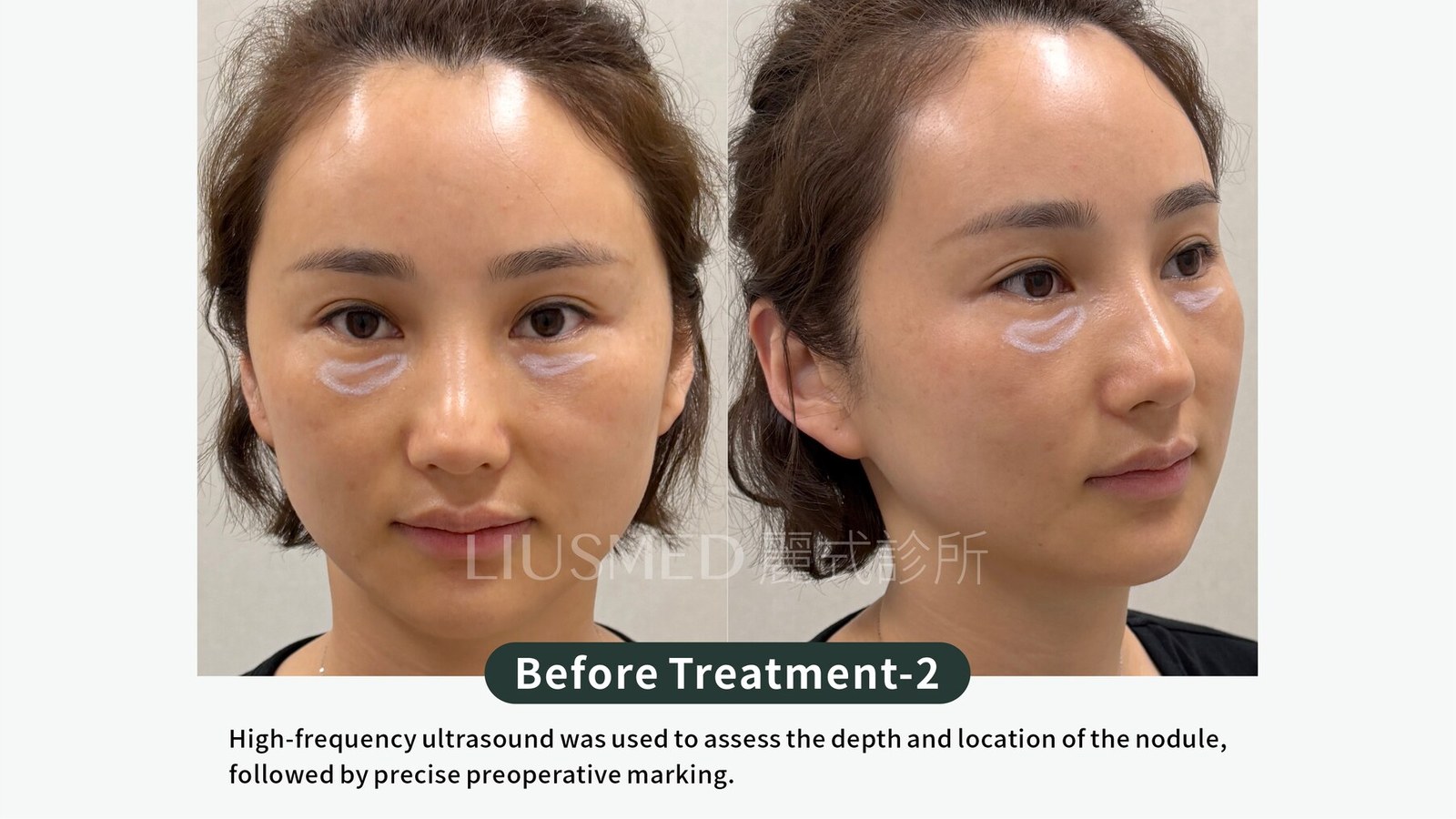
A real example: a patient whose forehead Ellansé had been hard lumps for two years, where neither hyaluronidase nor a saline flush made them go away. The lumps were mapped with ultrasound before removal, and the result was judged only at three months. Why it came to that, and why flatness right after a flush cannot count as a result, is in the forehead Ellansé case; the full removal record is in the three-month record on MinimalCutSurgery. How long to wait before judging each kind of treatment is covered in when you can tell whether a lump treatment worked.
Prevention: Ask These Questions Before Getting Forehead or Temple Filler
Rather than repairing afterward, it's better to gatekeep before you inject:
- Does the material suit my forehead? For people with thin skin that shows easily, a material's smoothness and reversibility should be considered together.
- Amount and planning: Collagen stimulators keep stimulating over time — better to go conservative and stage it than to overdo it all at once.
- Should this spot be injected at all? For people with high temple vascular risk or noticeable migration, consider whether to switch material or approach.
- Who injects it and who follows up? Whether you can be assessed with ultrasound guidance when needed, and whether there is post-procedure follow-up, are both key to the choice.
Key point: The forehead and temples are an area where "choosing the right material and planning ahead" matters more than "how much to fill." Time spent thinking it through before you inject beats far more effort spent repairing it afterward.
Frequently Asked Questions
Q: Why does forehead hyaluronic acid tend to sit unevenly? A: Hyaluronic acid's cohesivity and water-binding properties, combined with the forehead's thin skin on bone and little cushioning space, mean the slightest unevenness tends to show. The upside is that it can be dissolved with an enzyme, so there's still room to adjust.
Q: Will HArmonyCa cause lumps in the forehead, and can it be dissolved? A: HArmonyCa is a hybrid of hyaluronic acid plus CaHA, which makes it half-reversible — the hyaluronic acid portion can be dissolved, but the CaHA and the collagen already formed cannot. If a lump forms, handling it means first seeing the composition and distribution clearly before assessing — you can't simply treat it as "just dissolve it."
Q: My temple filler drifted to the brow tail and my forehead filler dropped to the eyebrows — what do I do? A: This is common migration in this area, related to the underlying fascial structure. First use imaging to see clearly where it has migrated and what the material is, then decide whether to dissolve, remove, or observe. Massaging to push it yourself isn't recommended.
Q: Will a forehead lump go away on its own? A: Hyaluronic acid may metabolize over time, but lumps caused by collagen stimulators or CaHA usually don't disappear on their own. Whether it hurts and how fast it's growing are the key points for judging whether to treat it actively.
Q: Is removing forehead filler dangerous, and will it leave a scar? A: Removal in the forehead and temples is indeed harder, because the vessels are dense and the layers are complex — which is exactly why seeing clearly with ultrasound first before treating is important. The actual approach is assessed case by case; you can start by learning more at Forehead and Temple Filler Revision Overview.
Q: What material do you recommend most for the forehead? A: There's no standard answer. In my experience, fat and acellular dermal matrix perform well for smoothness and low lump risk, but fat is very technique-dependent; collagen stimulators rely on up-front planning. In the end it still has to be decided individually, based on your forehead's condition and needs.
If you have questions about forehead or temple filler unevenness, lumps, or overfilling, you're welcome to reach out via online consultation for an individualized assessment by Dr. Ta-Ju Liu and the team. For more on filler revision, see Filler Revision Services.