"Just fill the other side to match" — why that sentence is risky under the eye
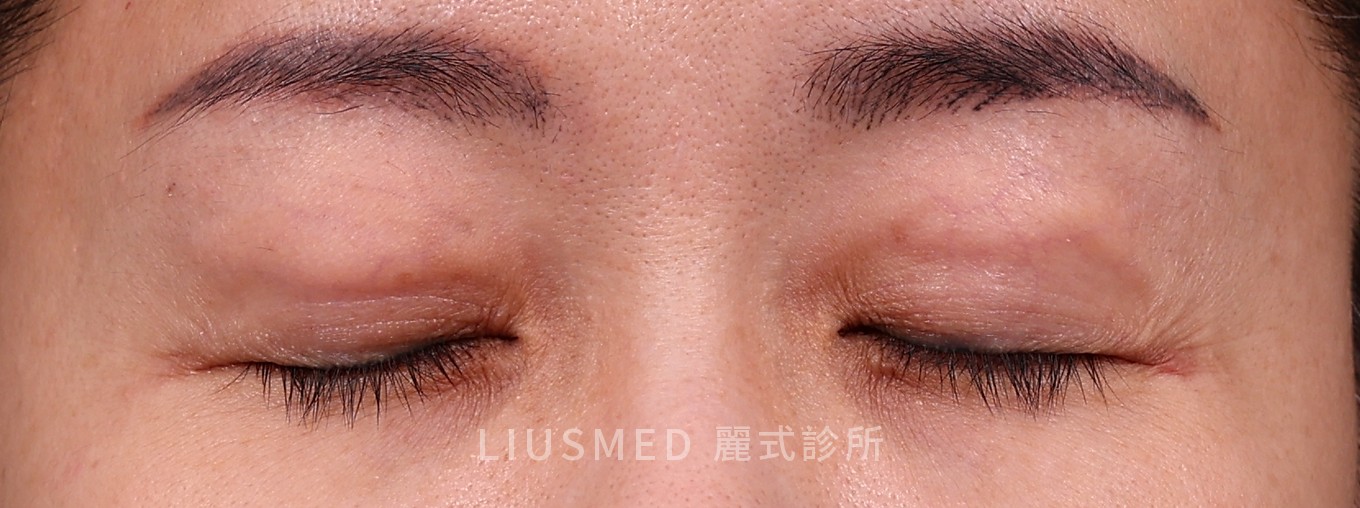
I see this patient often: there is already a palpable bulge under the eye, it throws a shadow the moment the light comes in at an angle, and it gets more obvious when she smiles. She shows me a photo on her phone and asks, "Someone told me that if we also fill the hollow next to it, both sides will be level and you won't notice it any more. Can we do that?"
It's an intuitive idea, and it's the suggestion I hear most often. Under the eye, though, it rarely holds up — not because of anyone's technique, but because of the physical conditions of the area. The skin is extremely thin, the space underneath is small, and the whole region moves all day long. What you inject does not stay obediently where you put it: the expression muscles work on it again and again, raking light magnifies it, and most of these materials offer no way back once something goes wrong.
So the question that actually needs answering is not "where should the second injection go" but "what is under my eye right now?" This article is not about how material gets removed. It is about the decision before the second needle: what to distinguish, what to look at, and when the best answer is to hold off.
First: work out what the lump you can feel actually is
"A bulge under the eye" is not one condition. It is several conditions that look alike and point in opposite directions, and the eye and fingertips alone struggle to tell them apart. In clinic, at least four are common:
- The injected filler itself — too much volume, placed too superficially, or sitting where it was put instead of spreading out.
- Migrated filler — material placed in the tear trough that has travelled up into the eye-bag region or slid down toward the cheek, looking like new tissue.
- A tissue response to the material — a collagen stimulator in a mobile area gets stimulated over and over, and the collagen it grows can outweigh the material itself.
- Not filler at all — an ageing orbital fat pad pushing forward, or plain oedema. Both look remarkably similar from the outside.
The next step differs completely between the four: one needs time, one needs dissolving, one can only be removed, and one should not be touched again at all. A second injection given before that distinction is made is a guess. This is why the order under the eye is always to look first, then decide whether to release, to reposition or to remove — rather than to keep adding.
Second: why "filling beside it" rarely levels anything here
Even if what you feel really is filler, filling next to it seldom solves the problem. Three reasons:
One — you now have one more thing to deal with. The original bulge has not gone anywhere; the area beside it has simply been raised. If it ever has to be addressed, there are now two deposits, often of different materials at different depths, which makes both mapping and removal harder. The under-eye compartment is small; every extra deposit raises the difficulty another notch.
Two — the area keeps moving, so the shape changes on its own. The orbicularis is one of the most active muscles in the face, and every blink and every smile works on the material beneath it. What looks level today can be squeezed into a different shape months later, and the step reappears — often somewhere you didn't expect. "It looked flat at the time, and six months later it looked stranger" almost always comes from this.
Three — the skin is too thin, so light exaggerates every step. Under-eye skin is the thinnest on the face, and any difference in height casts a shadow under raking light. What you need is therefore not "both sides at the same height" but a surface that transitions smoothly. Forcing the hollow up to match the bulge often just trades one shadow for another, and can leave the whole under-eye looking puffier and heavier.
Key takeaway: The under-eye is not a volume problem; it is a structure and position problem. When something is already sitting in there, adding another layer does not make it flat — it makes it more.
Third: the material decides whether you still have a way back
Much of whether a second injection makes sense comes down to what is already inside, because not every material lets you change your mind.
- Hyaluronic acid (HA): there is an enzyme that breaks it down (used only after in-person medical assessment), so there is relative room to adjust. Honestly, though: HA that has been in place for years or has become encapsulated often does not dissolve cleanly, and one session is rarely the end of it.
- Autologous fat: no antidote dissolves it. Fat does not always survive evenly under the eye, and once it consolidates into a lump, the direction left is precise removal under ultrasound guidance.
- Collagen stimulators (Ellansé, AestheFill, Sculptra and the like): also no antidote — and these keep working. Placed in the most mobile part of the face, they are stimulated repeatedly by the expression muscles and keep proliferating. That is exactly why under-eye stimulator lump extractions are a constant in clinic.
In other words, if what is already under your eye is one of the latter two, the cost of "let's try one more syringe" is not merely "it may not work." It is one more deposit that only removal can resolve. And removal is not a one-click undo: long-standing material can adhere to surrounding tissue, so how much can be removed varies with material, location and time. The first session usually removes about 30–50%; with most fillers, two to three sessions can reach about 80–90%. It is not 100%, and it varies from person to person.
This is not hypothetical. One patient had autologous fat placed under the eye to fill a tear trough and it consolidated into a lump; to level the bulge, a collagen stimulator went into the hollow beside it, and she ended up with two — for more than five years. Neither material had an antidote, so both layers could only come out: before, ultrasound mapping, what was removed, and three months on are on her case page.
A full grid of material against under-eye sub-area is in the under-eye filler decision map, where you can find your own square directly.
So when is filling still reasonable?
Filler is not off-limits under the eye; it has to be the right timing, the right place and the right material. If assessment shows the following, adding a little is reasonable:
- Ultrasound has confirmed there is no unaddressed old material or nodule still in there.
- Your problem really is a structural hollow rather than a pigmented or vascular dark circle — how to tell the three apart is in the three types of dark circle and filler candidacy.
- The material chosen is one that is comparatively easy to walk back, in a small and precise amount — not a collagen stimulator placed under the eye.
Conversely, if there is already something unresolved inside, the correct order is to clear the site first, and only then discuss whether to add. Clear, then rebuild: under the eye that is one of the few routes that genuinely gets back to smooth. Building on foundations that were never cleared usually just postpones the problem.
If assessment confirms the material cannot be dissolved and needs to come out, the removal itself and the full case records are handled by our sister clinic MinimalCutSurgery — see their periorbital repair area. The "one lump, then a second one" situation this article opens with is also documented end to end in a four-stage case record.
Frequently asked questions
There's already a lump under my eye — can filling the hollow beside it cover it flat?
Usually not advisable. Filling beside it does not make the original deposit disappear; it raises the surroundings, and with skin this thin the remaining step still casts a shadow. Worse, you now have an extra deposit, so future treatment means two of them, often at different depths. The safer order is to confirm with ultrasound what the original lump is and which layer it sits in, then decide whether to address it.
Does it matter whether the bulge appeared immediately or only later?
It matters a great deal. A bulge present right after injection is usually a volume or depth issue, and some of it settles as swelling resolves. One that slowly hardened and grew over months or years looks more like a tissue response or proliferation, and the direction of treatment is different. The timeline is an important clue alongside ultrasound, so describe it as precisely as you can at your visit.
If ultrasound shows something is there, does it have to come out straight away?
Not necessarily. Whether there are symptoms, how much it affects appearance, and the nature and position of the material all feed into the judgement. Some situations can be watched, some are suited to dissolving first (HA only), and some are better resolved before anything else is discussed. The point is that the decision follows seeing clearly, rather than adding more while it is still unclear what is inside.
Why not just try filling first and remove it later if it doesn't work?
Because most materials used under the eye offer no way back. Neither autologous fat nor collagen stimulators can be dissolved with an enzyme, so if "let's just try" doesn't turn out well, the only option left is removal — which has its own limits and recovery, and a clearance rate that varies by individual. In an area with no way back, looking before deciding is far better value than trying first and finding out later.
If you have had something injected under your eye and now have a bulge or a lump, and different doctors have given you different explanations, you are welcome to arrange an online individualized assessment or an in-person consultation. Dr. Ta-Ju Liu will use ultrasound to help you establish what is actually in there first, and decide the next step with you.
Related reading
- The under-eye filler decision map: dissolve, remove, or never inject at all
- The three types of dark circle and filler candidacy: which type benefits and which gets worse
- Under-eye puffiness: ageing or filler migration?
- Dissolve the hyaluronic acid, or remove it outright?
- Aegyo-sal overfilled or uneven? "Dissolve first, then revise" for HA