Why Is the Chin So Hard to Give "Definition"? First Understand That It's an Extension of the Bone Structure
"Doctor, why did my chin turn round and lose its shape after the injection?" "When I take photos from the side, a big chunk of my chin juts forward and I look like a witch — it's really unnatural." These two lines are the most common opening remarks from people who come to me for repair after a botched chin filler.
To understand why the chin is prone to these problems, we first need to look at its structure. The subcutaneous space under the chin is usually fairly generous — unlike the forehead, where thin skin sits right against the bone. A larger space that can hold more material sounds easy to fill, but it isn't — because the chin's true shape is determined by the bone structure underneath. Bone is hard; a beautiful chin relies on a three-dimensional contour propped up by bone, especially forward projection — that forward-jutting fullness of the chin.
And here's the problem: if you use something very soft to fill a place that needs "firm support," what happens?
Key point: The chin is not a place that becomes beautiful just by "adding volume" — it needs support that can act as an "extension of the bone structure." If the material is too soft, it can't hold a shape and just collapses into a round blob; if the material is firm enough but the wrong choice or placed in the wrong layer, it easily forms lumps in this constantly moving area. Choosing the right material matters more than adding more or less.
This is also why, across my years of filling and repair experience, the chin is the area where I find "material choice" has the most obvious impact on success or failure. Let's start with the materials.
What Material Should Be Used for the Chin? From Hyaluronic Acid and Collagen Stimulators to Structural Thread Lifting
There are quite a few materials that can be injected into the chin, but measured against the standard of "the chin needs an extension of the bone structure," they perform very differently. I've organized the categories I most often encounter in clinic into a table, then explain each one.
← Swipe to see more →
| Material | "Definition" on the chin | Migration tendency | Reversibility | My observation |
|---|---|---|---|---|
| Hyaluronic acid (HA) | Soft, tends to round out, less definition | More prone to migration | Dissolvable (the only reversible one) | Hard to create forward projection; the need for projection is difficult to meet |
| Collagen stimulators (HArmonyCa / Radiesse / Ellansé) | Firmer, more definition | Relatively stable, but the chin is highly dynamic | Irreversible or semi-reversible | Good definition, but the chance of lumps isn't low and they can grow into odd shapes |
| Structural thread lifting | Firm, supportive, gives definition | Does not migrate | Threads are absorbable | My preferred approach for chin shaping over these years |
Hyaluronic Acid: Soft, Round, Lacks Definition — but the Upside Is It Can Be Dissolved
HA is the most widely used filler, and its advantage is clear — it is the only filler that can be dissolved with an enzyme, so if things go wrong there's a way back. But on the chin, its physical properties work against it: its texture is soft and its cohesiveness is limited, so it can't hold up the firm edge and forward projection the chin needs, and often ends up as a round blob with less definition right after the injection. Especially in cases that want to extend the chin forward, HA struggles to meet aesthetic expectations.
So it's not that HA can't be used on the chin, but you have to recognize its role: it suits fine adjustments and people who want to keep the "can be dissolved back anytime" escape route open — but it's not the ideal material for sculpting contour.
Collagen Stimulators (HArmonyCa, Radiesse, Ellansé): Good Definition, but the Chin Is Highly Dynamic and the Chance of Lumps Isn't Low
If you want something "firm enough to act as an extension of the bone structure," clinically you'll most likely end up with the collagen stimulator category:
- HArmonyCa (a hyaluronic acid + CaHA hybrid, semi-reversible, by Allergan) — it's not a pure stimulator but a hybrid of hyaluronic acid plus calcium hydroxyapatite; the HA portion can be dissolved, while the CaHA and the collagen it has already generated cannot, which is why I classify it as "semi-reversible."
- Radiesse (CaHA, calcium hydroxyapatite) — a dual-action material that provides immediate lift plus subsequent collagen stimulation.
- Ellansé (PCL, polycaprolactone) — longer-acting collagen-stimulating microspheres.
These materials are indeed firmer and give more definition, and in theory are better suited to acting as an extension of the bone structure. But the chin has a variable that other areas don't: it is an extremely dynamic place. Talking, eating, making expressions — the chin muscles are constantly moving. When a filler sits in an environment that's continuously being tugged, the chance of problems rises over time — in the cases I've handled, the chin actually has a fair number of chances to form lumps, higher than many people assume.
Key point: "Firm enough, more definition" and "won't form lumps" are two different things. Collagen stimulators solve the "definition" problem but don't solve the lump risk that comes from the chin "constantly moving." That's why I look further for a more stable option.
Structural Thread Lifting: My Preferred Approach for Chin Shaping Over These Years
To close, I want to honestly share my own preference. After about fifteen years of filling experience, I still feel the best way to sculpt the chin is structural thread lifting (absorbable threads that build a supportive scaffold under the skin).
The reason is that it solves both of the earlier problems at once: it has the "firm enough, supportive, gives definition" advantages of a filler, while not migrating at all. More importantly — at least in all my years of experience, using structural thread lifting on the chin, I haven't yet encountered a case where it formed a lump. That's the biggest reason I treat it as my first choice.
Of course, everyone's chin condition, needs, and budget considerations are different, so material choice should still be decided case by case after an in-person consultation; what I'm sharing here is my leaning based on many years of experience, not a claim that other materials can't be used.
(If you'd like to understand how structural thread lifting differs from other approaches, or you already have a filler of unknown type in place, you can start with our overview of chin-related complications.)
When Collagen Stimulators on the Chin Go Wrong, What Does It Look Like?
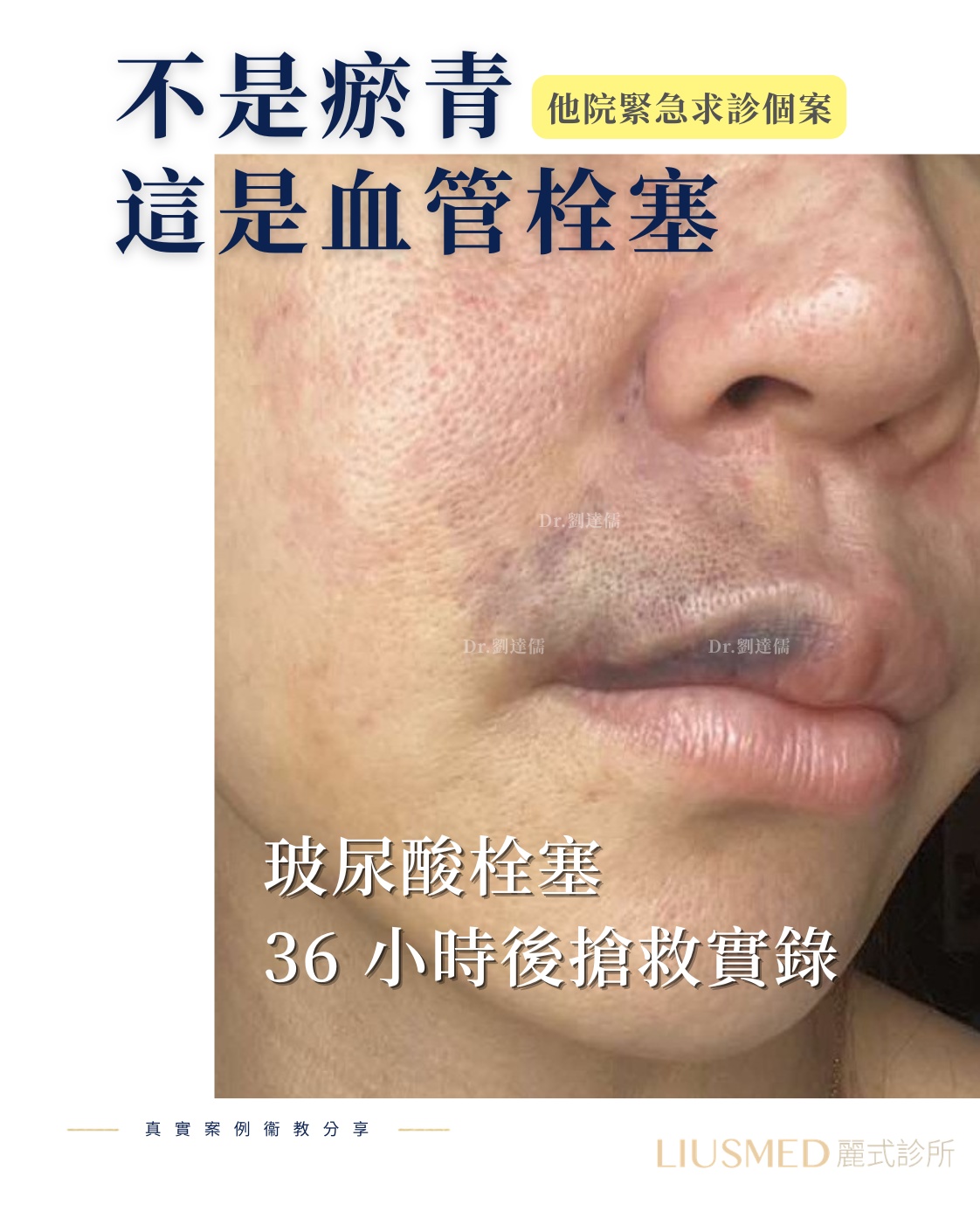
Most people assume a filler problem means "feeling a hard lump." But chin collagen-stimulator complications have a more distinctive characteristic — they don't obediently grow into a round ball, but into "odd shapes":
- Becoming very pointy — an unnatural protrusion appears at the tip of the chin.
- Odd forward protrusion — from the side, a big chunk juts forward, which is what many people describe as "looking like a witch."
- Left–right asymmetry — the two sides of the chin gradually become uneven in size.
This happens, as mentioned earlier, because the chin is constantly moving: the material is unevenly tugged in a dynamic environment and unevenly stimulates collagen growth, so the shape it produces naturally ends up crooked. If you were injected with a hybrid material like HArmonyCa and developed lumps, the handling logic differs from pure HA (because only the HA half can be dissolved).
This "odd shape" also explains patients' two main complaints: the first is appearance — profile photos look extremely unnatural, which is the main reason the vast majority can't stand it and want repair; the second is texture — the palpable hard lump they want removed.
What to Do About a Lump? Repair Is About "Smoothing and Evening Out," Not "Removing Everything"
This is the part I most want everyone to understand, and the part most often misunderstood.
Many people, on hearing "there's a lump in the chin," instinctively think "then just clear it all out, right?" But the goal of chin repair is not to remove all the filler.
The reason is very practical: chin problems usually lie in "proportion" and "shape," not in "having something there" per se. So the principle I follow is to optimize the aesthetic proportion of the side profile — trim away that unnatural protrusion, even out the two sides, and bring the profile proportion back to a fairly normal state without any odd bulge. If you indiscriminately remove everything, you often just return to the original state you wanted to improve, or end up with insufficient volume — a wasted effort, or even worse.
So repairing chin filler lumps is essentially about "smoothing and evening out" — precisely addressing the part causing the problem, rather than emptying it all out.
So how do we know where to repair and how much? This step requires first seeing clearly:
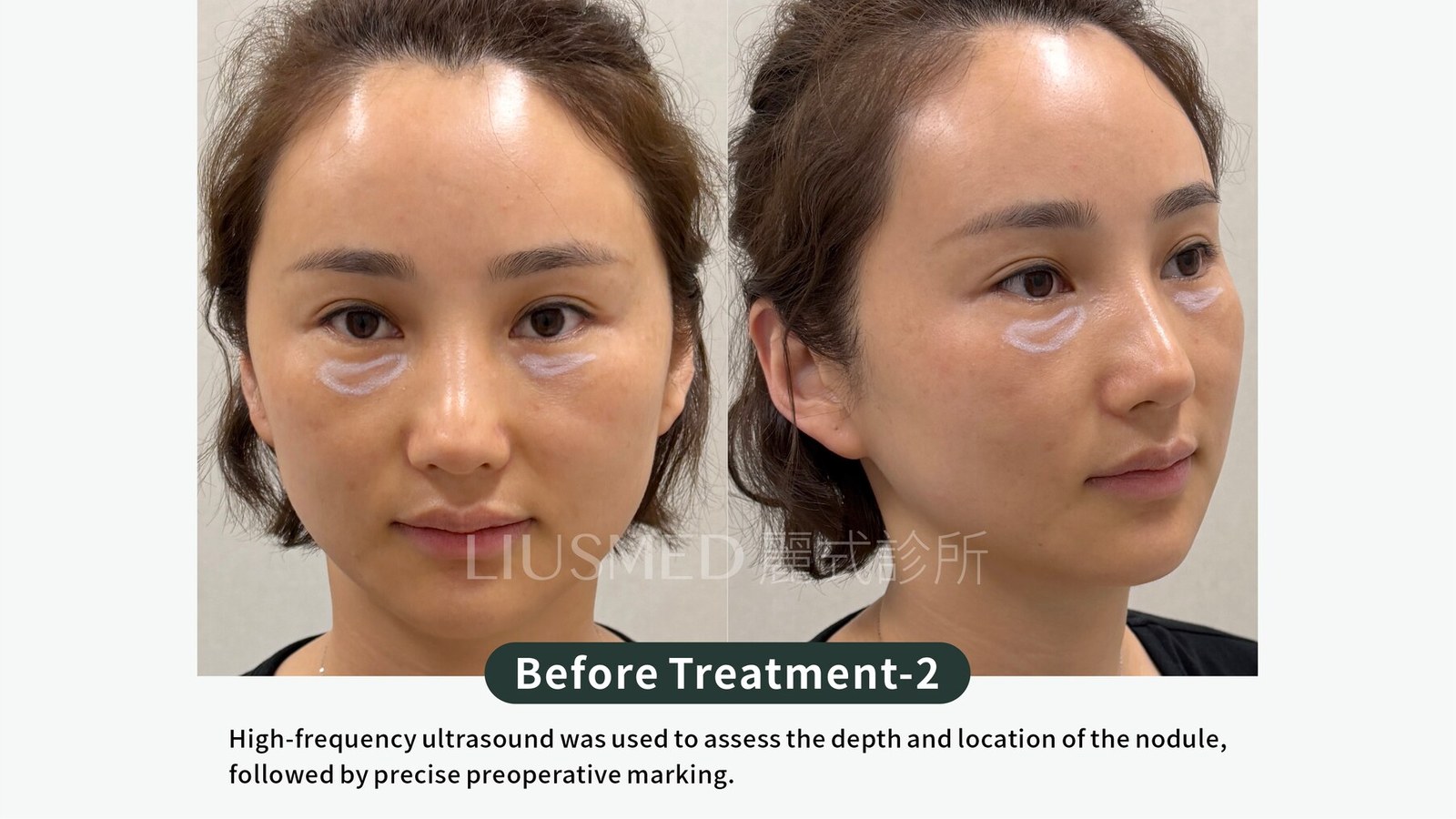
- First use ultrasound to see clearly the filler's actual location, depth, extent, and tissue condition, then decide on the approach. This is why "see clearly before deciding, don't dig blindly" has always been my consistent stance.
- What can be dissolved (for example, the HA portion) can be dissolved first; what can't be dissolved (the collagen stimulator itself and the collagen it stimulated) has to be precisely handled with ultrasound-guided minimally invasive extraction.
Key point: The question to ask in chin repair is not "can everything be removed," but "how do we smooth and even out the profile proportion." Honestly, the goal of repair is to improve toward natural and symmetrical — not to guarantee a 100% clearance, and a 100% clearance isn't necessary either.
How the actual extraction and repair are carried out, and how the ultrasound is used for localization, belong to the surgical-technique level and are planned after an in-person assessment based on individual circumstances. Our sister site, Minimal Cut Surgery, covers that execution layer in depth: chin and jawline filler removal with ultrasound mapping and single-pinhole reshaping, and the chin repair overview if you want the whole picture for this area first. The division is simple: what to inject, whether it can be dissolved, and whether it needs revision belong here; how the removal itself is performed belongs there.
Migration, Tightness, Foreign-Body Sensation: Do These Also Count as Chin Filler Problems?
Besides "odd-shaped lumps," chin filler has several other common situations with different causes and different handling directions; here I give you an entry point for further reading on each:
- Dropping down, turning into a double chin, the chin getting longer — this leans toward filler migration, which is not the same thing as odd-shaped lumps; for assessment and handling see chin filler migration, dropping down into a double chin.
- Tightness, foreign-body sensation, numbness — this requires distinguishing whether it's filler compression, fibrosis, or nerve-related; see chin filler tightness, foreign-body sensation, nerve numbness.
- Jawline crookedness, clumping, contour going off — for filler problems along the jawline, see jawline filler shifted and lumpy.
Before Getting Chin Filler, Ask These Questions First
Rather than repairing afterward, it's better to minimize the risk before the injection. If you're considering chin filler, it's advisable to confirm the following at your consultation:
- Is your chin need "fine adjustment" or "three-dimensional sculpting"? If you need obvious forward projection, a soft material (HA) is usually not ideal.
- What are the migration and lump risks of this material on the chin? The chin is highly dynamic, so ask clearly about "how it performs long-term in a dynamic environment," not just "how it looks right after the injection."
- Can this material be reversed? HA is dissolvable, HArmonyCa is semi-reversible, and pure collagen stimulators are irreversible — reversibility directly determines your escape route if you're unhappy.
- How does the doctor view the structural thread lifting option? If you care about "not migrating, not forming lumps," this is a direction worth discussing together.
Frequently Asked Questions
Why does chin HA filler turn round and lose its definition?
Because HA has a soft texture and can't hold up the firm edge and forward projection the chin needs. The chin's shape is determined by the hard bone structure underneath and needs a firmer material that can act as an "extension of the bone structure"; soft HA easily collapses into a round blob with less definition, and cases that want forward projection in particular struggle to meet aesthetic expectations.
Can lumps from chin collagen stimulators (HArmonyCa, Radiesse, Ellansé) be dissolved?
It depends on the material. HArmonyCa is a hyaluronic acid + CaHA hybrid — the HA half can be dissolved, while the CaHA and the collagen it grows cannot; the bodies of Radiesse and Ellansé and the collagen they stimulate can't be dissolved and usually have to be handled with ultrasound-guided minimally invasive extraction. So whether it can be dissolved starts with confirming which product you were injected with.
A big chunk of my chin juts forward on profile and looks unnatural — does it all have to be removed?
No, and it isn't recommended. The goal of chin repair is to "smooth and even out" the profile proportion, addressing only the part causing the unnatural protrusion. Removing everything often just returns you to the state you wanted to improve, or causes insufficient volume. The focus of repair is restoring a natural, symmetrical profile proportion.
Why do you treat structural thread lifting as your first choice for chin shaping?
Because it combines the "firm enough, supportive, gives definition" and "doesn't migrate" advantages, and in my roughly fifteen years of experience, using structural thread lifting on the chin, I have not yet encountered a case where it formed a lump. This is my personal preference based on many years of experience; whether it actually suits you still needs to be decided case by case after an in-person assessment.
What examination is needed before repairing chin filler lumps?
You first need to use ultrasound to confirm the filler's location, depth, extent, and tissue condition, judge what can be dissolved and what can only be extracted, then plan the repair approach. This is the foundation of "see clearly before deciding, don't dig blindly."
A botched, deformed, or lumpy chin filler is usually not as simple as "too much material" — it's a matter of material and proportion. If you're troubled by an odd-shaped chin, lumps, or an unnatural side profile, you're welcome to learn about the assessment options through our filler repair service, or book a consultation directly to be personally assessed by Dr. Ta-Ju Liu, and discuss together the repair direction that best suits you.