"I finished a round of lifting, and in the mirror it looks about the same."
I hear this far more often than I hear "lifting doesn't work." Patients usually aren't complaining. They're puzzled. The device had a good reputation, the person operating it was not a beginner, so why does the result sit at "maybe a little"?
What I eventually noticed is that part of this group shares something that has nothing to do with the machine. It's the question nobody asked them: is there still something else inside this face?
Ultrasound, radiofrequency, microwave, threads — all of these tools rest on the same assumption, that the energy going in acts on the patient's own tissue. If there is a mass of material under the skin that was never meant to be there, that assumption wobbles. The energy may change the material, or the material may change where the energy goes. Both directions degrade the result, and neither one shows up on palpation.
When lifting goes nowhere, it usually isn't about insufficient energy
The first instinct is to add more: more shots, a stronger device, or a second modality stacked on top. Sometimes that genuinely helps. But the situation I see more often in a revision clinic is that the sag being treated was never caused by laxity in the first place.
A face comes down along at least three routes. Skin and its supporting structures loosen, which is one. Tissue volume migrates to a place it shouldn't be, which is the second. Something sits on top and drags it down, which is the third. Energy devices address the first. For the second and third they do not help much, no matter how many sessions get stacked.
That is the gap I keep meeting in the filler revision clinic: the effort goes into lifting while the problem is weight. So when this kind of question comes in, I don't start by discussing which device to pick. I start by asking what was injected, where, and how long ago.
Sagging and heaviness are not the same thing: three states to separate before lifting
← Swipe to see more →
| State | Feel and appearance | On animation | On ultrasound | Role of energy lifting |
|---|---|---|---|---|
| Age-related laxity | Thinner skin, no abnormal palpable mass; nasolabial folds and jawline deepen gradually with age | Natural shape, all zones move consistently | Fat and fascial planes are distinct, no abnormal echo | A primary indication, with reasonable expectations |
| Filler weight and migration | Midface feels thick and heavy, often worse on one side or in one zone, with a ridge bulging above the nasolabial fold | That zone bulges more than its surroundings on smiling | A discrete mass or cord is visible, with the original planes pushed apart | Subtract first; heating alone will not make weight lighter |
| Encapsulation and fibrosis | A lump with a clear border, firm under pressure, shape unchanged by posture | Expression gets tethered, part of the smile doesn't move | Hyperechoic mass ringed by fibrous encapsulation | Heat does not reach material that is walled off |
The management differs completely across these three, and the pair that palpation most often confuses is the first and second. A patient with a heavy midface gets labelled "loose," while imaging shows the material is still there and has simply shifted downward a little.
Key point: What a lifting device can improve is the firmness of the tissue itself. If the heaviness comes from extra volume or from walled-off material, heating it first will not make it lighter. It just places the expectation on the wrong step.
If you aren't sure which row you're in, our page on the overfilled face covers the typical appearance, and FOS (Facial Overfilled Syndrome, overfilled-face syndrome from excess filler) can be screened roughly with the self-assessment. The mechanism by which filler pulls a face down is covered separately in cheeks that sag and feel heavier after filler.
What the literature actually says about energy devices soon after filler
People have studied this, and the findings are more nuanced than the clinic-floor version.
Two clinicopathological studies from 2023 used a similar design: inject hyaluronic acid (HA) into abdominal sites, treat each site with an energy device at a different interval, then biopsy to see how much material remained.
The monopolar radiofrequency (RF, radiofrequency energy that heats the dermis) study enrolled 14 volunteers with four sites each, one serving as control, treated on the same day, at day 14 and at day 28. On histopathology, HA grading scores decreased in 5 (35.71%), 1 (7.14%) and 1 (7.14%) participants respectively (J Cosmet Dermatol. 2023;22(3):798-803, PMID 36374532).
The microfocused ultrasound (MFU, focused ultrasound energy) study also enrolled 14 subjects, 0.25 ml per site, treated at 60 minutes, day 14 and day 28 after injection, with biopsy at day 56. At the two earlier timepoints, 7 subjects (53.9%) and 6 subjects (46.2%) showed HA loss; the day-28 group did not differ significantly from control, and no inflammation or granuloma developed (J Cosmet Dermatol. 2023;22(3):792-797, PMID 36374232).
Read this on two levels. First, the interval matters: heating soon after injection makes the material easier to affect, and by around four weeks the difference becomes unremarkable. Second, both studies had only 14 participants, used intradermal abdominal injection and a single device setting, so they cannot be converted into "any device on the face is safe after N days." The same author put it plainly in a 2024 piece: study conclusions conflict and the optimal interval remains unclear (Skin Res Technol. 2024;30(4):e13716, PMID 38634184).
So what I give in clinic is not a number of days. It's an order: establish what is inside first, then decide whether to wait and for how long. If energy has already been applied over filler and distortion has appeared, the management is covered in when laser or RF over filler goes wrong.
The other direction: material can keep energy from reaching its target
The above is energy affecting material. The reverse direction gets discussed less and matters just as much clinically.
Different devices deposit their heat at different depths. Monopolar RF mainly heats the dermis. HIFU (high-intensity focused ultrasound) focuses energy into the deeper fascial layer. Sofwave's SUPERB parallel-beam technology generates heat at roughly 1.5 mm in the mid-dermis. Microwave devices such as Onda use 2.45 GHz, a frequency chosen so energy is preferentially absorbed by subcutaneous fat. Different depths mean a different likelihood of running into material under the skin, and anyone who has had autologous fat grafting especially needs that factored in.
A 2024 cadaveric study placed hyaluronic acid, PCL (polycaprolactone, the base material of Ellansé) and PDO (polydioxanone, absorbable thread-lift material) at a depth of 2 cm, held 60°C for five minutes with a multi-wavelength laser, and measured how far the heat travelled. HA did not block heat regardless of its firmness (G', gel firmness, the filler's resistance to deformation), and PDO threads showed no notable thermal resistance, but a thicker layer of PCL caused heat to accumulate above it instead of moving deeper (J Cosmet Dermatol. 2024;23(11):3488-3492, PMID 38979908).
That is cadaveric tissue, a single light source and a fixed temperature, which is not the same as every ultrasound or RF platform in clinical use. But it points in a reasonable direction: the composition and thickness of the material layer under the skin changes how heat distributes. If the target plane happens to sit beneath the material, the energy may never arrive.
My own read is that this explains part of the "that device did nothing for me" group. The device isn't the problem. There is an extra layer in the way that it has to get through.
Key point: The same device gives different results on two faces, and the difference sometimes isn't the skin. It's whether a layer under the skin is redistributing the heat. That is why I look at the planes on ultrasound before anything gets heated.
Threads belong on this list too. Their course under the skin can't be seen and can't be reliably felt; the management of later inflammation or extrusion is covered in protruding, inflamed lifting threads.
How I sequence this in clinic
Four steps, and the order doesn't really tolerate rearranging.
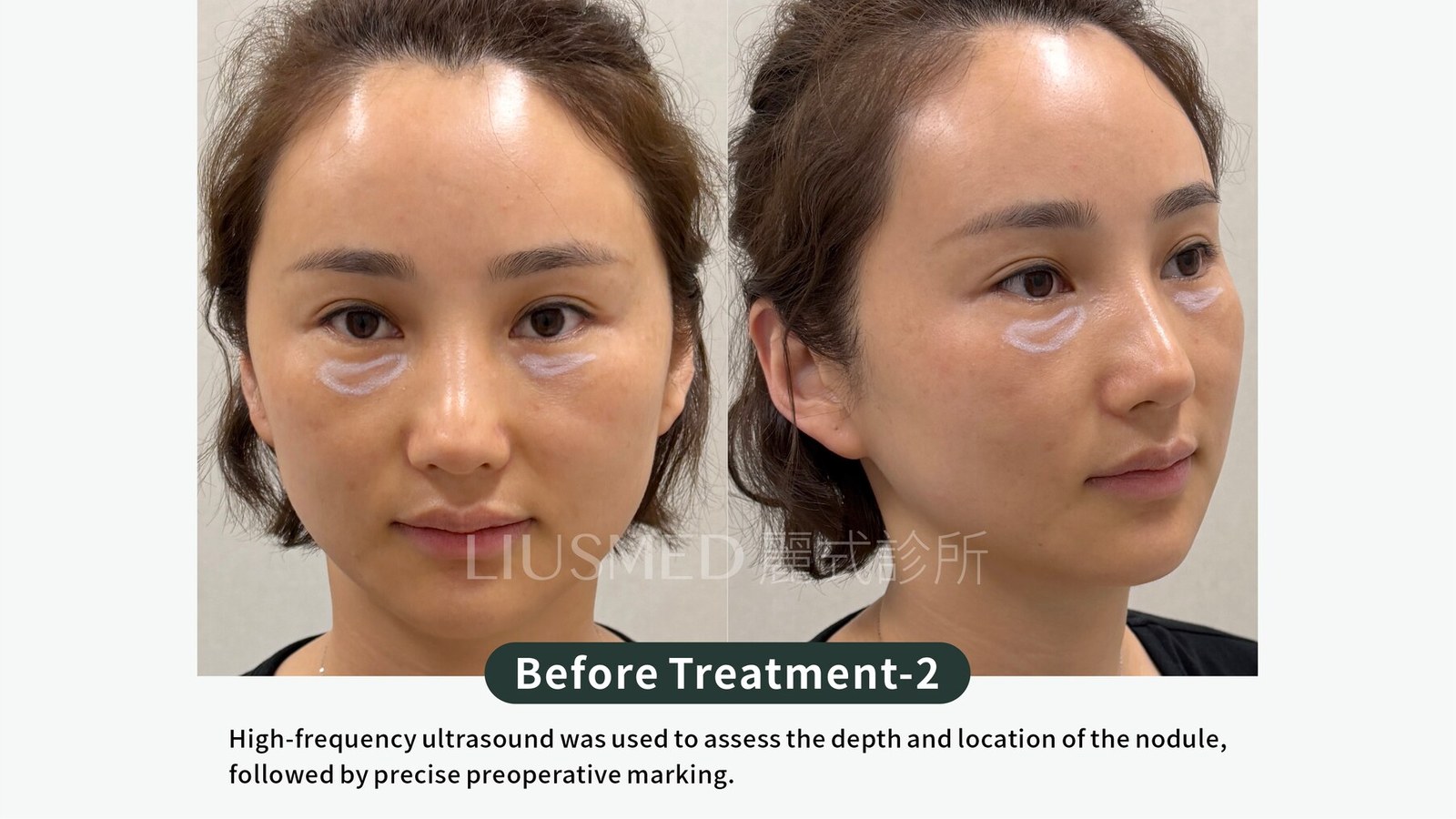
Step one is seeing clearly. High-frequency ultrasound across the whole area: is there residual material, in which plane, is there encapsulation around it, how close is it to vessels and nerves. This step isn't documentation for its own sake. Every decision in the next three steps rests on it. Palpation cannot answer which plane, and it cannot answer how much fibrous encasement there is.
Step two is subtraction. Once imaging confirms the heaviness comes from excess volume or migrated material, the excess comes out first. Our approach is to remove the material through a single pinhole under ultrasound guidance, staying clear of vessels and nerves and disturbing as little healthy surrounding tissue as possible. Removal is always staged: the first session typically takes out about thirty to fifty per cent, and two to three sessions together reach roughly eighty to ninety per cent, depending on the degree of fibrosis. I don't claim all of it, and sessions are usually about three months apart. The grading that drives those decisions is covered in FOS diagnosis and staged treatment for the overfilled midface.
Step three is support. For depressions such as the mid-cheek groove, or for a midface that needs holding up, I lean towards structural thread lifting rather than filler that can migrate. Threads can be placed precisely into different planes and arranged into something close to three-dimensional support, and they don't wander off on their own. That is consistent with what years of this work have shown me: the midface problem is usually structure, not a shortage of volume.
Tightening and sculpting come last. Once volume has been reduced and support is in place, an energy device at this point is a reasonable step, and now it is doing the one job that genuinely belongs to it, the firmness of the tissue itself. Radiofrequency is one of the tools I have used for many years, and with stacked heating it can also reduce excess midface soft tissue, though that takes a considerable amount of accumulated feel. Turning the energy up is not the same as doing it well.
The usual cost of reversing the order is a wasted round: lift first, discover some time later that what needed subtracting was never subtracted, and start again from step one.
Frequently asked questions
I have filler in my face. Can I still have ultrasound or RF lifting?
Yes, provided you first know what is inside and in which plane. What genuinely needs individual judgement is the type of material, its depth, and how long it has been since the last injection. Palpation cannot answer those three. Imaging can.
How long after hyaluronic acid should I wait before an energy device?
The literature gives a direction rather than a number: the shorter the interval, the higher the chance the material is affected, and by around four weeks the difference becomes unremarkable. But study conclusions conflict and there is no consensus on an optimal interval, so the actual interval should be decided by your physician based on what material was used and in which plane.
My face looks hollower after lifting. Is that normal?
For a face that has had fat grafting or filler, a change in volume after heating is worth confirming with imaging rather than waiting for it to "come back." Hollowness can also come from the original material distribution being altered. Results vary between individuals, but once clear asymmetry has appeared, stacking another round is not advisable.
I've tried several kinds of lifting with no effect. What's left?
Stop and get an assessment. Repeating the same category of energy does not become more effective against a problem that isn't laxity. Separate loose from heavy from walled-off first, then decide whether to subtract, support or tighten.
Finding out which step your face should start from
If you have had filler or fat grafting and your lifting treatments keep landing at "maybe a little," it is worth confirming with imaging rather than moving on to the next device.
At our clinic, Dr. Ta-Ju Liu starts by scanning the whole area with ultrasound to establish where the material is, how much remains, and whether fibrous tissue has encased it, then discusses with you whether to subtract, support or tighten. Being able to see it is what makes handling it safely possible.
For online preliminary assessment and appointments, please use contact us; international patients can share their current situation and treatment history remotely first.
References
- Jurairattanaporn N, Amornpetkul W, Rutnin S, Vachiramon V. The effect of combined hyaluronic acid filler injection and radiofrequency treatment: a clinic histological analysis. J Cosmet Dermatol. 2023;22(3):798-803. PMID: 36374532. doi:10.1111/jocd.15509
- Vachiramon V, Rutnin S, Patcharapojanart C, Chittasirinuvat N. The effect of combined of hyaluronic acid dermal filler and microfocused ultrasound treatment: a clinicopathological study. J Cosmet Dermatol. 2023;22(3):792-797. PMID: 36374232. doi:10.1111/jocd.15498
- Yi KH. Energy-based devices and hyaluronic acid filler, polymer filler, and threads: cadaveric study. J Cosmet Dermatol. 2024;23(11):3488-3492. PMID: 38979908. doi:10.1111/jocd.16467
- Yi KH. Treating energy-based devices and hyaluronic acid filler injection together? Skin Res Technol. 2024;30(4):e13716. PMID: 38634184. doi:10.1111/srt.13716
Written and reviewed by Dr. Ta-Ju Liu. This article is medical education content and cannot replace an in-person consultation. Individual situations should be assessed by a physician before any treatment decision, and results vary between individuals.