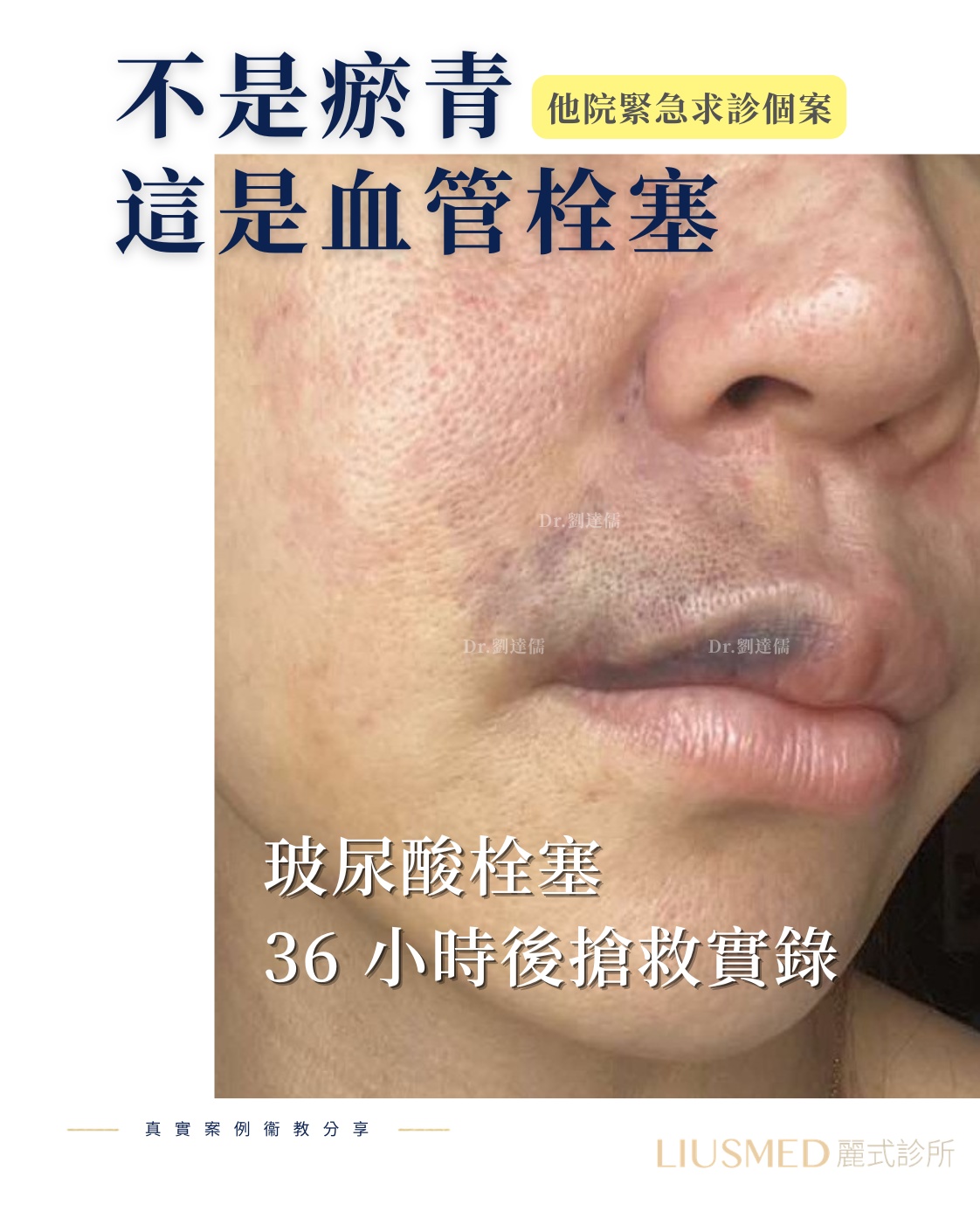
Nearly every filler vascular emergency people have heard of follows one route: material enters an artery, travels backwards against the flow, the skin blanches and then darkens, and in the worst cases vision is lost. I covered that route in the mechanism and emergency management of vascular occlusion.
There is a second route that almost no patient-facing writing discusses. Its mechanism differs, its timeline differs, and what can be done about it differs — and its mortality is higher than the arterial route.
Into a vein, no backward travel required
The arterial route needs particular conditions because it works against the blood pressure. Arterial blood travels away from the heart, so for filler to reach the eye or the brain it has to move backwards, which requires enough injection pressure to overcome arterial pressure. That pressure is achievable — it has been measured — but it is a threshold.
Veins are entirely different. Venous blood is already travelling toward the heart.
So filler entering a vein does not need to travel backwards and does not need to overcome anything. Following the direction the vessel already runs, the path is:
Vein → jugular vein → superior vena cava → right atrium → right ventricle → pulmonary artery → lodged.
The literature describes this as cardiopetal embolization — embolization toward the heart. Cadaveric work has demonstrated it: material injected into the temporal veins can be followed along venous flow to the pulmonary artery.
Because the obstruction that results is made of filler rather than clot, it is termed a non-thrombotic pulmonary embolism (NTPE).
Key point: Arterial embolism requires retrograde flow — the material is pushed somewhere it should not go. Venous embolism requires none — the material is carried to the lungs by normal circulation. One works against resistance; the other goes with the current.
The face's venous danger zone: the temple
Within facial injection, the position most discussed for venous risk is the temple.
The middle temporal vein (MTV) runs there, between layers of deep fascia. Two features make it awkward: its calibre is not small (cadaveric measurements span 1.66 to 3.42 mm, with imaging studies reporting wider), and it is held open by the dense temporal fat pad, so it does not collapse during injection the way other veins do. A vein that does not collapse is an open channel, and it connects directly onward to the jugular system.
Before going further, the proportions have to be stated, or this becomes fear-mongering rather than education.
But the face is not where this route does its damage
Laying the literature out, the facial numbers are these:
- Pulmonary embolism from facial hyaluronic acid: one reported case worldwide. A 2014 Korean case report describes a 35-year-old woman injected in the forehead and right cheek at a hair salon, by someone with no medical licence. Three days later she developed sudden breathlessness, syncope and confusion. She was ventilated and given steroids, was discharged on day eight, and had recovered fully at one month.
- Pulmonary embolism from facial autologous fat: five cases. Three of them occurred at the temple, one of which was a death confirmed by autopsy. So the cluster of cases at the temple involves fat, not hyaluronic acid.
- For comparison: systematic reviews have collected roughly 190 cases of blindness from facial filler.
In other words, on the face, the venous route to the lungs is about two orders of magnitude rarer than the arterial route to the eye. In one review of 90 cases of facial fat embolism, only 2.2% involved the lungs, while 41% involved the eye and 25.6% the brain.
I include these numbers because education that says only "this can happen", without saying how rare it is, leads people to misjudge risk. On the face, the arterial route remains the thing to worry about.
The deaths cluster where large volumes are injected
So where is this route dangerous? Away from the face.
The severe cases and deaths in the literature come overwhelmingly from the genitals, buttocks and breasts — sites where a large volume goes in at once. One series of genital non-thrombotic pulmonary embolism collected 14 cases: 7 of them died, and close to 60% of patients developed respiratory symptoms within 12 hours of the procedure.
This route is also material-agnostic. Fatal cases exist for hyaluronic acid, polyacrylamide hydrogel, polyalkylimide and liquid silicone. It is not a flaw in any one product; it is the consequence of material entering a vein.
There is a regulatory fact worth knowing here. Taiwan's approved indication for hyaluronic acid subdermal implants is to add volume to facial tissue, fill fine lines, and augment the lips. The US FDA explicitly lists breast augmentation and buttock augmentation as unapproved uses, and advises against injecting filler into bone, tendon, ligament or muscle. Almost all of the severe cases above occurred outside approved sites, and most were performed by people without appropriate qualifications.
"A small amount must be safe" — the evidence does not support it
People who read those cases often reassure themselves: those were tens of millilitres, I only had a little.
I searched for it, and no study has ever established a volume threshold. There is no "above X mL there is risk" and no "below X mL is safe".
There is direct evidence pointing the other way. A 2025 review pooling cadaveric studies puts it bluntly: small filler volumes were sufficient to cause severe complications, including blindness, stroke and pulmonary embolism. A separate fresh-cadaver perfusion study measured the intraorbital segment of the supratrochlear artery as holding a luminal volume of only 0.05 mL.
And the single facial hyaluronic acid case above? The original paper does not record the injected volume at all. So using it to argue anything about "how much less" was involved has no basis.
The decisive variable is not the amount. It is whether it entered a vessel.
One more thing worth knowing: aspirating before injection — drawing back to check for blood — is often treated as a safety guarantee, but the literature's position is that aspiration cannot be relied upon and should not be employed as a safety measure.
Symptoms and the time window: five minutes to four days
This is the part most worth remembering.
Symptoms: sudden cold sweating, breathlessness, rapid breathing, chest tightness or pain, cough, coughing blood, low oxygen saturation, altered consciousness, petechial rash, shock. In the facial case, the earliest presentation recorded in the paper was three things together — sudden sweating, dyspnoea and tachypnoea.
The interval varies widely. Cases are documented from 5 to 10 minutes after the procedure, and others that appeared on day three or day four. In the genital series, close to 60% presented within 12 hours.
What most often causes delay is that the first symptom does not look like a lung problem. One case opened with abdominal cramping and diarrhoea, with respiratory distress appearing only 90 minutes before death; another opened with lower abdominal pain. Without a volunteered injection history, this diagnosis is hard to reach in time.
So:
Key point: Any respiratory symptom after an injection means going to an emergency department immediately. And volunteer the details — what material, which site, roughly what volume, who performed it. Concealed injection history has genuinely caused diagnostic delay and death in the published record.
Why hyaluronidase cannot rescue an embolus in the lungs
Many people assume hyaluronic acid is reversible, so it can be dissolved wherever it ends up. That does not hold in the lungs.
Searching the literature, there is no evidence supporting hyaluronidase for hyaluronic acid emboli that have already reached the lungs. The one direct clinical statement available comes from the record of a patient rescued on ECMO: the material had spread to the terminal branches of the pulmonary artery, was difficult to dissolve with drugs, and there was no indication for interventional thrombolysis.
The reason is straightforward. For the enzyme to work, it has to reach the affected vessel — whether placed subcutaneously, intravascularly, or delivered under ultrasound guidance to a specific artery. The distal branches of the pulmonary arterial tree can neither be located nor selectively reached.
What remains is supportive care: oxygen, mechanical ventilation where needed, steroids, and ECMO to carry a patient through the acute phase in severe cases. That is not a counsel of despair. The 40-year-old woman in that report had received 27 mL of cross-linked hyaluronic acid and suffered cardiac arrest; she was supported on veno-arterial ECMO for eight days, survived to discharge, and was neurologically normal at one month. Getting to hospital promptly matters.
Note also that steroids are not universal: a case report involving a polyalkylimide filler warned that corticosteroids may actually worsen the situation. Which returns to the same point — the emergency department needs to know what you were injected with.
The two routes side by side
← Swipe to see more →
| Arterial route (the familiar one) | Venous route → pulmonary embolism | |
|---|---|---|
| Physical requirement | Must overcome arterial pressure, usually retrograde | No retrograde flow needed, goes with the current |
| Facial high-risk site | Glabella, nose, forehead, nasolabial folds | Temple (middle temporal vein) |
| Onset | Seconds to minutes | 5 minutes to 4 days |
| Typical presentation | Severe pain, blanching then necrosis, sudden vision loss | Sweating, breathlessness, chest pain, haemoptysis, hypoxia, confusion |
| Facial case volume | ~190 blindness cases | 1 hyaluronic acid case, 5 autologous fat cases |
| Can it be treated | Yes: hyaluronidase, window measured in hours | Largely not: no evidence for enzyme use in lung emboli |
| Main risk sites | The face | Genitals, buttocks, breasts (large volume) |
Frequently asked questions
Should I worry about pulmonary embolism when having facial filler?
On probability, this is not the leading concern for facial injection. There is one reported case worldwide of pulmonary embolism from facial hyaluronic acid, against roughly 190 reported cases of blindness from facial filler. Risk management for facial injection still centres on the arterial route. The value of knowing this route exists is different: if breathlessness or chest tightness follows an injection, you will not dismiss it as anxiety or a cold and delay.
Does that mean the temple should not be injected?
No. Temple hollowing is a common and reasonable thing to treat. It gets discussed because of a vein there that does not collapse, which raises the demands on anatomical knowledge, instrument choice and injection technique. Published suggestions for the area include blunt cannulas, small increments delivered while withdrawing, and avoiding high-pressure boluses. This is a question of technique and judgement, not of whether it can be done.
Why do some people have tens of millilitres without incident while others have problems from a small amount?
Because the decisive variable is not the total volume but whether material entered a vessel, how much entered, and which vessel. No volume threshold exists in the literature, and cadaveric work indicates small volumes suffice for severe complications. A larger total does raise the probability, but "a small amount" is not a guarantee of safety.
How long after injection am I in the clear?
There is no clean cut-off. Documented onset ranges from 5 minutes to day four. The practical approach is this: in the days after an injection, if breathlessness, chest tightness, cold sweating, coughing blood or confusion appears, go to an emergency department and volunteer the injection history.
I have already had injections and now I am worried. What should I do?
If no respiratory symptoms have followed your injection, no specific testing is needed for this. This route presents acutely; it does not lie dormant and then surface much later. If your concern is the injection site itself — a lump, migration, tenderness — that is a separate matter, and can be discussed through an online assessment or a consultation.
A closing thought
I wanted to write this because the phrase "non-surgical" is widely read as "low risk".
It means one thing only: no incision. It does not mean low risk, and it certainly does not mean no risk. Any filler, in the wrong vessel, can turn a procedure that sounds simple into an emergency.
This venous route deserves its own article not because it is common — on the face it is extremely rare — but because once it happens we have almost no antidote available and can only support the patient through it. And its first symptom is frequently mistaken for something else.
Before any injection, it is worth knowing one thing: what is underneath the needle. On the materials themselves and how their vascular risks differ, the hyaluronic acid page and the vascular occlusion hub go further; for what actually happens in an emergency, see the mechanism and emergency management of vascular occlusion and a real rescue case.
Dr. Ta-Ju Liu Filler Revision — filler complication repair, ultrasound-guided single-pinhole extraction