
Permanent Fillers (Silicone, PAAG, PMMA)
Silikon-1000 · Artecoll · Bio-Alcamid · Aquamid
Non-absorbable fillers designed to last permanently. Include liquid silicone, polyacrylamide gel (PAAG), and polymethyl methacrylate (PMMA). Highest complication risk.

Composition
Various non-biodegradable synthetic polymers.
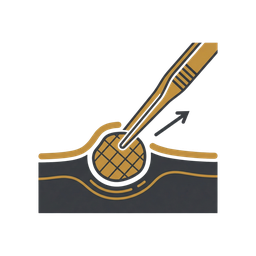
Common Complications
Chronic inflammation, granuloma, migration, disfigurement, infection, tissue necrosis. Often requires surgical intervention for complications.
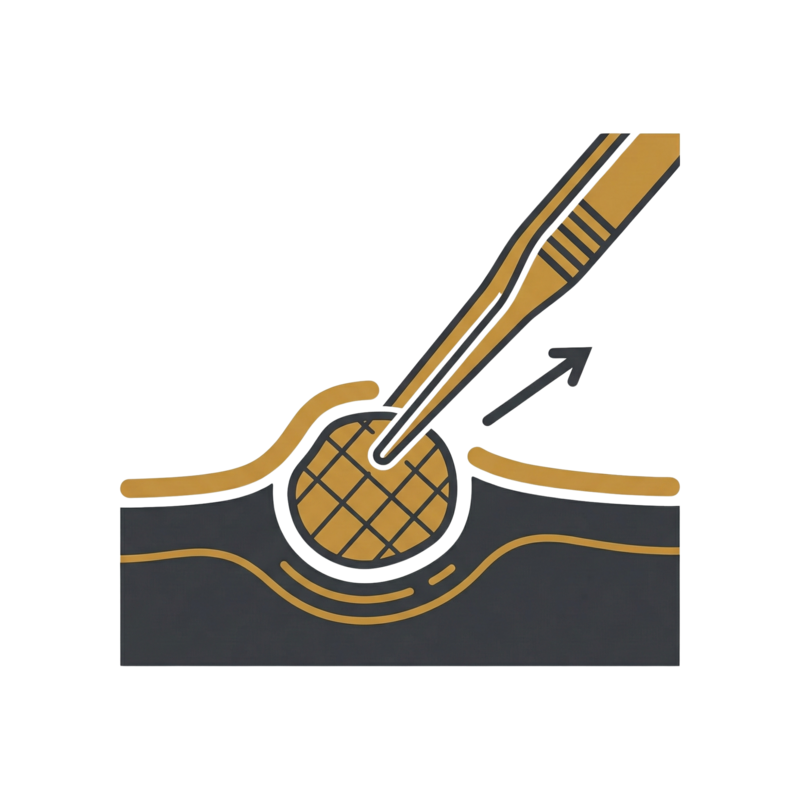
Extraction / Removal Method
Ultrasound-guided extraction combined with micro-surgical techniques. Most challenging type to remove. May require staged procedures.
Top 10 Patient Complaints

1Zero Biodegradability — Permanent Prisoner
Synthetic polymers stay forever. Body's macrophages are powerless.
2Severe Gravitational Migration Over Decades
As facial bone resorbs and muscle atrophies with age, material migrates downward like mercury. Face progressively deforms.
3PAAG Monomer Toxicity
PAAG degrades over time, releasing neurotoxic/potentially carcinogenic acrylamide monomers that poison surrounding tissue.
4Extreme Tissue Adhesion
Material bonds with muscle fibers, vessels, and facial nerves through severe fibrotic adhesion. Tissue becomes rubber-like.
5Chronic Recurring Infection
Biofilm + permanent foreign body = perpetual infection reservoir. Every immune dip triggers a flare.
6Tissue Necrosis and Fistula Formation
Severe inflammation/vascular compression causes skin necrosis. Pus and material mixture may break through skin surface.
7Silicone Granuloma Spreading
Liquid silicone infiltrates tissue gaps. Immune cells create countless micro-granulomas that merge and expand over years.
8Traditional Surgery = Devastating Destruction
Open surgery requires large facial incisions, massive scarring, and high risk of permanent facial nerve damage (facial paralysis).
9Impossible 100% Removal
Gel/liquid material infiltrates deep into muscle fibers. Complete removal is medically impossible. Goal is maximum debulking.
10Crushing Psychological and Financial Burden
Decades of suffering, multiple surgery failures, massive costs, social isolation, and depression.

Why Traditional Methods Fail
Traditional open surgery leaves devastating scars and risks facial nerve damage. Squeezing/pressure extraction is crude and dangerous. No dissolution agent exists for any permanent material. Many doctors refuse these cases entirely.

The Liusmed Repair Strategy
"Maximum Debulking via Micro-Dissection" — like defusing a high-difficulty bomb. Full-session continuous ultrasound monitoring. Millimeter-by-millimeter dissection separating material from nerves and vessels. Through 1-2mm pinholes, micro-curettes and drainage tubes scrape and aspirate the toxic gel plus necrotic tissue. Goal: remove as much material as can be safely removed, infection source control, nerve decompression, contour restoration. Applies to gel in both the face and the breasts — still through pinholes of about 2 mm, with no incision. Multi-session approach for extensive cases.
Dr. Liu's Clinical Perspective
"I won't promise 100% removal — that would be dishonest. But meaningful debulking is enough to resolve symptoms, stop chronic inflammation, restore contours, and end the cycle of suffering. Every patient tells me the same thing: 'I wish I'd come sooner instead of spending 10 years being told nothing could be done.'"

Recovery Timeline
The pinhole is small, but this is an extraction, so swelling and bruising are expected. Swelling and bruising usually settle in about 2–3 weeks, the pinhole heals in about 2 weeks, and the final result takes about 3 months, varying from person to person. Depending on the extent and depth, it may need to be done zone by zone, in stages, or over more than one session. We cannot guarantee 100% removal; the goal is as much improvement as can be achieved safely, and a return to natural contours.
FAQ
Is it possible to remove silicone filler?
Yes, but it is the most challenging type of filler to remove. Liquid silicone integrates deeply with tissue, requiring ultrasound guidance and micro-surgical precision. Complete removal may not always be possible, but significant improvement is achievable.
My doctor said silicone is permanent and nothing can be done — is that true?
"Permanent" means silicone is not metabolized or dissolved by any enzyme — it does not mean it cannot be removed. Most general practitioners simply lack the ultrasound mapping and micro-extraction technique to address it, so they default to "nothing can be done." Through pinhole entries under ultrasound guidance, a large proportion of the deposited silicone can be physically extracted, meaningfully reducing lumps, distortion, and inflammation even when total clearance is not realistic.
Why are silicone lumps and hardening appearing years after my injection?
Liquid silicone provokes a slow, chronic foreign-body response. Over years the body walls off the silicone droplets with fibrous tissue, forming granulomas (siliconomas) that feel hard and may grow. The silicone can also migrate along tissue planes under gravity and muscle movement, surfacing as new lumps far from the original site. Because this is a gradual immune process, flare-ups can also be triggered by illness, dental work, or other infections years later.
Real patient questions
Questions from the patient Q&A forum, answered by Dr. Liu.
Ask your own question in the forum

Related Symptoms
References
- Narins RS, et al. Dermatol Surg. 2006;32(2):276-289
- Chasan PE. Plast Reconstr Surg. 2007;120(7):2126-2133
- Rapaport MJ. Plast Reconstr Surg. 2007;120(7):2128-2133
This information is for educational purposes only. Treatment options depend on individual circumstances. Consult a qualified physician.

Read next: when this material goes wrong
Case-by-case decisions, written by Dr. Ta-Ju Liu
Minimally Invasive Extraction vs. Open Surgery: Scarring, Recovery and How Much Can Be Removed
Ultrasound-guided pinhole extraction vs. open surgery: how wound size, scarring, recovery and residual filler differ, and what to realistically expect.
No Idea What's in Your Face? Ultrasound Identification of Unknown Filler
Cannot remember what was injected years ago? Specialized ultrasound identifies unknown filler materials — the essential first step before any treatment.
Silicone & PAAG Removal: Alternative to Wide Excision
Told you need wide excision for silicone or PAAG? FILLER REVISION offers ultrasound-guided minimally invasive extraction as a tissue-sparing alternative.