Your Jawline Filler—From Sharp to Lumpy
"My jawline looked great for the first month, then lumps started appearing and the definition disappeared. Dissolution flattened the good areas along with the bad." At FILLER REVISION, jawline filler complications are among our most common cases. Patients arrive after dissolution attempts that removed volume indiscriminately — flattening the sculpted areas they wanted to keep while leaving displaced filler in unexpected locations. The jawline's unique biomechanical forces make it one of the highest-risk areas for filler complications, and treatment demands precision that blind dissolution cannot provide.
For the full picture on choosing chin and jawline filler materials and how lumps are revised, start with this overview: Chin & jawline filler deformity, lumps and migration — complete guide.
Classifying Jawline Filler Problems
← Swipe to see more →
| Problem Type | Appearance | Feel | Primary Cause |
|---|---|---|---|
| Downward displacement | Drooping mass below jawline | Palpable lump under chin area | Gravity + deep injection |
| Posterior migration | Unnatural fullness behind jaw angle | Firmness below ear | Tissue plane pathways |
| Superficial clumping | Visible bumps along jawline | Hard lumps with clear borders | Too shallow or excessive volume |
| Fibrous encapsulation | Fixed, immovable nodules | Rock-hard, non-compressible | Chronic foreign body reaction |
| Asymmetry | Inconsistent jawline shape bilaterally | One side lumpy, other side not | Uneven migration or resorption |
Key Insight: At FILLER REVISION, we see this pattern regularly — the jawline is a dynamic structure where talking, chewing, and swallowing constantly engage the region. Filler here endures far greater mechanical forces than in static areas, which is precisely why jawline filler is especially prone to displacement and deformation.
Why Jawline Filler Is Particularly Challenging
Anatomy and Biomechanical Forces
- Masticatory muscle power: The masseter and other chewing muscles generate powerful forces that squeeze and push filler
- Multiple tissue planes: The mandibular region contains several potential tissue planes along which filler can track and migrate
- Persistent gravity: Located at the lower face, gravity constantly pulls filler downward
- Variable skin laxity: Skin looseness along the jaw varies significantly between individuals, directly affecting filler stability
- Individual bone variation: Mandibular morphology influences how filler is supported and distributed
Key Insight: An ideal jawline contour depends not just on the amount of filler, but on filler remaining stable at the correct position. Once displacement occurs, even if the total volume is appropriate, the result becomes irregular and uneven.
Three Displacement Patterns in Jawline Filler
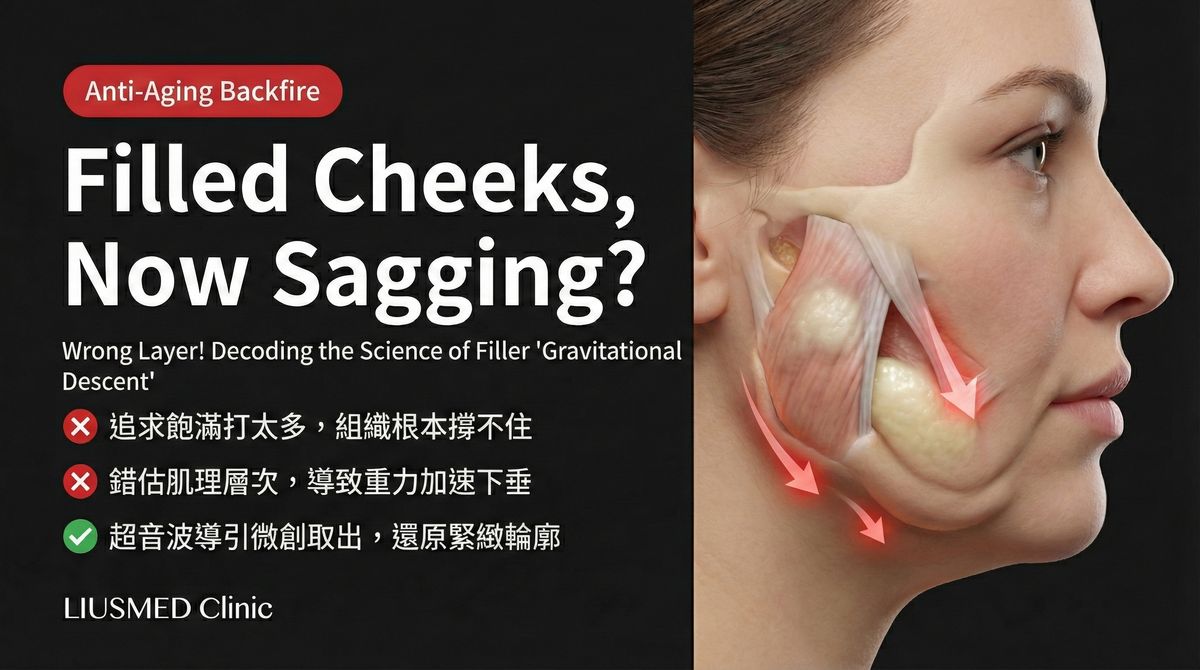
Pattern 1: Downward Sagging
Filler slides off the mandibular border due to gravity, forming palpable masses below the chin. From the front, the jawline actually appears less defined. From the side, an unnatural bulge is visible in the submandibular area.
Pattern 2: Posterior Sliding
Filler tracks along tissue planes toward the area behind the ear. The result is unnatural fullness behind the jaw angle, while the anterior jawline—the area you wanted to enhance—shows poor improvement.
Pattern 3: Superficial Extrusion
Masticatory muscle activity pushes filler from deeper layers toward the surface, creating visible bumps and irregularities along the skin. This is particularly pronounced in lean faces with thin subcutaneous tissue.
Ultrasound (Ultrasonography) Diagnostic Value
For jawline filler problems, ultrasound assessment can confirm:
- Current position vs. intended position: Precisely determining displacement direction and distance
- Relationship to bone: Whether filler remains adherent to the mandibular border
- Surrounding structures: The spatial relationship between filler and nearby vessels and nerves
- Encapsulation status: Whether fibrous tissue has formed around the filler
- Total volume and distribution: The foundation for planning removal strategy
Key Insight: Jawline anatomy includes the facial artery, marginal mandibular nerve, and other critical structures. Any revision procedure in this area benefits enormously from ultrasound guidance—not just for finding filler, but for protecting what matters.
Repair Strategies
For downward displacement: Locate displaced filler under ultrasound guidance and perform minimally invasive extraction of material that has moved from the correct position.
For posterior migration: Ultrasound confirms the migration pathway and endpoint, enabling selection of the safest extraction route.
For superficial clumping: Choose between enzyme dissolution (for hyaluronic acid) or ultrasound-guided extraction (for non-HA fillers) depending on the filler type.
For encapsulated nodules: Dissolving enzymes cannot penetrate the fibrous capsule. Direct ultrasound-guided extraction of the encapsulated filler mass is required.
For asymmetry: A comprehensive bilateral assessment of filler distribution differences is needed to develop a side-specific treatment plan.
When Dissolution Can't Distinguish Good From Bad: The FILLER REVISION Approach
The core challenge of jawline filler revision is selectivity — patients want displaced filler removed while preserving well-positioned material. Blind hyaluronidase injection cannot make this distinction; it dissolves all HA (Hyaluronic Acid) in its path. At FILLER REVISION, ultrasound guidance enables us to selectively target only the displaced or clumped filler while leaving correctly positioned material intact. For encapsulated nodules and non-HA jawline fillers, pinhole extraction under real-time imaging provides the precision needed to navigate the jawline's critical vascular and neural structures. This selective approach restores contour definition rather than simply reducing overall volume.
Prevention Guidelines for Jawline Filler
- Select products with adequate firmness but not excessive rigidity
- Prioritize supraperiosteal injection depth for the most stable support
- Control total volume per session to avoid exceeding tissue capacity
- Avoid vigorous chewing of hard foods after injection (especially the first two weeks)
- Schedule regular follow-up assessments for stability and symmetry
If you've already tried treatment for jawline filler complications without success, FILLER REVISION specializes in exactly these cases. Our ultrasound-guided selective approach restores contour definition with precision.
Frequently Asked Questions
Why did my jawline filler look great at first but turn lumpy and lose definition later?
The jawline is a dynamic structure constantly engaged by talking, chewing, and swallowing, so filler there endures far greater mechanical forces than static areas and is especially prone to displacement and deformation. Filler can sag downward below the chin, slide posteriorly behind the jaw angle, or be pushed superficially into visible bumps. Even when the total volume is appropriate, once it shifts off the correct position the result becomes irregular and uneven.
I had my jawline filler dissolved but it flattened the good areas too. Why does that happen?
Blind hyaluronidase injection cannot distinguish displaced filler from well-positioned filler — it dissolves all the hyaluronic acid in its path, flattening the good areas along with the bad. That is why dissolution can remove the sculpted definition you wanted to keep while leaving displaced filler in unexpected locations. Ultrasound guidance is what allows correctly positioned material to be preserved while only displaced or clumped filler is targeted.
I have a hard, rock-like lump on my jaw that dissolving enzymes didn't shrink. What can be done?
Encapsulated jawline nodules are wrapped in fibrous tissue from a chronic foreign body reaction, and dissolving enzymes cannot penetrate that capsule. These nodules therefore cannot respond to dissolving enzymes and require direct ultrasound-guided pinhole extraction of the encapsulated filler mass. Ultrasound first confirms whether fibrous tissue has formed around the filler before planning removal.
Is jawline filler removal risky given how many vessels and nerves are in that area?
Jawline anatomy includes the facial artery, marginal mandibular nerve, and other critical structures, so any revision in this area benefits enormously from ultrasound guidance — not just for finding the filler, but for protecting what matters. Real-time imaging lets the procedure map the spatial relationship between filler and nearby vessels and nerves before extraction. Pinhole extraction under real-time imaging provides the precision needed to navigate these critical vascular and neural structures.
What can I do to help my jawline filler stay in place and not shift after a new injection?
Aftercare matters because the jawline endures powerful biomechanical forces. The article advises avoiding vigorous chewing of hard foods after injection, especially during the first two weeks, and scheduling regular follow-up assessments for stability and symmetry. On the treatment side, prioritizing supraperiosteal injection depth and controlling the total volume per session help keep filler stable. These are general guidelines; your specific plan and any cost are discussed individually at consultation.