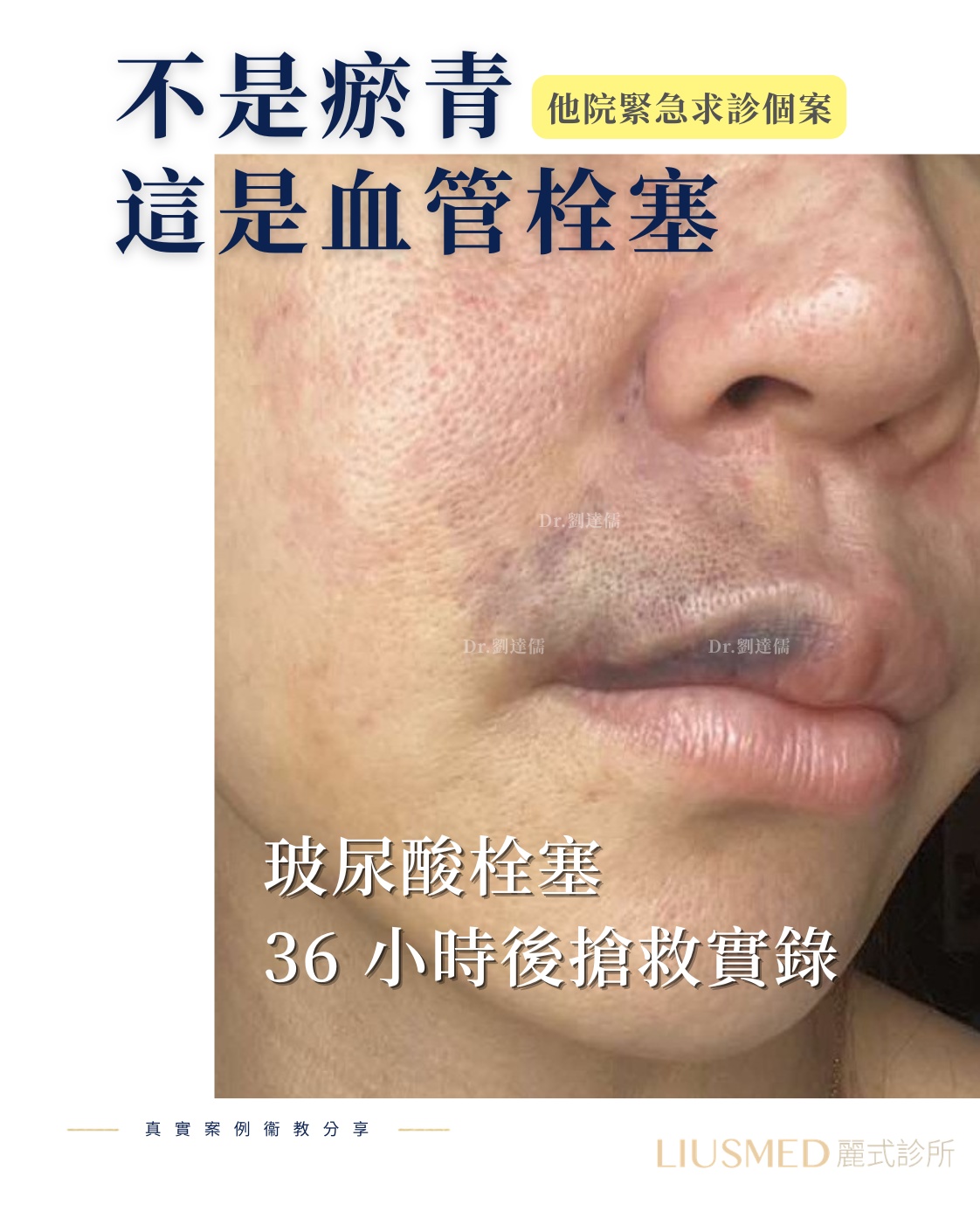
"My chin filler looks like it slid down. There's a soft fullness under my jaw now that wasn't there before." When someone shows me this, the first job isn't to reach for the hyaluronidase. It's to work out whether the filler actually moved, or whether it's still sitting where it was placed and something else is going on.
For the full picture on choosing chin and jawline filler materials and how lumps are revised, start with this overview: Chin & jawline filler deformity, lumps and migration — complete guide.
Migration, swelling, or just overfilled? Three different things
"Migration" gets used as a catch-all, but at least three separate situations produce a chin that looks off, and they are not treated the same way.
← Swipe to see more →
| True migration | Swelling | Overfill | |
|---|---|---|---|
| What happened | Product moved away from where it was injected | Normal post-injection edema | Too much product, sitting where it was placed |
| Timing | Appears or persists after swelling settles | First 2 weeks, up to ~8 | Present from the start, doesn't resolve |
| What you see | Fullness below the jaw, jowl, or off to one side | Diffuse puffiness, resolves | A chin that's simply too big or too projected |
| What it needs | Locate and dissolve/remove the displaced part | Time | Dissolve the excess |
Key point: Swelling settles on its own, usually within two weeks. Overfill was there from day one and doesn't move. True migration tends to show up or become obvious after the swelling has gone. If the shape is changing weeks or months later, that's the pattern that points toward migration.
This distinction matters because the fix differs. You don't dissolve swelling; you wait. Overfill and migration both may need hyaluronidase, but migration first needs locating, because the product isn't where you'd assume.
Dr. Ta-Ju Liu: "'Doctor, why did my chin turn round and lose its shape after the injection?' 'When I take photos from the side, a big chunk of my chin juts forward and I look like a witch — it's really unnatural.' These two lines are the most common opening remarks from people who come to me for repair after a botched chin filler."
Neither complaint necessarily means the filler moved. A round, shapeless chin or a block that juts forward on profile usually describes product sitting where it was placed, in an amount or a material that doesn't suit the chin; that side of the problem is covered in the chin and jawline guide.
Does chin filler dissolve on its own, or does it migrate?
It does break down on its own eventually, but not on the schedule most people expect, and that slow breakdown is a different process from migration. Breakdown means the product is gradually absorbed where it sits. Migration means it has moved somewhere else. Filler that has drifted below the jaw is still filler, and it fades on the same unpredictable timeline as the rest.
That timeline is longer and less uniform than the "6 to 12 months" people are often told. In an MRI review of 33 patients, hyaluronic acid was still visible in every one of them two years after injection, and in one patient up to 15 years later (Master and colleagues, 2024, all midface). A small CT/MRI series around the eyes found HA persisting for up to nine years (Chang and colleagues). The chin can be quicker: in a single-patient MRI follow-up, chin HA had almost completely degraded by 19 months while midface filler in the same patient was still present (Master and Roberts, 2022). Nobody can tell you in advance whether yours will be gone in a year or still there in five.
That is also why migration can surface late. In the chin case described further down, the one that needed MRI to find the filler, symptoms began two years after the injection (Mariluis and colleagues). A change that appears a year or two later is not automatically a new problem. It may be old filler that has moved or spread.
Why chin filler migrates
Filler can move from where it was placed by more than one mechanism (Jordan & Stoica documented this across several routes), and the chin has a few specific reasons it happens here.
The mentalis muscle. The chin is one of the most dynamic areas of the lower face. The mentalis is a small, constantly active muscle that elevates and protrudes the lower lip. Experimentally, HA injected into this area stays put when the muscle is kept still but tracks along the muscle when it's allowed to contract. That movement is why some clinicians add a small dose of botulinum toxin to the mentalis to "hold" chin filler, though that's an adjunctive practice rather than a strongly proven one.
Injection plane and depth. Chin projection is meant to be built deep, right on or just above the bone (supraperiosteal, meaning on top of the periosteum, the membrane covering bone). Product placed too superficially sits in mobile soft tissue, where it displaces far more easily.
Overfilling. Too much volume raises local pressure and can push product along the paths of least resistance, below the jawline, into the jowl or the pre-jowl area, or toward the midline under the chin.
Product spread along tissue planes. Filler can also track along fascial planes and disperse diffusely into the subcutaneous fat rather than moving as one lump. This diffuse spread is part of why the chin can look heavier or more "sagging" without an obvious single bump.
People ask the same question about the jaw ("does jaw filler migrate?"). Much less has been published on jawline migration specifically, so we don't borrow chin figures for it. The assessment is the same, though: separate migration from swelling and overfill, then find where the product actually is on ultrasound. Jaw-specific patterns are covered in jawline filler that has shifted or gone lumpy.
What migrated chin filler looks like on your face
It rarely looks like a neat lump that moved. More often it shows up as a change in the lower-face silhouette:
- soft fullness below the mandible, an ill-defined "double chin" that wasn't there before
- a pointed or sagging pouch sitting over the jaw margin
- heaviness in the jowl or the marionette/pre-jowl area
- asymmetry, where one side has more fullness lower down than the other
These are exactly the changes that make people think they've aged or gained weight in the lower face, when the real cause is filler that has drifted from where it was placed.
Dr. Ta-Ju Liu: "The shape of a chin is held up by the bone underneath. Hyaluronic acid is fairly soft, and placed somewhere that moves every time you talk or eat, it often spreads into a round, shapeless mound even if it hasn't actually migrated. So when you feel your chin has 'changed', I first separate the two: has the product moved, or was a soft material never able to hold a shape in the first place?"
How doctors find it: ultrasound first, MRI when it hides
This is the step most articles skip, and it's the most important one. You cannot plan a fix for migrated filler you can't locate.
High-frequency ultrasound is the first-line tool. In the office, in real time, it shows HA as dark (anechoic to hypoechoic) deposits, maps where the product actually sits, distinguishes it from other causes, and guides the needle for dissolving (Gonzalez and colleagues documented filler migration among the nonvascular complications that ultrasound can characterize). Seeing before acting is the whole principle here, because in a mobile area like the chin, guessing where the filler is wastes doses and misses the real deposit.
Ultrasound has one limitation worth knowing. When HA has spread very diffusely rather than pooling into a discrete shape, ultrasound can miss it. There's a documented case of a woman with chin pressure two years after HA where high-frequency ultrasound found only a small deposit, but MRI revealed a substantial amount of HA dispersed through the subcutaneous fat, which then resolved after targeted hyaluronidase (Mariluis and colleagues). That's a single case, so MRI is not routinely needed. But when the ultrasound is negative and the symptoms are real and persistent, it's a reminder that "nothing on ultrasound" doesn't always mean "nothing there."
Dissolve vs remove: when hyaluronidase is enough, and when it isn't
For HA chin filler that has migrated, hyaluronidase (the enzyme that breaks down hyaluronic acid, used only after in-person assessment) is first-line. Injected directly into the located deposit, and often over more than one session because the enzyme's activity in tissue is short-lived, it can dissolve displaced HA. Ultrasound guidance helps target the material that has moved.
But dissolving has honest limits that most pages don't mention (Yi and colleagues lay these out):
- It can't fully dissolve a fibrous capsule. If the body has walled off the filler, the needle has to physically breach that capsule to reach the material; the enzyme alone won't clear a hardened, encapsulated mass.
- Overdone, it degrades your own tissue. Excess hyaluronidase breaks down your native HA too, which can leave volume loss and laxity, exactly the opposite of what you wanted.
- There's a hypersensitivity risk, so it's done where a reaction can be managed.
So where does physical removal fit? For migrated HA, it usually doesn't come first; dissolving is the reasonable start. Physical, ultrasound-guided removal through a single pinhole is reserved for material hyaluronidase can't handle: non-HA or permanent fillers, or an encapsulated nodule that won't dissolve. That's the honest boundary. If you had HA and it migrated, the first tool is the enzyme, used with a clear map of where the product actually is. If it's a material the enzyme can't touch, removal becomes the answer. Which situation you're in is exactly what the assessment is for, and it's the same principle behind dissolving versus removing HA filler.
Dr. Ta-Ju Liu: "If the ultrasound shows something other than HA, a firmer material such as Radiesse or Ellansé, the goal changes. I don't aim to 'get it all out'; I aim to smooth and even out the proportions of your profile. Taking everything out can sometimes take you back to what you wanted to improve in the first place, or leave too little."
What about botulinum toxin? Relaxing the mentalis is sometimes combined with chin filler, before or alongside the injection, and two small studies suggest it can help the filler work better: a 50-patient randomized trial found more surface change per unit of filler over the first six months, and a similar result with less HA (Guo and colleagues, 2024), and a 46-patient retrospective comparison with toxin placed in the mentalis reported fewer top-ups over six months (Betti and colleagues, 2026). Neither measured migration, and we found no study showing that toxin moves already-displaced filler back or makes it smaller. For filler that has already moved, locating and dissolving it comes first. Toxin belongs to the conversation about whether and how the chin is treated again.
If you haven't had chin filler yet: what lowers the risk
The same three drivers are the three things worth asking about before treatment.
- Where will the product go? Chin projection is built deep, on or just above the bone. Ask whether that is the plan, because product left in mobile soft tissue displaces more easily.
- How much in one session? A large volume in one go raises local pressure. Ask whether the plan is conservative and staged, with a review once swelling has settled.
- How active is your chin? People with a recessed chin often have a tense, overactive chin muscle (Guo and colleagues). If your chin puckers when you close your lips, ask whether that changes the plan.
None of this guarantees the filler stays put, but these are the factors the literature ties to migration, and a careful injector should be able to answer each one plainly. Keep your pre-treatment photos too; if the shape changes months later, they make it much easier to see what moved.
When to wait, and when to act
Clinically significant chin migration is uncommon compared with areas like the lips. The chin's dense tissue actually resists movement when filler is placed deep and correctly. Minor settling over months is common and usually not visible. So not every change needs intervention.
What I'd act on: a shape change that persists after swelling should have resolved, fullness that has clearly dropped below the jaw, or asymmetry that's bothering you. What I'd wait on: puffiness in the first couple of weeks, which is very likely swelling. Beyond three or four weeks with a shape that isn't settling, waiting usually doesn't answer the question, and locating the filler on ultrasound does.
Key point: The order is the same every time: work out whether it's migration, swelling, or overfill; locate the product on ultrasound (MRI only if ultrasound is blank but symptoms persist); then dissolve what can be dissolved and remove only what the enzyme can't. Reaching for hyaluronidase before you've located the filler is how doses get wasted and the real deposit gets missed.
Frequently asked questions
Does chin filler actually migrate?
Yes, it can, though clinically significant migration is uncommon and better documented in case reports than in large studies, so no reliable percentage exists. Filler can move from where it was placed by several mechanisms, and in the chin the main drivers are the constant motion of the mentalis muscle, a too-superficial injection plane, and overfilling. Placed deep and in the right amount, it's much more likely to stay put.
How do I know if my chin filler migrated or if it's just swelling?
Timing is the biggest clue. Swelling shows up right after treatment and settles within about two weeks. Overfill is present from the start and doesn't move. True migration tends to appear or become obvious after the swelling has gone, as fullness that has dropped below the jaw or shifted to one side. If the shape is still changing weeks later, that points away from simple swelling, and ultrasound can confirm where the product actually is.
Can migrated chin filler be dissolved?
If it's HA, yes, hyaluronidase is first-line, injected into the located deposit, often over more than one session. The limits are that it can't fully dissolve a fibrous capsule, and too much of it degrades your own tissue and can cause volume loss. That's why locating the filler and dosing carefully matters, rather than flooding the area.
My filler moved and made a "double chin." Will dissolving fix it?
Often, if the fullness under the chin is displaced HA, dissolving the located deposit improves it. But it depends on what's actually there. If part of the fullness is your own anatomy or fat rather than filler, dissolving won't change that part, which is another reason to image before treating rather than assume all of it is filler.
Does chin filler dissolve on its own?
Eventually, but not on a predictable schedule. A midface MRI study of 33 people found hyaluronic acid still present two years after injection in every one of them, and occasionally far longer, although a single-patient follow-up found chin filler almost gone by 19 months. Natural breakdown is also a different thing from migration: filler that has moved below the jaw fades on the same slow timeline, so waiting doesn't reliably fix a shape that has changed.
Can Botox fix chin filler that has already moved?
No study we could find shows that. Relaxing the chin muscle with toxin is sometimes combined with chin filler, before or alongside it, to help the result hold, but it does not move displaced product back or dissolve it. For migrated HA, the first step is locating the deposit on ultrasound and dissolving it.
Is surgery needed to remove migrated chin filler?
Usually not for HA. Dissolving is the reasonable first step. Physical, ultrasound-guided removal through a single pinhole is reserved for material hyaluronidase can't dissolve, non-HA or permanent fillers, or an encapsulated mass, not routine migrated HA.
The bottom line
A chin that looks like it dropped or gained a soft "double chin" is unsettling, but the path forward is orderly. First separate migration from swelling and overfill. Then locate the product on ultrasound, using MRI only if the ultrasound is blank but the symptoms are real. Then dissolve what can be dissolved and remove only what the enzyme can't.
Dr. Ta-Ju Liu: "After dissolving, if you still want a defined chin, what I've favoured for sculpting chins over the years is structural thread lifting. It's firm, less prone to migrating and gives shape, and in my experience I have not yet seen a case where it formed a lump. Whether it suits you still has to be decided at an in-person consultation."
If your chin filler looks like it moved, or you have new fullness under the jaw that isn't settling, bring the details to your online assessment and consultation: when you were injected, with what, and when the change appeared. You can also read the general picture of how fillers migrate and, for the jaw specifically, jawline filler that has shifted or gone lumpy.
References
- Jordan DR, Stoica B. Filler Migration: A Number of Mechanisms to Consider. Ophthalmic Plast Reconstr Surg. 2015;31(4):257–262. PMID: 25650796. (Soft-tissue fillers can migrate from the injection site by several mechanisms and persist in the tissue for months to years; review with case reports.)
- Gonzalez C, Duque-Clavijo V, Kroumpouzos G, et al. Ultrasonographic features of nonvascular complications of hyaluronic acid fillers. Clin Dermatol. 2024;42(5):538–546. PMID: 38763380. (Retrospective study, 50 patients / 52 complications; filler migration was among the nonvascular complications characterized by high-frequency Doppler ultrasound.)
- Yi KH, Wan J, Yoon SE. Considerations for Proper Use of Hyaluronidase in the Management of Hyaluronic Acid Fillers. Plast Reconstr Surg Glob Open. 2025;13(3):e6566. PMID: 40040950. (Reviews hyaluronidase use and its limits, including the need to breach a fibrotic capsule to reach the filler and the risks of overuse.)
- Mariluis CA, Lagonegro D, Cavallieri F, Barrera P. Where Is the Filler? Magnetic Resonance Imaging Reveals Hidden Hyaluronic Acid in a Delayed Chin Complication. Plast Reconstr Surg Glob Open. 2026;14(1):e7412. PMID: 41523919. (Chin case: high-frequency ultrasound detected only a small deposit, while MRI revealed HA diffusely dispersed in the subcutaneous fat, which resolved after targeted hyaluronidase. Single case report.)
- Master M, Azizeddin A, Master V. Hyaluronic Acid Filler Longevity in the Mid-face: A Review of 33 Magnetic Resonance Imaging Studies. Plast Reconstr Surg Glob Open. 2024;12(7):e5934. PMID: 39015357. (HA detectable on MRI in all 33 patients at two years or more, one up to 15 years; midface only, and some patients were scanned because of swelling.)
- Chang JR, Baharestani S, Salek SS, et al. Delayed Superficial Migration of Retained Hyaluronic Acid Years Following Periocular Injection. Ophthalmic Plast Reconstr Surg. 2017;33(3S Suppl 1):S116–S118. PMID: 25902386. (Three patients; HA persisted up to nine years around the eyes.)
- Master M, Roberts S. Long-term MRI Follow-up of Hyaluronic Acid Dermal Filler. Plast Reconstr Surg Glob Open. 2022;10(4):e4252. PMID: 35433153. (Single patient; chin HA almost completely degraded by 19 months while midface filler remained.)
- Guo Y, Wang J, Wei W, Zhang A. Treatment of Chin Retrusion With Botulinum Toxin Plus Hyaluronic Acid Filler in Comparison With Hyaluronic Acid Filler Alone: A Randomized, Evaluator-Blinded, Controlled Study. Aesthet Surg J. 2024;44(5):537–544. PMID: 38036752. (50 patients, 9-month follow-up; chin hypertonia common in chin retrusion; higher surface-volume coefficient for the first 6 months and similar scale scores with less HA. Migration was not an outcome.)
- Betti E, Paglianiti M, Vaira LA, et al. Combined Botulinum Toxin Type A and Hyaluronic Acid Versus Exclusive Hyaluronic Acid Injections: A Potential Nonsurgical Alternative for Chin Augmentation. J Craniofac Surg. 2026. PMID: 42682023. (Retrospective, 46 patients; mentalis toxin 10–15 days before HA; fewer top-ups by 6 months. Non-randomized; migration was not an outcome.)