"I had botulinum toxin. So why is there something here?"
A typical version goes like this: a firm spot the size of a grain of rice beside the nasolabial fold, from an injection the person was told was botulinum toxin. The toxin's effect wore off long ago. The spot has not.
Consultations like hers cluster after the news reports a seizure of smuggled injectables. The problem is not in the news, though. It sits in a gap that rarely gets explained: the way botulinum toxin works, it was never going to leave behind something you can feel. So if you can feel it, more went in than you think, or what went in was not the toxin at all.
Botulinum toxin leaves no lump, and that follows from how it works
Botulinum toxin acts at the neuromuscular junction, the point where nerve meets muscle. It blocks the release of acetylcholine, so the muscles it reaches contract more weakly. What it changes is how hard a muscle pulls, not how much volume sits under the skin. Dosing is counted in units, the fluid volume that enters the tissue is small, and the tissue metabolises it. Once nerve endings sprout again, strength returns and the effect fades.
That pharmacology carries a useful corollary for revision work. The toxin provides no support and occupies no space, so it has no physical form in which to persist. Local swelling, bruising and tenderness in the first few days are the needle's marks, and they settle on their own.
So where does a firm lump that lasts weeks or months come from? In clinic there are three routes.
The first: filler went in during the same session, and the patient remembers only the two words she heard most often. Combined sessions on one face are ordinary practice, and after the appointment memory tends to keep the most familiar name.
The second: what went in was not botulinum toxin. With an unlicensed product, the label and the contents are two separate facts. There is an example below.
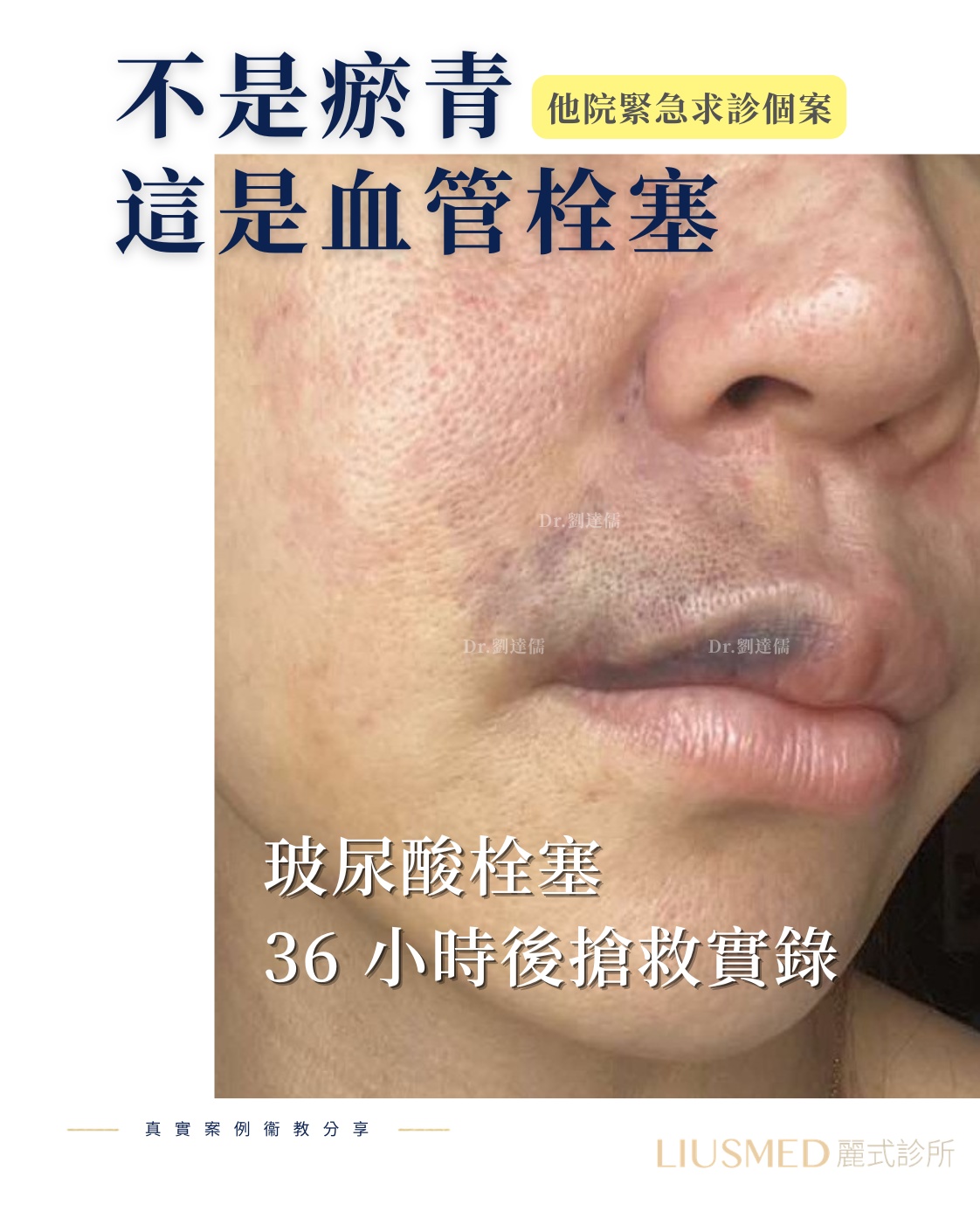
The third: a complication of the injection itself, such as a haematoma, an infection, a biofilm, or a foreign-body inflammatory reaction. These share one property. They persist, and they evolve.
In a filler revision practice the first two are the ones that come up more often. The patient is not lying. She genuinely does not know.
Key Insight: A lump that persists cannot be explained by the pharmacology of botulinum toxin. Almost always it is telling you that more went in than you were told.
What can actually be inside an unlicensed injectable
In March 2024, seven women in Tennessee and New York City developed symptoms after cosmetic injections given in non-medical settings. All seven had drooping eyelids, dry mouth, difficulty swallowing, shortness of breath and weakness. Four were hospitalised, two of them in intensive care. Six of the seven were injected in a residence and one at a cosmetic spa, and every injector was unlicensed. The US FDA later determined that the product given to four of them was counterfeit: the carton claimed 150 units, a strength the manufacturer does not make, and its lot number belonged to an expired 100-unit batch (PMID 38990782).
The point is not the unit figures. It is that what the box says and what the vial holds are two different facts. Once a product's provenance is unknown, so are its ingredients, its concentration, and whether it contains only one substance at all.
Taiwan has the same category of case. In April 2025 the Taiwan Centers for Disease Control reported that year's first suspected botulism case linked to cosmetic injection: a woman in her forties in northern Taiwan bought an injectable online, a seller injected it at her home, and about three days later she developed difficulty swallowing, excess saliva, drooping eyelids and muscle weakness, and was later intubated. The CDC also noted that botulism acquired by injection can begin anywhere from hours to weeks after the injection.
Imaging literature recorded this gap long ago. One cutaneous ultrasound study opens by noting that cosmetic filler injections are rising worldwide, yet neither the details of the procedure nor the agent used are always reported to, or remembered by, the patient (PMID 21418333). Not knowing what went in is not carelessness. It is the ordinary state of this market.
Checking afterwards whether the product was licensed
Taiwan's FDA lists several things a patient can verify without any special access.
← Swipe to see more →
| Checkpoint | What a licensed product looks like |
|---|---|
| Outer carton | Carries a Chinese product name and licence number |
| Seal over the vial | Inspection seal fully affixed across the opening, printed in colour-shifting ink and impossible to reattach once removed |
| Lot and dates | Lot number and manufacturing and storage dates match between carton and vial |
| Traceability | The lot number can be checked against the FDA's biologics inspection-seal records |
| Setting and injector | A registered medical institution, with a licensed medical professional performing the injection |
The FDA's position is that every batch is tested before an inspection seal is issued. For a patient, the meaning of that sticker and that licence number is simple. They are the only things you can go back and check later.
If you never saw any of it, and nobody will tell you the product name or licence number now, then treat "I do not know what went in" as a premise to work with, rather than a blank to skip over. How to choose the physician who takes this on is covered in the checklist for choosing a filler revision doctor.
What ultrasound can see under the skin
Not knowing what went in does not mean it cannot be worked out. Ultrasound reads the echo characteristics of the material itself.
A two-centre retrospective study in Spain scanned 60 patients who had previously received dermal fillers. Forty-eight showed one well-defined pattern and 12 a mixed one, and the authors described four patterns (PMID 33641224).
← Swipe to see more →
| Ultrasound pattern | Typical material | What it means for treatment |
|---|---|---|
| Heterogeneous: alternating hyperechoic and anechoic areas | Healthy subcutaneous tissue, and fully integrated hyaluronic acid | Clear borders may not exist; read the distribution instead |
| Fine grain snowfall | Liquid injectable silicone | Not dissolvable; physical extraction |
| Coarse grain snowfall | Calcium hydroxyapatite (CaHA) and polymethyl methacrylate (PMMA) based fillers | Hyaluronidase does nothing; physical extraction |
| Globular, cystic and anechoic | Polyalkylamides and polyacrylamides, and hyaluronic acid immediately after injection | Separate recent hyaluronic acid from a permanent material first |
The same study noted that mixed patterns arise mainly from different procedures performed at different times. That matters especially in unknown-source cases, where one region may have been layered two or three times with something different each time.
An earlier study found filler deposits in 118 patients referred for skin disorders, most commonly hyaluronic acid among the degradable agents and silicone oil among the non-degradable ones. Deposits were loosely scattered through the subcutaneous tissue, occasionally infiltrating local muscles and loco-regional lymph nodes, and the accompanying skin problems included highly localised inflammation unresponsive to conventional treatment, morphea-like reactions, fat necrosis and epidermal cysts (PMID 21418333). A 2025 imaging review of eleven studies concluded that ultrasound improves the accuracy and safety of hyaluronic acid filler work, covering vascular mapping, filler detection, and the detection and identification of complications (PMID 39884168).
Put plainly, the value of imaging is not that it names a brand. It answers three questions: which layer the material sits in, how much of it there is, and whether it can be dissolved. Those three decide what can be done next, and palpation cannot answer any of them. The reading itself is covered in more detail in ultrasound imaging for filler identification and identifying an unknown filler material. If imaging shows silicone or a polyacrylamide, the approach is set out in permanent filler removal.
Key Insight: Mixed patterns are considerably more common than single ones, which is why "I only ever had one thing" often fails to hold up on imaging. The risks of layered materials are covered in the compounding risk of mixed fillers.
Which symptoms need an emergency room, and which can wait for an appointment
Two categories need immediate attention: neurological and vascular.
Go to an emergency room rather than waiting for a clinic appointment if you have:
- Difficulty swallowing, a change in your voice, or excess saliva
- Drooping eyelids, blurred vision, or double vision
- Shallow breathing, a sense of not getting enough air, or weakness in the limbs
- Skin at the injection site turning pale, a dusky mottled pattern, severe pain, or a sudden change in vision
The first three are the typical presentation of botulism. Symptoms acquired by injection can begin hours after the injection or weeks later, so "nothing happened that day" rules nothing out. When you arrive, state the date, the site and whatever product name you were given, and bring the box or a photograph if you have one. The last item follows the vascular occlusion route, where time matters; see vascular occlusion rescue.
What can wait for an appointment is whatever stayed behind: a lump you can feel, swelling that keeps returning, tenderness on pressure, an asymmetric contour. None of that is urgent, but none of it resolves by itself either, and the earlier the imaging, the clearer the distribution still is.
One thing not to do: massage it, press hard on it, or apply heat. Working at something that will not break up tends to blur its borders, which makes later extraction harder. The reasoning is in the myth of massaging a filler lump away.
Frequently asked questions
Can botulinum toxin leave a lump?
Botulinum toxin acts at the junction between nerve and muscle and provides no volume support, so by itself it does not leave a lump that persists. Swelling and bruising in the first few days usually settle on their own. If you can still feel a distinct firm spot a week or two later, the more reasonable explanation is that something else was injected in the same session, or that the injection triggered an inflammatory reaction.
I have no idea what was injected. Can it still be identified?
The category and the layer, usually yes. The brand, usually no. Ultrasound shows which class of material the echo pattern belongs to, which layer it occupies and how far it extends, and that is enough to decide between hyaluronidase and physical extraction. A brand name has to come from the records or the packaging.
I have difficulty swallowing and a drooping eyelid. Which specialty should I see?
Go straight to an emergency department rather than booking an aesthetic or dermatology appointment. These symptoms belong to a systemic neuromuscular problem and need acute assessment and supportive care. Revision assessment comes after the acute phase is stable.
If imaging shows hyaluronic acid, can it simply be dissolved?
Hyaluronidase works only on hyaluronic acid, and it is used after an in-person assessment by a physician. Some of what looks like hyaluronic acid on imaging has already been walled off by fibrous tissue, which blunts the result; the reasons are in seven reasons hyaluronidase fails. If a material that cannot be dissolved is layered alongside it, the sequence has to be worked out before anything is injected.
When you do not know what went in, start by seeing it
If you were injected with something whose label or provenance nobody can account for, and there is now something you can feel, the first step is not deciding between dissolving and extracting. It is finding out what is in there.
At Filler Revision Clinic, Dr. Ta-Ju Liu begins by scanning the whole injected region with ultrasound to establish the material's echo pattern, its layer and its extent, and then discusses what is workable with you. Seeing it is what makes safe handling possible. Results vary between individuals, and each case is decided after a physician's assessment.
For an online preliminary assessment or an appointment, use contact us. International patients can send their current status and past history remotely first.
References
- Thomas CM, McElroy R, Yackley J, et al. Notes from the Field: Illnesses After Administration of Presumed Counterfeit Botulinum Toxin in Nonmedical Settings - Tennessee and New York City, March 2024. MMWR Morb Mortal Wkly Rep. 2024;73(27):609-611. PMID: 38990782. doi:10.15585/mmwr.mm7327a3
- Urdiales-Gálvez F, De Cabo-Francés FM, Bové I. Ultrasound patterns of different dermal filler materials used in aesthetics. J Cosmet Dermatol. 2021;20(5):1541-1548. PMID: 33641224. doi:10.1111/jocd.14032
- Wortsman X, Wortsman J, Orlandi C, Cardenas G, Sazunic I, Jemec GB. Ultrasound detection and identification of cosmetic fillers in the skin. J Eur Acad Dermatol Venereol. 2012;26(3):292-301. PMID: 21418333. doi:10.1111/j.1468-3083.2011.04047.x
- Almushayt SJ. The role of ultrasound in facial hyaluronic acid dermal filler injections - A review article. Clin Imaging. 2025;119:110413. PMID: 39884168. doi:10.1016/j.clinimag.2025.110413
- Taiwan Centers for Disease Control. Advisory on cosmetic botulinum toxin injections: choose a qualified medical institution and personnel and licensed products. 15 April 2025.
- Taiwan Food and Drug Administration. Simple 123 guide to identifying licensed botulinum toxin. 3 December 2014.
Written and reviewed by Dr. Ta-Ju Liu. This article is medical education content and cannot replace an in-person consultation. Individual situations should be assessed by a physician before any treatment decision, and results vary between individuals.