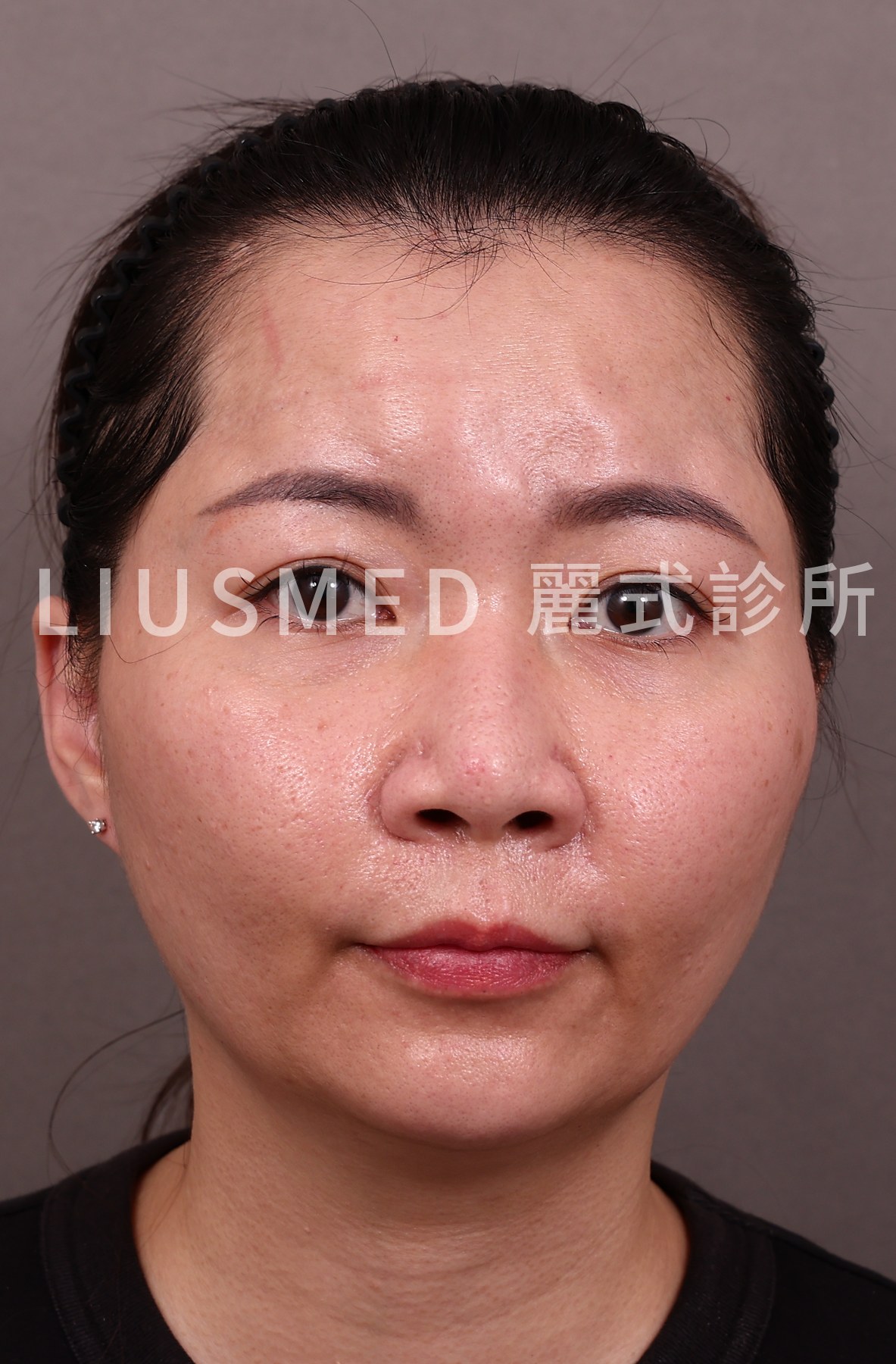
"Mine was the liquid kind, not the one with particles, so it should be safer, right?"
I hear this often. The trouble is that some of the people saying it had the particle kind. They are not misinformed so much as caught out by the vocabulary.
In Taiwan, the phrase "liquid PCL" currently sits on two different products. And once a lump appears and someone has to decide what to do about it, those two products do not follow the same path.
Separating the two: microsphere versus liquid
PCL (polycaprolactone) is a polyester that the body breaks down slowly. The polymer itself is not the issue. What matters is the form in which it was placed in your face.
Ellansé is the microsphere product. The approved Taiwanese insert states it plainly: the principal component is polycaprolactone microparticles suspended in a gel carrier. The spheres measure 25 to 50 microns, and that size is deliberate — large enough not to be taken up directly by macrophages, so the material stays and keeps stimulating collagen.
GOURI is the liquid one. It contains no microspheres at all. Each 1.0 mL prefilled syringe carries 210 mg of PCL, present as polymer chains below a tenth of a micron, two to three orders of magnitude smaller than an Ellansé sphere.
There is a reason for the confusion. Ellansé marketing often calls it a "liquid injectable", describing how it handles and flows during injection rather than claiming an absence of particles. Round-up articles then compressed that adjective into "liquid PCL", and two different products ended up sharing one label.
Key point: "Liquid" describes injection feel in the Ellansé context and the material itself in the GOURI context. The same word, pointing at different things.
While we are here: a widely copied composition error
Look up what is in Ellansé and you will quickly meet "70% CMC plus 30% PCL". That sentence is wrong in two places.
First, 30 to 70 is the volume ratio of microspheres to carrier gel, not a CMC concentration. Second, the carrier is not pure CMC. The approved Taiwanese insert specifies a gel carrier of phosphate buffer, glycerin and carboxymethylcellulose (CMC).
This is not pedantry. The carrier is resorbed within weeks, and it accounts for most of what you see in the mirror on day one; the microspheres are what remain and what determine everything that happens afterwards. Getting the carrier right is what lets you explain why someone looks deflated after the swelling settles and then feels a lump a year later.
GOURI sits in a different situation: its approved Taiwanese insert lists only PCL 210 mg and does not list a carrier at all. The literature describes it as dispersed in water, but sources disagree on whether it is genuinely a solution or a fine dispersion. That is the actual state of the public record, and I am not going to invent numbers to fill it.
The counterintuitive part: the approved sites are reversed
If you remember one thing, make it this.
← Swipe to see more →
| Ellansé (microsphere PCL) | GOURI (liquid PCL) | |
|---|---|---|
| Approved site in Taiwan | Nasolabial folds | Lateral canthal lines, short-term (e.g. 12 weeks) |
| Eye area | Insert explicitly warns against eyelids, under-eye, lateral canthal lines, glabella | Approved for the lateral canthal lines, though the insert still advises avoiding the orbital rim and central forehead |
| Long-term effect | Licence states safety and effectiveness beyond two years are not demonstrated | Insert states long-term safety and effectiveness are not yet established |
| Versions registered in Taiwan | S and M (the licence field lists only S; M is in the approved insert and the UDI registry) | Single presentation |
You read that correctly. One PCL product's insert lists the lateral canthal lines among the areas to avoid; the other PCL product's insert lists them as its only approved indication.
Something worth saying clearly here, because it is easy to twist: off-label use is lawful and commonplace across medicine, and it does not mean the injector did anything wrong. What it actually means is that in that particular area, the product has not completed official verification of safety and effectiveness. So if something develops in an area outside the approved range, there is less published material to draw on than you might expect. This is a question of being informed, not a question of blame.
"Lasts two to three years" depends on which version
Ellansé comes in S, M, L and E versions, with stated durations rising alongside the length of the PCL polymer chain — roughly one, two, three and four years.
Worth knowing: the versions actually trialled are S and M. S stayed ahead of hyaluronic acid at 12 months in a split-face study; M still showed improvement at 24 months in a randomised comparison. As for three years for L and four for E, the literature that offers those numbers states outright that they are extrapolated from the S and M data plus known PCL degradation behaviour. They were not measured.
The Taiwan licence (026659) enumerates only ELLANSÉ-S (1 ml and 0.5 ml) in its specification field, followed by one specification-addition entry whose contents are not itemised. That entry is where M lives: the Chinese labelling approved on 2023-06-13 carries a sealed ELLANSÉ-M (1 ml) label and insert, approved for the laugh lines, and the national UDI database registers two device identifiers under this same licence, one S and one M. The EU and Australian registries also list S and M. So "Taiwan only has S" is a misreading of one public field, while L and E genuinely are absent from every official layer. More to the point, the efficacy field on that same licence states, in Chinese, that the safety and effectiveness of this product in long-term use beyond two years have not been demonstrated. So even the version enumerated on the licence is underwritten only to two years.
GOURI's Taiwanese insert gives no duration at all. It is approved for short-term (e.g. 12 weeks) correction of the lateral canthal lines and states that long-term safety and effectiveness are not yet established. Both PCL products flag long-term safety as unestablished, in the wording of their own Taiwanese approval documents.
I am not writing this to rank one product above another. I am writing it because in clinic, "mine lasts three years" is often the yardstick a patient uses to decide whether a lump they can feel counts as normal. If that three-year figure was extrapolated to begin with, and the version you received is not registered here, then the yardstick needs recalibrating.
Working out which one you had, after a lump appears
If you still have the receipt, the sticker or the packaging, that is fastest. The approved Taiwanese names are 洢蓮絲植入劑 for Ellansé and 格奧潤植入劑 for GOURI, and both can be looked up in the TFDA medical device licence database.
Without records, there are still clues:
- The site treated. Reasoning only from the approved ranges, nasolabial folds lean towards Ellansé and lateral canthal lines towards GOURI. Because off-label use is common, treat this as a clue rather than a conclusion.
- The needle and the feel at the time. The Ellansé insert recommends a 27G needle; GOURI's recommends 30G.
- How it reads on ultrasound. This is the most reliable of the three. Spheres of 25 to 50 microns behave differently on high-resolution ultrasound from a material with no particles, and together with the capsule and the pattern of surrounding fibrosis this usually narrows things down.
I tend to weigh all three together. Any single clue can mislead; combined, they are usually enough to decide the next step. For how the lumps themselves sort by type and timing, delayed-onset nodules after Ellansé goes into more detail. If what you had was GOURI and the problem is under the eye, what to do when bruising after GOURI under the eye will not fade follows a different decision path.
Neither PCL dissolves: the order of operations
This is one of the few places where the two behave identically, and it is the most commonly misunderstood point.
Hyaluronidase does nothing to PCL. The enzyme cleaves the glycosidic bonds in hyaluronic acid; PCL is a polyester and the enzyme has no purchase on it. This has been shown directly in bench work: add hyaluronidase, a steroid or lidocaine to Ellansé and the material does not dissolve. So "let us try dissolving it first" is not a route that exists here, and whether any enzyme can dissolve Ellansé covers this in full.
So what does the sequence look like in practice?
- Establish what this actually is. Material accumulation, an overshoot of collagen growth, a delayed foreign-body reaction, or infection. The four call for different directions, and ultrasound is already doing work at this stage.
- Observe what can be observed. Early, small, asymptomatic papules will sometimes settle on their own.
- When intervention is needed, ask whether the material can be physically reduced. PCL has no antidote, which means taking the foreign material out often addresses the source better than repeatedly medicating the reaction around it. What I do is locate it under ultrasound guidance and remove the material, along with the excess tissue it provoked, through a 1 to 2 mm entry point.
- Watch the cost of steroids. They will quiet inflammation, but repeated injection carries a risk of local fat atrophy and depression, and the stimulating material is still sitting there.
As for whether something injected a while ago can still be removed, time itself is not the deciding variable; whether Ellansé can still be taken out sets out the four things that actually determine feasibility. To see how the various collagen stimulators rank on the question of what can be undone, there is the reversibility comparison, or you can start from the collagen stimulator complications hub. The material itself is covered on the Ellansé and PCL page.
Key point: What the two share is the absence of an enzymatic antidote, which makes identifying the material the first step of treatment rather than optional background. Whether you are carrying 25-micron spheres or sub-0.1-micron chains changes what to look for on ultrasound, and changes how removal is done.
Frequently asked questions
Is liquid PCL safer than the microsphere kind?
There is no comparative data supporting that claim. The two have never been compared head to head in a single trial, and the liquid form is recent: its human studies cover only the lateral canthal lines, with follow-up mostly between 12 weeks and six months. Microsphere nodules often surface after nine months. Using a shorter-followed product's "we did not see it" to conclude it is safer does not hold up on the timeline.
There is also this: GOURI's own approved Taiwanese insert lists lumps, nodules and induration among its expected adverse effects. So "no particles means no nodules" sits at odds with the product's own official documentation.
I had it in my crow's feet but the clinic said it was Ellansé. Is that a problem?
Not in itself. Off-label use is lawful and common, and clinicians select material and site on clinical judgement. What you should know is that in that area the product has not completed official verification, so if something develops later there is less published material to draw on. Treat it as information about what to watch for, rather than as an accusation about who did what wrong.
Are lumps from the two equally difficult to remove?
Not quite. The microsphere product has a defined particulate that is relatively easy to localise on ultrasound, and removal deals with the spheres plus the tissue they provoked. The liquid form, having no particles, relies more on changes in the surrounding tissue and the appearance of the capsule. In practice what usually decides difficulty is not the form of the material but the depth, the thickness of the capsule, the relationship to nerves and vessels, and whether the area has been repeatedly injected with steroids.
It is already injected. What should I do now?
If you have no symptoms, nothing. If you can feel a lump, or you get recurrent swelling, an ultrasound assessment to establish what it is and which layer it sits in is the sensible first step. Judging an individual case requires seeing the imaging and the history, which can be discussed through an online assessment or a consultation.
A closing thought
This article really comes down to one sentence: the same three letters on the box do not guarantee the same object.
In revision work, the time goes less into the removal itself than into establishing what was injected in the first place. Misidentifying the material sends the whole plan off course from step one. And at the level of information, what reaches patients has usually been flattened once already by marketing language. "Liquid PCL" pointing at two different products is a textbook example.
If a lump is troubling you, do not rush the decision about treating it. Work out which one you had first.
Dr. Ta-Ju Liu Filler Revision — filler complication repair, ultrasound-guided single-pinhole extraction