Three Rounds of Dissolving Enzymes and the Lump Is Still There
"I have had five rounds of hyaluronidase and the lump has not changed at all — is something wrong with my body?" At FILLER REVISION, we hear this question almost daily. Patients arrive exhausted and confused, having been told to "just try one more round" each time. The answer is almost never that something is wrong with their body. The answer is that hyaluronidase has specific limitations that their previous practitioners did not identify.
Many of the patients who come to FILLER REVISION for help have already attempted at least one round of hyaluronidase elsewhere without improvement. This article provides a complete analysis of the seven most common reasons hyaluronidase fails — and explains what FILLER REVISION does when dissolving is not the answer.
Reason 1: The Material Is Not Hyaluronic Acid
This is the most fundamental and most frequently overlooked cause. Hyaluronidase has a highly specific mechanism—it can only cleave the particular chemical bonds within hyaluronic acid molecules. If the injected material is not HA (Hyaluronic Acid), the dissolving enzyme will have absolutely no effect.
Common misidentification scenarios include:
← Swipe to see more →
| Actual Material | Patient's Belief | Hyaluronidase Effect |
|---|---|---|
| Calcium hydroxylapatite (Radiesse) | "I think it was HA" | Completely ineffective |
| Poly-L-lactic acid (Sculptra) | "I am not sure" | Completely ineffective |
| Polycaprolactone (Ellanse) | "The clinic said it could be dissolved" | Completely ineffective |
| Silicone / unregulated injectables | "It was done years ago" | Completely ineffective |
| HA (already encapsulated) | "It is definitely HA" | Extremely limited effect |
Key Insight: At FILLER REVISION, we see this scenario constantly: patients who do not know the exact material that was injected, especially when treatments were performed years ago at different clinics. Without clear material documentation, using hyaluronidase is essentially blind treatment. This is why our protocol always begins with high-resolution ultrasound to confirm material identity before any treatment decision.
Reason 2: Encapsulation Has Created a Physical Barrier
Even when the material is confirmed as hyaluronic acid, if the body has formed a dense fibrous capsule around the filler (encapsulation), hyaluronidase cannot penetrate this biological wall to reach the HA molecules inside.
This is analogous to trying to dissolve sugar inside a sealed glass jar by pouring water over the outside. No matter how much water you pour, the sugar inside remains untouched. For a detailed explanation of the encapsulation mechanism, see our article: Encapsulation: Why Dissolvers Fail.
High-risk factors for encapsulation include:
- More than one year since injection
- History of repeated inflammation
- Use of permanent or semi-permanent fillers
- Excessive injection volume or concentration
Reason 3: Insufficient Dosage or Imprecise Injection Location
The effectiveness of hyaluronidase is highly dependent on two factors: adequate dosage and precise injection placement. Common failure patterns in clinical practice involve overly conservative dosing or injection into the wrong tissue plane.
The Dosage Dilemma
Many practitioners tend to be conservative with hyaluronidase dosing, concerned that excessive amounts may over-dissolve native hyaluronic acid in surrounding healthy tissue. This concern is valid, but the result is often a dose too small to produce meaningful results.
Positional Errors
A more common problem is that without imaging guidance, practitioners rely on experience or palpation to estimate the filler's location and depth. However, filler may have already migrated from its original injection site. When hyaluronidase is injected into the wrong tissue layer, it simply cannot contact the filler material.
Key Insight: Hyaluronidase injection without ultrasound guidance is fundamentally a blind procedure—the practitioner cannot confirm whether the needle has actually reached the filler location. This is precisely why we insist that all filler treatments must be performed under real-time ultrasound monitoring.
Reason 4: Biofilm Has Formed on the Filler
Biofilm is a thin, colony-forming bacterial layer that establishes itself on the filler surface. Once biofilm is present, it not only protects bacteria from antibiotic attack but also alters the local tissue environment around the filler, leading to chronic inflammation and tissue overgrowth.
When biofilm is present, even if hyaluronidase can dissolve a portion of the HA, the problem cannot be fundamentally resolved—because the lump is caused not only by the filler itself but also by the surrounding inflammatory tissue and bacterial colonies. For more information on biofilm, see: Biofilm and Recurrent Filler Swelling.
The FILLER REVISION Approach: When Dissolving Has Reached Its Limits
At FILLER REVISION, we do not view hyaluronidase failure as a dead end — we view it as a diagnostic signal. When dissolving fails, the reason is almost always identifiable: wrong material, encapsulation, biofilm, or a combination. Our ultrasound evaluation reveals which of these factors applies, transforming a frustrating mystery into a clear treatment plan. For encapsulated lumps, we perform ultrasound-guided pinhole extraction, physically removing the material and its capsule. For biofilm cases, we combine extraction with targeted antibiotics. For mixed materials, we identify each component and develop a material-specific strategy. Many of our patients arrive after failed dissolution — and for them, switching from chemical to physical removal under imaging guidance is often the turning point, with the aim of as much improvement as can be achieved safely.
Reason 5: Mixed Material Injections
Some patients have received multiple injections of different materials in the same area over time. For example, HA may have been injected first, followed by calcium hydroxylapatite or a collagen stimulator. In these cases, hyaluronidase can only dissolve the HA component, while the non-HA portions remain and maintain the lump's shape.
← Swipe to see more →
| Mixed Scenario | What Hyaluronidase Can Address | Remaining Problem |
|---|---|---|
| HA + Radiesse | HA only | CaHA (Calcium Hydroxyapatite) residue persists |
| HA + Sculptra | HA only | PLLA (Poly-L-Lactic Acid) nodules persist |
| HA + Ellanse | HA only | PCL (Polycaprolactone) residue persists |
| Multiple HA brands | Partially effective | Highly cross-linked HA may resist |
Reason 6: Excessively High Cross-Linking Density
Different brands of HA fillers have varying degrees of cross-linking. Higher cross-linking density means greater molecular stability and greater resistance to enzymatic breakdown. Certain highly cross-linked fillers—especially those designed for deep tissue injection—demonstrate significantly stronger resistance to hyaluronidase.
Additionally, over time, interactions between the filler and surrounding tissue can further stabilize the filler structure, reducing the enzyme's effectiveness even further.
Reason 7: Tissue Fibrosis and Scar Formation
Repeated hyaluronidase injections can themselves trigger local tissue inflammation and fibrosis. Each injection constitutes tissue trauma, and the body responds with a repair response—generating more fibrous tissue. This creates a vicious cycle:
- Hyaluronidase injection fails to fully dissolve the filler
- The injection process causes local inflammation
- The body generates reparative fibrous tissue
- Fibrous tissue further encases the remaining filler
- The next hyaluronidase attempt is even less likely to penetrate
For more on the cumulative damage from repeated dissolving enzyme injections, see: Cumulative Damage from Repeated Hyaluronidase Injections.
Can Radiesse, Sculptra, or Ellanse Be Dissolved With Hyaluronidase?
No — and this is the single most common reason patients are told "the filler won't dissolve." Hyaluronidase (sold under names such as Hylenex or hyalase) only breaks down hyaluronic acid. Radiesse cannot be dissolved by hyaluronidase because it is calcium hydroxylapatite; Sculptra (poly-L-lactic acid) and Ellanse (polycaprolactone) are equally unaffected. No number of enzyme rounds changes this — the dissolving enzyme simply has nothing to act on.
If your filler will not dissolve and the material may be a collagen stimulator, the question is not "more enzyme" but physical removal under imaging:
- Ellanse and Radiesse removal — what is actually possible
- Can Ellanse be removed?
- Radiesse complications and calcium deposits
Confirming the exact material on ultrasound before any further injection is the step that ends the cycle of failed dissolving.
Is Hyaluronidase Itself Safe? Allergy, Skin Tests, and Your Own Hyaluronic Acid
Hyaluronidase is a well-established drug that most people tolerate, but it is not risk-free: its two real hazards are an allergic reaction to the enzyme and the fact that it dissolves your own tissue hyaluronic acid along with the filler. Both are separate from the question this article is mostly about, which is whether the enzyme will work on the lump at all. A patient searching "hyaluronidase gone wrong" is usually asking about one of these two.
Allergic reactions: uncommon, mostly local, and only partly predictable
Allergic reactions to hyaluronidase are a recognized side effect. Jung (2020, PMID 32718106) summarized the drug's properties and side effects and described most reactions as local (redness, swelling, itching at the injection site), with systemic reactions occurring only infrequently; because most are immediate-type hypersensitivity, a skin test before use is recommended, but delayed reactions also happen and a skin test may not predict them. Murray and colleagues (2021, PMID 34840662), writing a safety guideline for hyaluronidase in aesthetic medicine, single out a history of allergy to bee or wasp stings as something that raises the risk of allergy to the enzyme, which is why that question belongs in every pre-injection history. Rzany (2009, PMID 19958438) reviewed the evidence and concluded that the treatment appears safe, with the caveat that allergic reactions have been reported and patients should be told about them before treatment.
How often does it happen? Rarely enough that the published record is thin. In a 2021 systematic review of hypersensitivity after cosmetic injections, Wang and colleagues (PMID 32206863) found 57 published patients across 14 articles, and by the authors' listing only one appears attributable to hyaluronidase; the large majority were reactions to hyaluronic acid filler itself. So the enzyme accounts for a small share of the allergy risk in the filler story. The risk is real, though, and each additional round is another exposure.
It dissolves your hyaluronic acid too
Hyaluronidase cannot tell filler apart from the hyaluronic acid your skin makes. It is a hydrolytic enzyme that cleaves the glycosidic bonds in any hyaluronic acid it reaches, whether that is a cross-linked gel or the native HA that keeps your dermis hydrated and plump. Jung (2020, PMID 32718106) also notes that the enzyme is rapidly degraded and deactivated in the body, which is why a sufficient dose has to be placed close to the filler: enzyme that diffuses into the surrounding skin instead is spent on your own tissue. That is the mechanism behind the thinning and hollowing some patients notice after several rounds, and we cover it in depth in Cumulative Damage from Repeated Hyaluronidase Injections.
This is also why the "just try one more round" advice deserves pushback. If ultrasound has already shown that the lump is not hyaluronic acid, or that it is walled off in a capsule the enzyme cannot enter, another round exposes you to the allergy risk and the native-HA loss with no realistic chance of benefit.
Radiesse vs. Sculptra vs. Ellanse vs. HA: Where Each Stands on Reversibility
The four materials differ mainly in whether they can be chemically reversed at all: hyaluronic acid can, and Radiesse, Sculptra, and Ellanse cannot. Everything else about managing a lump that will not go away follows from that one fact.
← Swipe to see more →
| Material | What it is and how it works | Longevity (varies by product, site, and person) | Can it be dissolved? | When a lump will not go away |
|---|---|---|---|---|
| Hyaluronic acid (HA) fillers | A cross-linked sugar gel that adds volume directly | Months to years, often longer than patients were told | Yes, with hyaluronidase, unless encapsulation, biofilm, or high cross-linking blocks it | Ultrasound to confirm why the enzyme failed, then targeted enzyme or physical extraction |
| Radiesse (calcium hydroxylapatite, CaHA) | Calcium microspheres in a gel carrier; the gel absorbs, the particles stimulate collagen | Longer than most HA; particles persist while collagen forms | No. Hyaluronidase has no target | Ultrasound-guided physical extraction of the particle deposit and its capsule |
| Sculptra (poly-L-lactic acid, PLLA) | Polymer microparticles that trigger collagen growth over months | Long-lasting; the effect is your own collagen | No | Physical extraction of nodules; some clinics try steroid injections instead, with inconsistent results (see Sculptra lumps and steroid failure) |
| Ellanse (polycaprolactone, PCL) | Polymer microspheres in a carboxymethylcellulose carrier; collagen stimulation | Long-lasting by design, in several duration grades | No | Ultrasound-guided extraction (see Can Ellanse be removed?) |
How Common Are Filler Nodules, and Why Does the Number Matter Here?
Nodules after calcium hydroxylapatite (Radiesse) are uncommon in the published record: a 2017 review by Kadouch (PMID 28247924) pooled 21 studies covering 5,081 CaHA treatments in 2,779 patients and found adverse events in about 3% of treatments, with nodules making up 96% of those events. The same review notes that most CaHA nodules are not visible and settle without intervention, and that about half of the reported nodules occurred in the mobile areas of the face already known to be prone to them.
So why does a clinic that removes filler talk about a low number? Because it changes what the number means for you. If you are one of the roughly 3 in 100 and your lump has not settled, you are already outside the group the reassuring statistics describe, and the useful question becomes what the lump is made of. For a CaHA nodule the answer to "will hyaluronidase help" is no at any dose, because the enzyme has nothing to act on. The incidence figure tells you the lump is unusual; ultrasound tells you what to do about it. For the calcium-specific picture, see Radiesse complications and calcium deposits.
Real case → 36-hour delayed vascular rescue via ultrasound-guided IAHA — two days of extravascular hyaluronidase at the original clinic failed; only intra-arterial hyaluronidase under real-time ultrasound salvaged the penumbra.
Ultrasound (Ultrasonography)-Guided Minimally Invasive Extraction: See It to Solve It
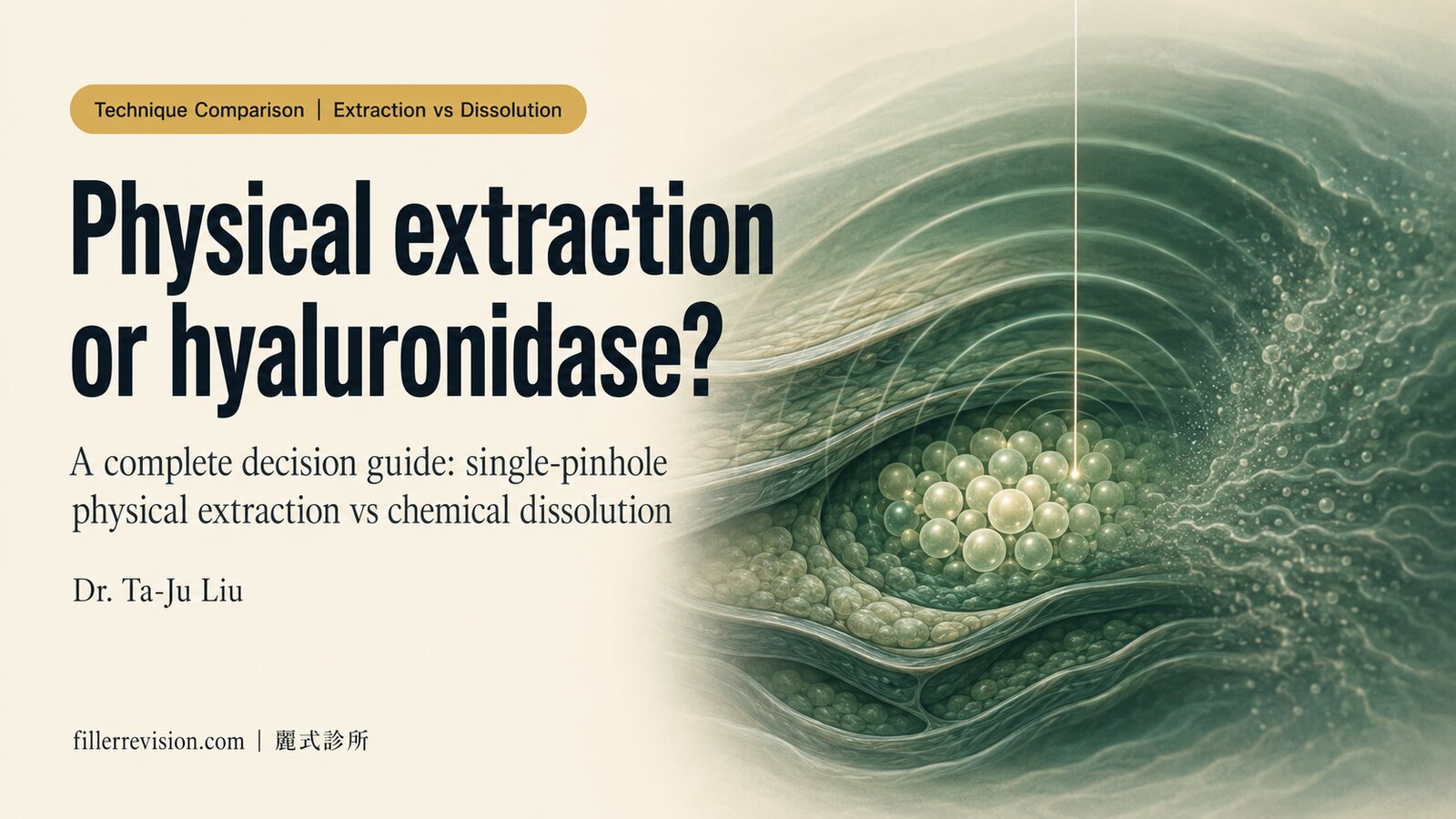
When hyaluronidase treatment fails repeatedly, continuing to inject blindly is not only ineffective but may cause further harm. Our Ultrasound-Guided Pinhole Extraction technique offers a fundamentally different treatment approach:
Treatment Process
- High-resolution ultrasound scanning: Precisely identifies the filler's material type, location, depth, extent, and relationship to surrounding structures
- Real-time image guidance: Under continuous ultrasound monitoring, a single pinhole entry is made at the exact location
- Physical extraction: Directly removes the filler material and capsule tissue rather than relying on chemical dissolution
- Post-procedure confirmation: Ultrasound verification of clearance completeness
The "See Before You Treat" Philosophy
The fundamental problem with traditional hyaluronidase injection is that it is performed blind—the practitioner cannot confirm the material, cannot locate the filler precisely, and cannot assess the degree of encapsulation. Ultrasound completely changes this equation, ensuring every step of the procedure is performed under visual confirmation.
Key Insight: Hyaluronidase failure does not mean the problem is unsolvable. It means a different treatment strategy is needed. Shifting from chemical dissolution to physical extraction, from blind injection to image-guided treatment—this is the correct approach for managing resistant filler complications.
Is There Anything Conservative or At-Home You Can Try Before Extraction?
There is no at-home method that makes filler dissolve faster or shrinks a lump that has already resisted hyaluronidase; the one legitimate conservative option is watchful waiting, and it only applies to certain lumps, which is a decision to make on ultrasound rather than by feel.
Lumps that can reasonably be watched: soft, early fullness in the first days to weeks after an injection, when product and swelling are still settling; and small, non-inflamed calcium hydroxylapatite deposits that are felt but not seen, since Kadouch's review (2017, PMID 28247924) found that most CaHA nodules resolve without any intervention. Even here, "watch" means a follow-up plan and a scan, so the next decision is based on what the lump actually is.
Lumps that should not be waited on: anything firm with a distinct border, anything present for more than a year, anything that has swollen or reddened more than once, and any lump where you cannot say what material was injected. These are the same red flags listed in the next section, and each one lowers the odds that time or enzyme will fix it.
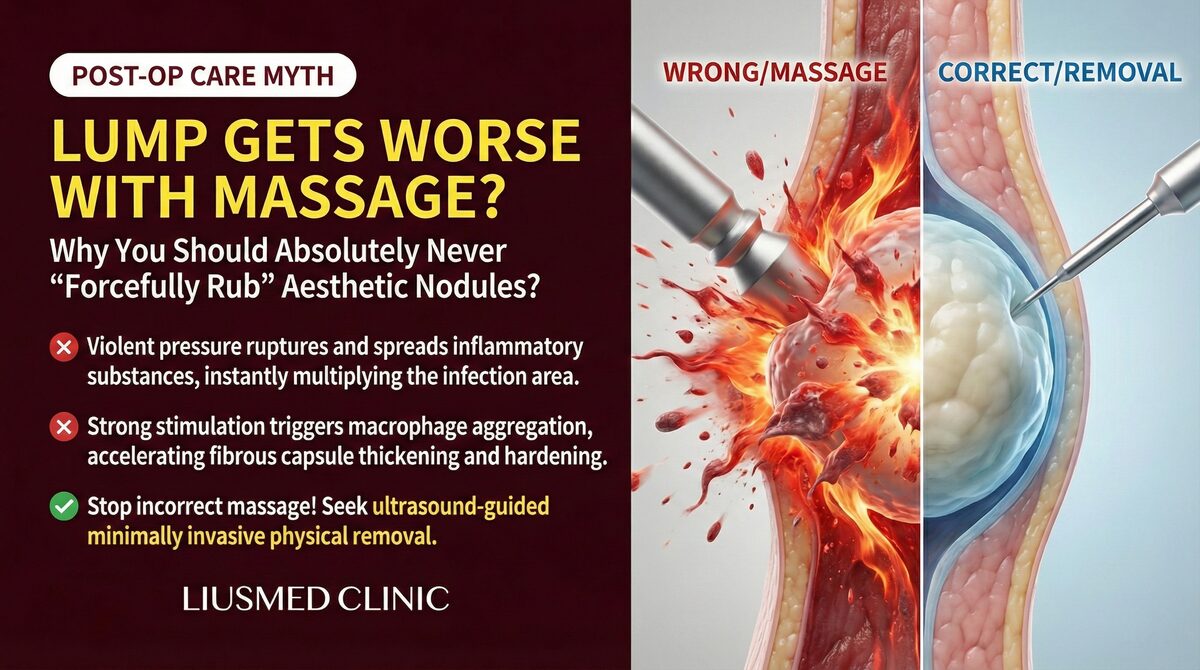
What not to do at home: kneading, pressing, or applying heat to a firm nodule. A capsule does not open under finger pressure. What we see instead is irritation around the lump, and irritation feeds the fibrosis cycle described in Reason 7. Creams, oral supplements, and massage devices do not reach filler sitting in the deep dermis or fat, whatever the packaging promises. If a lump is bothering you enough to work on it every day, it is bothering you enough to get scanned.
When Should You Stop Trying Hyaluronidase and Pursue Extraction?
If any of the following conditions apply, it is advisable to stop further hyaluronidase attempts and seek an ultrasound evaluation as soon as possible:
- Two or more rounds of hyaluronidase with no significant improvement
- Uncertainty about the injected material
- More than two years since the filler injection
- The lump feels firm or has distinct borders on palpation
- Recurrent episodes of swelling or inflammation
- History of infection at the injection site
If you are facing repeated hyaluronidase failure, we recommend starting with a comprehensive ultrasound evaluation to identify the root cause before deciding on next steps.
Schedule a consultation and let us help you find a real solution.
Conclusion
If you have already been through multiple rounds of hyaluronidase without improvement, FILLER REVISION specializes in exactly these cases. Our ultrasound evaluation identifies why dissolving failed — and our extraction-based approach addresses the root cause that hyaluronidase cannot reach.
Once dissolving has repeatedly failed, the next question is what actually removes the material — not what only images or heats it. See single-pinhole extraction vs ultrasound for why imaging and energy devices leave resistant filler behind while physical extraction does not.
Stop trying the same approach expecting different results. Book a consultation →
Frequently Asked Questions
Can Radiesse, Sculptra, or Ellanse be dissolved with hyaluronidase?
No. Hyaluronidase only breaks down hyaluronic acid, so it has no effect on Radiesse (calcium hydroxylapatite), Sculptra (poly-L-lactic acid), or Ellanse (polycaprolactone). No number of enzyme rounds changes this, because the dissolving enzyme has nothing to act on. If the material may be one of these collagen stimulators, the next step is confirming the exact material on ultrasound and considering physical removal under imaging rather than more enzyme.
I have had several rounds of hyaluronidase and the lump is unchanged — is something wrong with my body?
Almost never. The answer is usually not that something is wrong with your body, but that hyaluronidase has specific limitations the previous practitioner did not identify — such as the material not being hyaluronic acid, encapsulation, biofilm, or a combination. Confirming which factor applies through ultrasound turns a frustrating mystery into a clear treatment plan. Many patients who come to us have already failed at least one round of hyaluronidase elsewhere, so this situation is common rather than unusual.
When should I stop trying hyaluronidase and consider physical extraction instead?
Consider stopping and seeking an ultrasound evaluation if any of these apply: two or more rounds of hyaluronidase with no significant improvement, uncertainty about the injected material, more than two years since the injection, a lump that feels firm or has distinct borders, recurrent swelling or inflammation, or a history of infection at the site. Continuing to inject blindly when it is not working is not only ineffective but may cause further harm. A comprehensive ultrasound evaluation is the recommended first step to identify the root cause before deciding what to do next.
Why might hyaluronidase fail even when the filler really is hyaluronic acid?
Even when the material is confirmed as hyaluronic acid, several barriers can block the enzyme. The body may have formed a dense fibrous capsule around the filler, so the enzyme cannot reach the HA inside — like pouring water over a sealed jar to dissolve the sugar within. Highly cross-linked HA resists enzymatic breakdown, biofilm can keep the lump going through inflammation, and an injection placed in the wrong tissue layer simply never contacts the filler. This is why identifying the specific reason on ultrasound matters before deciding on treatment.
Can repeated hyaluronidase injections make the lump worse or harder to treat?
Yes, it can. Repeated hyaluronidase injections can themselves trigger local inflammation and fibrosis, because each injection is a form of tissue trauma that the body answers with a repair response, generating more fibrous tissue. This sets up a vicious cycle: the dissolving fails, inflammation follows, fibrous tissue encases the remaining filler, and the next attempt penetrates even less. That is why, once dissolving has failed repeatedly, switching to an ultrasound evaluation rather than another round is the safer path.
Is hyaluronidase itself safe to keep injecting?
It is tolerated by most people, but each round carries two costs that have nothing to do with whether the lump shrinks. The first is allergy: reactions are uncommon and mostly local, yet systemic reactions have been reported, a history of bee or wasp sting allergy raises the risk, and a skin test does not catch every delayed reaction (Jung 2020, PMID 32718106; Murray 2021, PMID 34840662). The second is your own hyaluronic acid: the enzyme breaks down native HA in the skin as readily as filler, which is why repeated rounds can leave the area thinner and more hollow. Once ultrasound shows the lump is not HA, or is encapsulated, another round adds these costs with no realistic benefit.
How common are nodules after Radiesse, and does that change whether hyaluronidase will work?
Uncommon, and no, it does not change the answer. A 2017 review of 5,081 calcium hydroxylapatite treatments found adverse events in about 3% of treatments, almost all of them nodules, and most of those settled on their own (Kadouch 2017, PMID 28247924). If yours has not settled, hyaluronidase still will not help, because calcium hydroxylapatite is not hyaluronic acid and the enzyme has nothing to act on. The low incidence tells you the lump is unusual; it does not make the material dissolvable.
Can I massage, heat, or treat a failed-dissolution lump at home?
No, and pressing on it can make things worse. A firm, encapsulated nodule does not open under finger pressure or heat; what usually follows is irritation around it, which feeds the fibrosis cycle described in Reason 7. Creams and oral supplements do not reach filler in the deep dermis or fat. The only conservative option that holds up is watchful waiting for soft, early lumps or small non-inflamed calcium deposits, and that should be decided on ultrasound, not by feel.