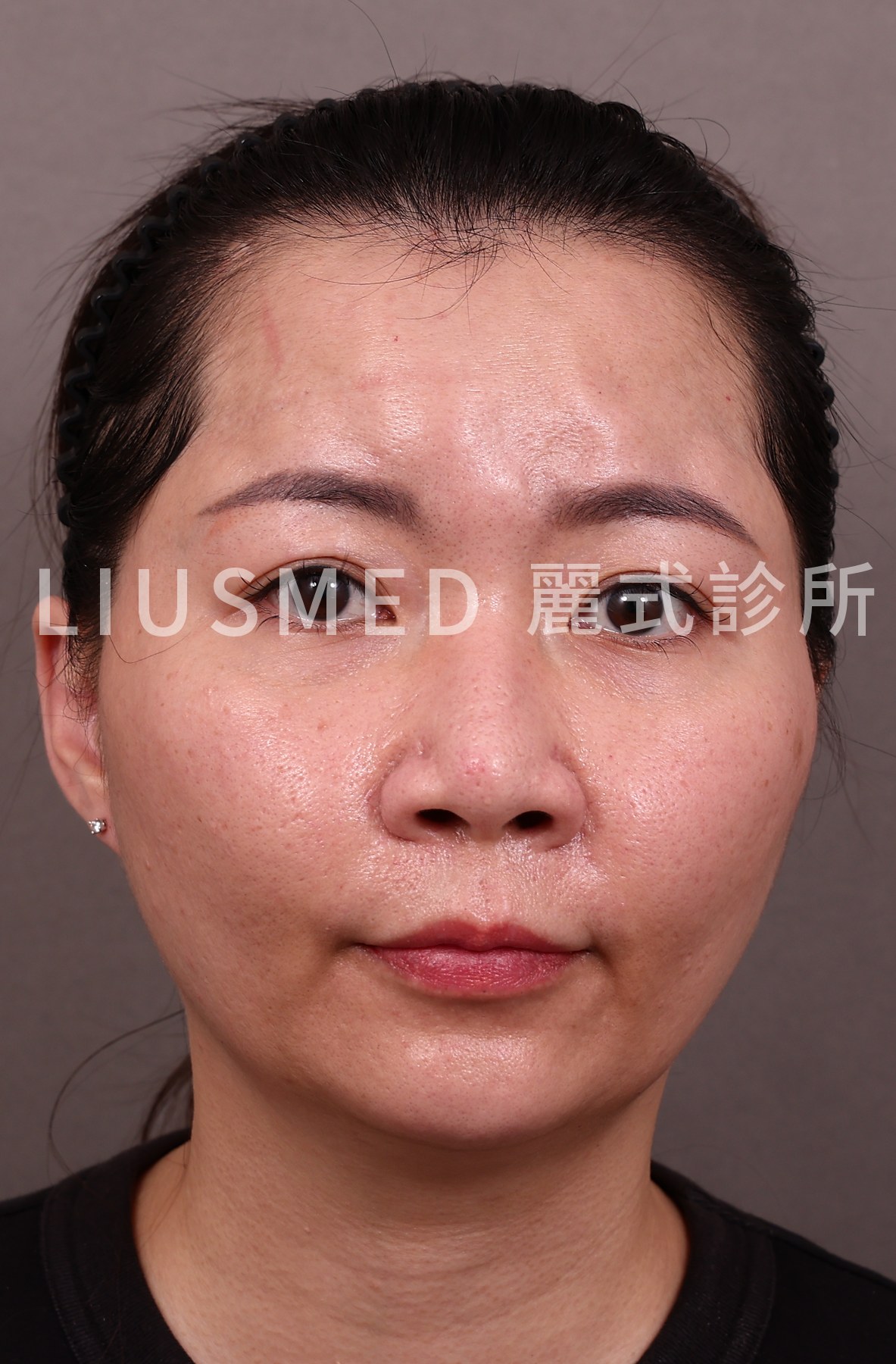
"I had one of the collagen injectables, my cheek feels lumpy, and dissolving it didn't fully clear it." I hear a version of this almost every week. The hard part is often not the lump itself. It is that we haven't yet pinned down which material caused it.
First, work out which "collagen needle" you actually had
The names in this category are a mess, especially once they cross languages. Several different materials share similar marketing nicknames, and whether your lump can be dissolved depends entirely on which one is under your skin. So step one is translating the name back into an ingredient.
← Swipe to see more →
| Marketing name | Actual product | Main ingredient | Does hyaluronidase work? |
|---|---|---|---|
| Sculptra, "collagen needle" | Sculptra | PLLA (poly-L-lactic acid) | No |
| Juvelook, "new collagen needle" | Juvelook (volumizing version = Lenisna) | PDLLA + hyaluronic acid composite | Only on the HA half |
| AestheFill, "elf needle" | AestheFill | PDLLA powder (no HA) | No |
| Ellansé, "girl needle" | Ellansé | PCL (polycaprolactone) | No |
Notice the pattern. The only one of these where hyaluronidase does anything at all is Juvelook, and even then only partway. The rest are all materials that stimulate your own collagen; there is no HA for the enzyme to act on. So when someone tells you "just dissolve it," the honest first question is whether they confirmed what you were injected with.
This article is about Juvelook specifically. It is a Korean composite (made by VAIM) that suspends PDLLA (poly-D,L-lactic acid) microspheres in non-cross-linked hyaluronic acid (HA). The small-particle base version is marketed for skin quality and often placed superficially, "skin-booster" style; the larger-particle, higher-concentration version is sold as Lenisna in Japan for volume. AestheFill is also PDLLA, but it is a pure powder with no HA, and its lumps behave differently, which I cover in the AestheFill nodule treatment ladder.
Why hyaluronidase only dissolves half: Juvelook is only half-reversible
This is the part that most people misunderstand, and it is the whole point of the article.
Pure hyaluronic acid is reversible. Hyaluronidase (an enzyme that breaks down HA) can dissolve it. But Juvelook is not pure HA. It is a composite. When hyaluronidase goes in, the only thing it can take apart is the HA that acts as the carrier. The part that actually becomes a lasting lump, the PDLLA microspheres and the collagen your body builds around them, is untouched.
Key point: Juvelook is half-reversible. Dissolve the HA half and the lump shrinks a little, so it looks like it worked. Then the PDLLA keeps stimulating collagen and the firmness often comes back. That is not an under-dose of enzyme. It is the enzyme working on the wrong target.
This logic isn't unique to Juvelook. HArmonyCa is also a composite, half HA and half insoluble CaHA microspheres, and it behaves the same way: you think it will dissolve, and it only half does. I go into that in managing HArmonyCa nodules. The shared lesson is simple. With any composite, "it contains HA" does not mean "the whole thing dissolves."
← Swipe to see more →
| Pure HA lump | Juvelook (PDLLA + HA) lump | |
|---|---|---|
| What it is | HA gel | PDLLA microspheres + your own collagen (HA is just the carrier) |
| Response to hyaluronidase | Dissolves | Only the HA half goes; particles and collagen stay |
| Typical history | Dissolve and it's gone | Shrinks, then returns weeks later |
| Main treatment path | Hyaluronidase | Triage by nodule type; ultrasound-guided physical extraction for the stubborn ones |
When lumps appear: a timeline
When a lump showed up is a real clue to what it is, because Juvelook nodules are not all the same thing.
- First few days: usually injection swelling and bruising. It settles on its own and is not a nodule.
- Around three weeks: the literature has documented firm, painless nodules appearing about three weeks after PDLLA in the tear trough (the Seo 2025 case was Juvelook specifically). These non-inflammatory lumps are usually tied to uneven distribution, too-superficial placement, or over-concentration.
- Three months to several years: this leans toward delayed hypersensitivity. The classic story is a spot that was fine, then suddenly turns red and angry.
- Six months to two years: the classic window for a true granuloma (a chronic immune reaction that walls off foreign material into a firm nodule). But do not treat that as a safe period. A granuloma has been reported as early as four months.
In other words, a lump that shows up more than a year after your injection can absolutely be related to it. More time passing does not mean you are in the clear.
The "skin-booster" superficial technique is itself a risk
Juvelook is heavily marketed as a "water-light" skin treatment, placed in fine droplets over a wide area in the superficial dermis. The very thing that sells it, broad coverage and skin-quality improvement, is also what makes it prone to nodules.
These materials were designed to sit at a certain depth, adequately diluted. Placed too shallow and too dense, the particles stay in the superficial dermis, and your body wraps collagen and fibrous tissue around each droplet. The result is not one big lump but a whole field of palpable grittiness. Why these "booster-style" nodules resist dissolving and what they look like on ultrasound is covered in detail in when collagen stimulators are used as skin boosters. Juvelook simply adds the HA layer on top, which makes the "it only dissolved halfway" confusion more obvious.
Five kinds of nodule, five directions
There is no single move for a lump. In practice, treating PDLLA nodules starts by working out which type you have, because the direction changes completely. The published guidance (Magacho-Vieira 2025) lays this out as a diagnostic flowchart.
- Temporary swelling or injection-point bumps: the puffiness, bruising, and slightly raised spots in the first few days. These recede on their own and are not true nodules; usually they just need observation, not treatment.
- Material clumping or too-shallow non-inflammatory nodule: not red, not painful, just firm. Start with massage and needle subcision under ultrasound guidance; for an early, simple, low-volume one, heating with an energy device can also improve the appearance (PDLLA is structurally softer than PLLA and responds reasonably to radiofrequency). This type does not need antibiotics or steroid.
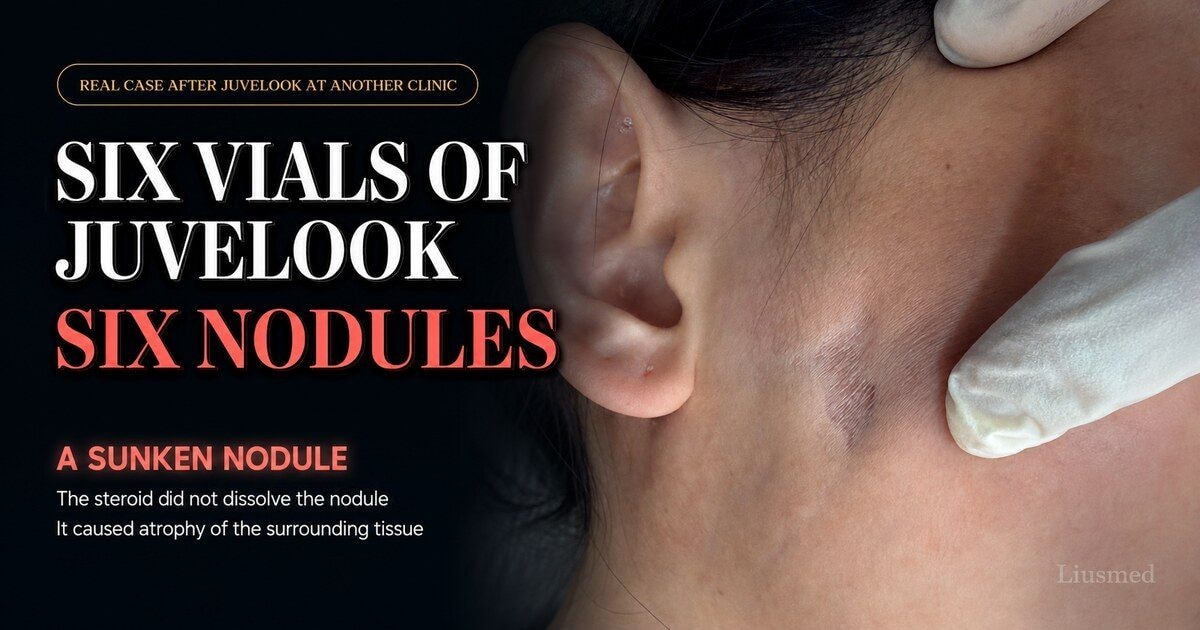
- Delayed inflammatory (hypersensitivity) nodule: a spot that was fine, then turns into a recurring "angry" red bump. This is where intralesional steroid (triamcinolone, an anti-inflammatory injected into the lesion) has a role. But steroid has a cost: injected into the same spot, it thins and atrophies the surrounding tissue and lowers its capacity to heal, which makes any later removal harder and riskier — so not every lump should get steroid first, which I cover in the tissue-atrophy risks of steroid injection. That page also carries a case video of one patient with six nodules, only one of which was injected with a steroid.
- Infection or biofilm-related: red, swollen, warm, tender, often within days to weeks. This is antibiotic-first, with drainage if needed; add antibiotics if biofilm (a bacterial film on the filler surface) is suspected. This is not a steroid situation.
- Histologically confirmed foreign-body granuloma: a chronic firm nodule the immune system walls off around the material, confirmed by the clinical timeline, imaging, and biopsy when needed. The literature includes a granuloma that responded better to steroid than to collagenase; the genuinely stubborn, disfiguring, medication-unresponsive ones are when removing the foreign material directly becomes reasonable.
One thing to be clear about: the reason hyaluronidase only half-works on Juvelook is that it acts on HA and nothing else; it has no target on the PDLLA particles or the collagen. By the same logic, this clinic does not offer collagenase as an injectable service; we only note it at the level of the literature. For particles-plus-fibrosis that are already established, my approach is to see the position clearly on ultrasound and then use the single-pinhole physical extraction that our filler revision clinic has developed over the years, rather than repeatedly injecting to suppress symptoms.
Why it keeps coming back even though you keep treating it: settling down is not the same as being gone
This is the question I get asked most often in clinic, and the one that gets answered least directly: "I keep treating it, so why does it keep coming back?" The answer lives in a distinction that rarely gets spelled out. A lump settling down and a lump being gone are two different things.
Let me be clear about where my vantage point comes from, so you know how to weigh what follows. Almost every lump that reaches me has already been treated — heat, massage, saline flushing, steroid, 5-FU, and some have already been operated on, the skin lifted and the area cleaned out directly. Even opening it up does not guarantee it comes out clean. What I see is what was still there after all of that. And there is a bias I have to state plainly: the people whose treatment worked never turn up in my clinic, so my denominator is skewed towards the ones that did not resolve. That does not mean those methods are useless. It means that when they fail, the reason is usually the same one — what got treated was the appearance, not the material.
Many of the treatments aimed at a lump — injecting saline to spread the particles apart, heating it with energy devices like radiofrequency or ultrasound, taking anti-inflammatory or immune-suppressing medication — can make it look flatter and feel softer in the short term. The swelling recedes, the fluid spreads it out, the inflammation is pushed down, and the photo genuinely looks better. But those change how it looks, not whether the material itself is still there. Days to weeks later, the saline is absorbed and the medication wears off, and the original lump often drifts back up. That is not a relapse. It never actually left.
Heat deserves a more precise word, because it is the most misunderstood. PDLLA is structurally softer than PLLA, and for an early, simple, low-volume non-inflammatory nodule, heating with an energy device plus massage genuinely can improve the appearance — the literature includes a non-inflammatory tear-trough nodule that visibly settled within a day on monopolar radiofrequency (Seo 2025). But the same heat, faced with a consolidated mass already walled in collagen, changes the surrounding inflammation and the surface, not which plane the mass is sitting in. So the question is never "does heat work," it is whether you are measuring the appearance or whether the thing itself is still there.
And this road is not unique to Juvelook. Different collagen stimulators follow the same pattern. Someone who had Ellansé (PCL) years ago got a nodule, tried saline and a large-bore needle, and it would not budge, so they ended up living with it. Someone who had a collagen-type stimulator had recurring swelling for over a year, went through antibiotics, steroid, and anti-swelling injections, and it still never truly cleared. Someone else flew back to the country where the injection was done, again and again, for several consecutive days of heating each time, and came home with the problem still there. Different products, similar roads, similar endings. As long as the physical material stays where it is, any treatment that does not remove it buys you a temporarily better-looking result.
So "has been treated" and "has been resolved" are two different things. Has been treated means a lot of sessions have happened. Has been resolved means the thing causing the problem is actually reduced. The number of sessions and the amount of lump actually removed have never been the same number: I have seen people treated five or six times whose lump measures much the same as it did at the start, and people on strong anti-inflammatories or even immune-suppressing medication whose inflammation and swelling genuinely came down while the palpable mass stayed exactly where it was. Medication can control inflammation. It cannot make a solid mass of material disappear on its own.
Sometimes what a patient needs is not more reassurance but a more direct sentence: it may still be in there. It is not pleasant to hear in the moment, but it saves months of walking in circles.
Key point: To judge whether a nodule treatment worked, don't look at how flat it is the day it's done; look at whether it's still there a few months later. People who watch the clock are harder to convince with a photo of reduced swelling.
When to remove, and when to leave it alone
Before we talk about removal, I want to pump the brakes.
Not every nodule should be treated. A small, symptom-free lump that isn't red, isn't painful, and isn't visible usually does not need chasing with more injections or surgery. Overtreatment is its own kind of harm. It buys you new depressions, more fibrosis, and cost and discomfort for a problem you couldn't see. The published guideline makes the same point directly: for minor issues, think hard about whether any intervention is truly warranted.
So when would I push toward active treatment? Inflammation, signs of infection, steady growth, or a lump that is now visibly changing your face and keeping you from going out. When that is the case, the order is fixed. First use ultrasound to see which layer it sits in, how big it is, and its relationship to vessels and nerves. Then decide which half to dissolve and which part to remove. Seeing before acting matters a lot with a half-soluble composite like Juvelook, because working blind, it is easy to clear only the dissolvable half and leave the real problem behind.
What that judgment actually looks like in practice, I have written up as one patient's full record: Case: nodules after six vials of Juvelook — where the ultrasound put each lump and in which layer, the material that actually came out, before and after removal, and how the one site that had been injected with steroid differed from the sites that had not.
Key point: With a Juvelook lump, sequence matters more than speed. Identify the material, then the nodule type, then locate it on ultrasound, and only then decide whether to remove it. Skipping identification and going straight to dissolving usually just replays the "only half gone" problem.
Frequently asked questions
I dissolved it and it only shrank a little before coming back. Is that a dosing problem?
Usually no; it is a material problem. Juvelook is a PDLLA-plus-HA composite, and hyaluronidase can only break down the HA half. The PDLLA microspheres and the collagen they stimulate have nothing for the enzyme to act on. So "shrinks and returns" is characteristic of this material, not a sign the dose was too low. Adding more hyaluronidase does not help the core that's left, and it can keep irritating the surrounding tissue.
I keep treating it, so why does the lump keep coming back?
Because many treatments address the appearance, not the material itself. Injecting saline to spread the particles, heating with an energy device, or taking anti-inflammatory or immune-suppressing medication can all make a lump look flat and feel soft in the short term. But as long as the PDLLA particles and the collagen they stimulated are still sitting in that layer, the lump often drifts back up once the medication wears off and the saline is absorbed. That is not a relapse; it never really left. The test of whether a treatment worked is not how flat it is the day it's done, but whether it's still there months later. Actually reducing it means removing the material, not repeatedly suppressing the symptom.
Are Juvelook, "new collagen needle," Sculptra, and AestheFill the same thing?
No. Sculptra (PLLA) is the original "collagen needle." Juvelook (PDLLA + HA) is the newer product borrowing that name. AestheFill (PDLLA powder, no HA) is different again. Similar names, different ingredients, different handling of a lump. Confirming which one you actually had is where every decision starts.
I had Lenisna — is that the same thing as Juvelook?
In the literature and on the market, Juvelook Volume and Lenisna refer to the same higher-concentration, larger-particle product; it just appears under two names. It comes from the same Korean maker (VAIM) as the base Juvelook (the blue vial) and belongs to the same PDLLA-plus-HA family. A lot of people ask "I had Lenisna, not Juvelook" — but the handling logic is the same: still half-reversible, still triage by type first. The composition figures and the differences between the blue and black (Lenisna) vials are laid out in Juvelook blue vs black vial.
What is the difference between the blue and black vial, and does injecting by gun avoid nodules?
Both vials carry the same ratio of collagen-stimulating material; the difference is total load and particle size, which decides which plane the material stops in — not whether it stimulates collagen. So "the blue vial is just a skin booster, so it cannot cause nodules" does not hold up. A mesotherapy gun makes depth and dose per pass more even, but its needle is very fine and this material may not pass through it reliably. The full blue vial / black vial (Lenisna) identification, composition figures and evidence tiers are set out in Juvelook blue vs black vial: which one you received.
Will a Juvelook lump go away on its own?
It depends on the type and the timing. Day-one swelling settles. A non-inflammatory nodule at three weeks may soften over time, or may not. The hypersensitivity or granuloma type that appears months later usually does not resolve on its own, because the immune reaction is ongoing. So rather than wait, it is better to work out which type you have.
What do people mean by Juvelook "going wrong," or by "collagen needle side effects"?
Both are patient words rather than a diagnosis, and they have to be unpacked first. When someone says the injection failed, they usually mean one of four different things: the result fell short of what was expected, the surface became uneven or asymmetric, there are lumps you can feel, or the material migrated somewhere it should not be. "Side effects" is just as broad. It can mean the swelling and bruising of the first few days, or a delayed inflammatory reaction that surfaces months later. These have completely different answers, and keeping them under one word is why people keep searching without finding one. Start with three facts: which product you actually had (the "collagen needle" nicknames cover several different materials), when the problem appeared, and whether you feel a discrete lump or a broadly uneven surface. Inflammation, signs of infection, or something that keeps growing are the ones worth acting on quickly.
Do I have to have it surgically removed?
Not necessarily. Removal is rarely the first step. Non-inflammatory lumps get subcision and observation first; infected ones get medication first. The ones that actually reach physical extraction are those that are stubborn, unresponsive to medication, or disfiguring, and even then it is done through a single pinhole under ultrasound guidance, not open surgery. A small, symptom-free nodule I would usually leave alone.
How do I lower the chance of lumps before I get injected?
Many Juvelook nodules are decided at the moment of injection: the depth, the dilution, whether the spread is even. When you book, it is worth asking which layer it will go into, how it is diluted, and why this material was chosen. Placed as a wide, superficial "skin booster," the odds of a gritty texture go up, and that is a conversation worth having before treatment, not after.
The bottom line
The reason a Juvelook lump is so unsettling is that "I dissolved it and it only half worked" is deeply counterintuitive. But once you lay out the logic, that it is a composite and only the HA half is soluble, the path forward has direction. Identify the material, triage the nodule, see it clearly on ultrasound, then observe what should be observed and remove what should be removed.
You'll notice that almost all of this Juvelook conversation is about prevention: the right plane, the right dose, finding a skilled injector. All of that is true, but it's advice for people who haven't been injected yet. People who already have a lump need the other half of the answer: how to work out which type it is, which layer it's in, and whether to take it out. That second half is what this article is for.
If you have a palpable lump or recurring redness after Juvelook or any "collagen needle," bring three facts to your online assessment and consultation: when you were injected, which product it was, and when the lump appeared and how it has changed. Those few sentences make the assessment far faster. You can also read the collagen stimulator nodule overview for the bigger picture.
References
- Magacho-Vieira FN, Ducati EPJ. Clinical Management of Poly-D,L-Lactic Acid Nodules: A Guideline With Diagnostic and Treatment Flowchart. J Cosmet Dermatol. 2025;24(4):e70158. PMID: 40162495. (Classification, onset timelines, and treatment flowchart for PDLLA nodules; cautions against overtreating minor asymptomatic nodules.)
- Seo SB, Wan J, Yi KH. Energy-Based Device Management of Nodular Reaction Following Poly-D,L-Lactic Acid Injection for Tear Trough Rejuvenation. J Cosmet Dermatol. 2025;24(1):e16575. PMID: 39283001. (Single case of a firm, non-inflammatory nodule about three weeks after Juvelook in the tear trough.)
- Perez Willis KM, Ramirez Galvez R. Granuloma after the Injection of Poly-D,L-Lactic Acid (PDLLA) Treated with Triamcinolone. Case Rep Dermatol Med. 2024;2024:6544506. (Granuloma four months after PDLLA, treated with intralesional triamcinolone, which outperformed collagenase; single case.)
- Seo SB, Park H, Jo JY, Ryu HJ. Skin rejuvenation effect of the combined PDLLA and non cross-linked hyaluronic acid: A preliminary study. J Cosmet Dermatol. 2024;23(3):794-802. PMID: 37969055. (Efficacy and dermal collagen/elastin increase for the PDLLA + non-cross-linked HA composite; preliminary study, n=16.)
- Lee KWA, Chan LKW, Lee AWK, et al. Poly-d,l-lactic Acid (PDLLA) Application in Dermatology: A Literature Review. Polymers (Basel). 2024;16(18):2583. PMID: 39339047. (PDLLA is amorphous, unlike crystalline PLLA; stimulates collagen via fibroblast and M2-macrophage pathways.)