"I had a collagen filler, I can feel a firm lump here on my cheek, and when I had it dissolved, nothing happened." I hear this often. Most of the time the sticking point is not that the lump is hard to treat. It is that we haven't established what was actually injected. I have used collagen filler for more than ten years. It is a decent material, but when it goes wrong, the logic is nothing like hyaluronic acid.
The "panda needle" is not one thing: Taiwan and Hong Kong differ
"Panda needle" is a nickname for a dark-circle treatment, not a single product. Where you were injected decides what it is and whether it can be dissolved.
← Swipe to see more →
| Taiwan "panda needle" | Hong Kong "panda needle" | |
|---|---|---|
| Common material | Porcine collagen | Teosyal Redensity II (hyaluronic acid) |
| Does hyaluronidase work? | No target, won't dissolve | Yes, it breaks down |
| If you have a lump | Locate on ultrasound, physical removal | Often start with hyaluronidase |
Key point: The same "panda needle" is usually collagen in Taiwan and often HA in Hong Kong. One does not dissolve, the other does. So when I assess a lump, my first question is usually "where were you injected, and with what." Get the source wrong and the repair plan flips.
One more easy mix-up: Sculptra (also grouped loosely under "collagen") is a collagen stimulator. It contains no collagen itself; it works by prompting your body to build its own. That is a different material with a different approach. Injectable collagen and collagen stimulators are not synonyms, so let's keep them apart from the start.
Why hyaluronidase does nothing to collagen
This is the most common misunderstanding. Hyaluronidase (an enzyme that breaks down hyaluronic acid, the "dissolving injection," to be used only after in-person assessment by a doctor) only cleaves the bonds in hyaluronic acid (HA). Injectable collagen is collagen, not HA, so the enzyme has nothing to act on.
So "I had it dissolved and the lump stayed" is not an under-dose. It is the wrong target. Turn that around and it becomes a useful clue: if hyaluronidase does absolutely nothing, the material probably isn't HA. Breaking down collagen would in theory require collagenase, but this clinic does not offer collagenase injections; we note it only at the level of the literature. For a collagen lump that has already formed, my approach is to see its position clearly on ultrasound and then remove it physically, rather than repeatedly injecting to dissolve something the enzyme can't touch.
What kind of material injectable collagen is
To be fair, start with what it does well. Injectable collagen is a long-established material whose signature is that it sits smoothly and looks natural. I have used it for over a decade and rate it a decent filler. Its main drawback is that it metabolizes fast, absorbed by the body over roughly three to six months.
The trouble is on the immune side. Early collagen fillers were immunogenic enough to require a skin test before injection, which is part of why HA displaced them. Purified porcine collagen lowered the allergy rate, but delayed reactions have not disappeared. In the literature, follow-up of porcine collagen in areas like the nasolabial folds shows mostly mild, self-limiting swelling as the adverse events (Lee 2014, a multicenter study). But high-mobility, thin-skinned areas are a different story. In the lips, porcine collagen produced a high rate of nodules, and the authors advised against using it there at all (Braun 2008, a small series of twenty). So how safe it is depends a lot on where it went and how many times.
Two faces of a collagen lump
A collagen lump is not one thing. In practice I sort it into two types, and the direction differs sharply.
1. The mechanical build-up type
Repeated top-ups accumulate, or a single too-superficial, uneven injection leaves collagen stacked into a palpable lump. This type is not especially inflamed; it is just firm. Because it is solid foreign material plus fibrosis, medication does little. The mainstay is to locate it with ultrasound (ultrasound guidance) and remove it through a single pinhole. That work falls under the filler revision clinic; the material itself and how to recognize it are covered in the injectable collagen encyclopedia entry.
2. The recurring inflammatory type
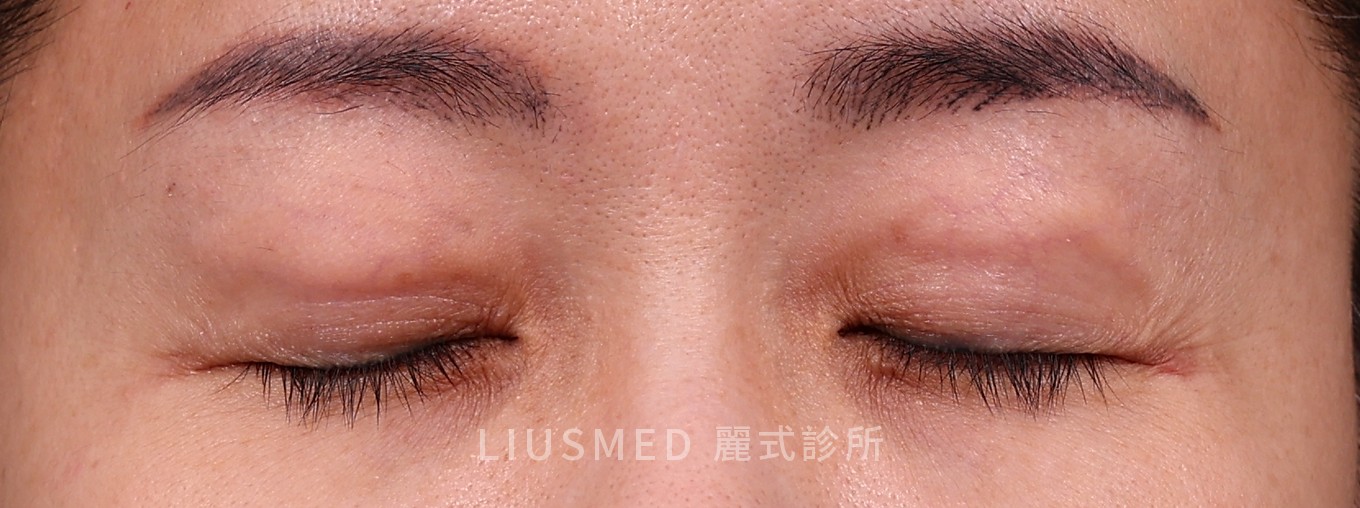
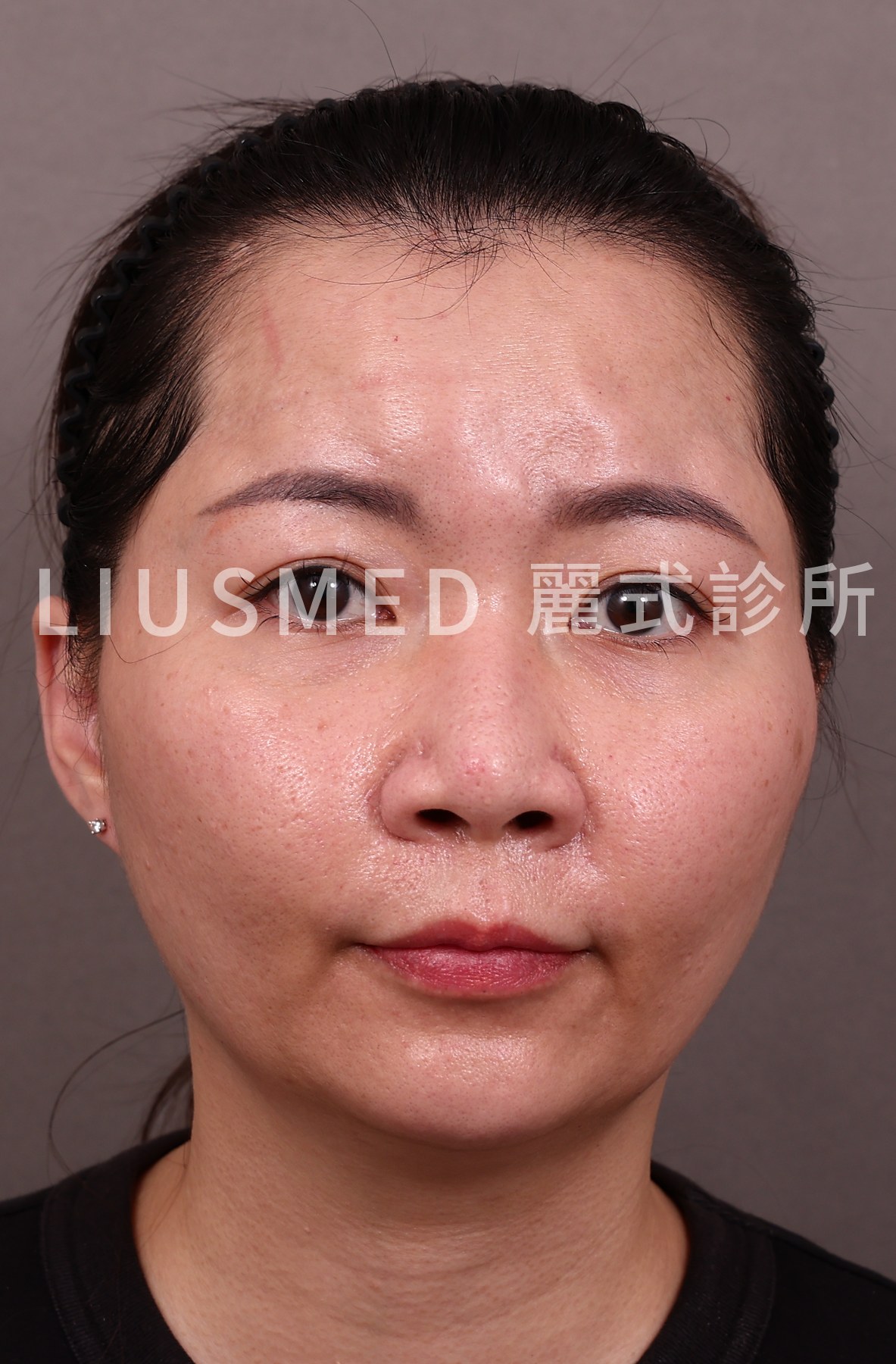
This is the one I have come to see more of in recent years, and the one that troubles patients most. It doesn't present as a simple lump but as recurring swelling in the same spot. Some people flare every two or three days; at its worst the swelling can close the eye, and it takes anti-inflammatories or antibiotics, occasionally an inpatient course, to settle. I tend to suspect a combination of biofilm (a bacterial film that forms on the filler surface) and a subsequent immune reaction. The link between biofilm and late, recurring filler inflammation has real case analysis behind it (Zhang 2024, a retrospective study of sixty-one patients that found bacteria and chronic inflammatory tissue changes in some lesions), though attributing any single case entirely to biofilm still warrants caution.
Treatment order here differs from the build-up type. Because the problem is inflammation rather than a plain mass, the first step is usually medication: for delayed-onset inflammatory nodules the guidance is an antibiotic (a macrolide or tetracycline) for two weeks first, and for non-HA fillers an intralesional steroid (triamcinolone, an anti-inflammatory) can be added (King 2016). The steroid suppresses inflammation, not the foreign material itself, which is worth stating plainly; it treats the symptom. Only when flares keep recurring and medication can't hold them does reducing and removing the material come into play. And the recurring swelling is often harder to live with than the appearance. Go out and someone asks "what happened to your face." Over time many people just stop going out, and their mood follows. That drain on quality of life is what I most want to help with.
What removal can and cannot do
I want to set expectations honestly up front.
For the recurring inflammatory type, the goal of physical removal is not to guarantee it will never swell again. My approach is to locate the deposit under ultrasound and reduce it, drawing out most of the material. After that, occasional swelling may still happen, but the frequency and severity usually fall well below what they were, and many patients describe it as a large relief. No longer being tied to a flare every two or three days is the change they feel most.
I don't use words like "cure" or "complete clearance," because an immune reaction is never absolute. What I can say responsibly is this: physically reducing and removing the foreign material addresses the root more truly than repeatedly injecting hyaluronidase (the wrong target) or leaning on steroids to suppress symptoms. What I do is ultrasound-guided removal and reduction, a direction this clinic has developed over years and as one of the few in Taiwan focused on filler removal and revision.
Frequently asked questions
I have a lump from a panda needle and hyaluronidase did nothing. Why?
If you were injected in Taiwan, the panda needle is usually porcine collagen, not hyaluronic acid. Hyaluronidase only breaks down HA and has no target on collagen, so no response is expected; it isn't a dosing problem. Turned around, that's a clue: if the enzyme does nothing, it probably isn't HA. The Hong Kong panda needle is often Teosyal HA, which does dissolve, so confirming where you were injected and with what really matters.
Are the panda needle and Sculptra the same thing?
No. The panda needle (usually porcine collagen in Taiwan) puts collagen directly in. Sculptra is a collagen stimulator; it contains no collagen and works by prompting your body to make its own. Different materials, different handling of a lump. Both involve "collagen," but they are not the same.
After a collagen filler, the same spot swells every few days. What's going on?
This sounds like the recurring inflammatory type I've described, which I tend to link to biofilm plus an immune reaction. It shows up as repeated swelling in one place, sometimes bad enough to close the eye, needing anti-inflammatories or antibiotics to settle. The approach is to control inflammation with medication first, and if flares keep recurring and medication can't hold them, to locate and reduce the material under ultrasound. Don't keep enduring this one; get it assessed sooner rather than later.
Collagen metabolizes on its own, so why is there still a lump?
Injectable collagen does metabolize relatively quickly, over about three to six months. But "it metabolizes" doesn't mean "it leaves no problem." Repeated top-ups accumulate, too-superficial placement stacks in the dermis, and the immune/biofilm type has nothing to do with metabolic speed at all. It is your body's response to foreign material and won't simply vanish because the material is theoretically absorbable. That's why "wait for it to resolve" often doesn't work for this type.
Will it stop swelling after removal?
I won't promise that. For the recurring inflammatory type, the goal of removal is to reduce most of the foreign material so that flares become much less frequent and less severe, which gives most patients a large relief, though occasional swelling may remain. I would rather say this plainly than write "cure." Compared with endlessly injecting to suppress symptoms, reducing and removing the source is usually the more practical path.
The bottom line
A collagen panda-needle lump is unsettling, partly because the enzyme did nothing and partly because the recurring swelling wears you down. But once you separate two things, whether you had Taiwan collagen or Hong Kong HA, and whether your lump is the mechanical build-up type or the inflammatory type, the path forward has direction.
If you have a palpable lump after a collagen filler (panda needle), or the same spot keeps flaring red, bring a few facts to your online assessment and consultation: where you were injected, what it was, when the lump or swelling started, and how often it flares. Those sentences make the assessment much faster. If you want to understand the other big category, collagen stimulators like Sculptra and Juvelook, see what to do about Juvelook nodules.
References
- King M, Bassett S, Davies E, King S. Management of Delayed Onset Nodules. J Clin Aesthet Dermatol. 2016;9(11):E1–E5. PMID: 28210391. (For delayed inflammatory nodules, antibiotic first for two weeks; intralesional steroid for non-HA fillers; biofilm as a cause remains debated.)
- Zhang YL, Sun ZS, Hong WJ, Chen Y, Zhou YF, Luo SK. Biofilm formation is a risk factor for late and delayed complications of filler injection. Front Microbiol. 2024;14:1297948. PMID: 38260874. (Retrospective analysis of sixty-one patients; bacteria and chronic inflammatory tissue changes found in some lesions, supporting a biofilm link to delayed complications.)
- Braun M, Braun S. Nodule formation following lip augmentation using porcine collagen-derived filler. J Drugs Dermatol. 2008;7(6):579–81. PMID: 18561590. (Porcine collagen in the lips caused multiple nodules in sixteen of twenty patients, some persisting over a year; the authors advise against lip use. Small series, site-specific.)
- Lee JH, Choi YS, Kim SM, Kim YJ, Rhie JW, Jun YJ. Efficacy and Safety of Porcine Collagen Filler for Nasolabial Fold Correction in Asians: A Prospective Multicenter, 12 Months Follow-up Study. J Korean Med Sci. 2014;29(Suppl 3):S217–S221. PMID: 25473212. (Multicenter study of porcine collagen for nasolabial folds in Asian skin; adverse events were mostly mild, self-limiting swelling.)