I hear this sentence a lot in clinic: "Doctor, my whole face swelled up after my dissolving session. Am I allergic to it?"
Almost always, no.
Hyaluronidase (the enzyme that breaks down hyaluronic acid, which patients usually call the dissolving injection) does two things once it is in the tissue. It cleaves cross-linked hyaluronic acid, and it briefly changes how permeable the local tissue is. That second effect on its own makes the area swell, redden and feel warm. That is a different event from the immune system recognising the protein and reacting to it, but in the mirror the two look nearly identical.
Telling them apart matters. Someone wrongly labelled as allergic gets shut out of a treatment they may need later. Someone genuinely allergic who was reassured it was normal walks into a bigger problem at the second injection.
Most swelling after hyaluronidase is not allergy
A UK guideline on the clinical use of hyaluronidase is direct about this. Local swelling and erythema after injection that resolve on their own within 24 hours are classified as non-allergic, and a concentration mixed too strong (above 1,500 units in 10 mL) is itself irritant (PMID 34840662).
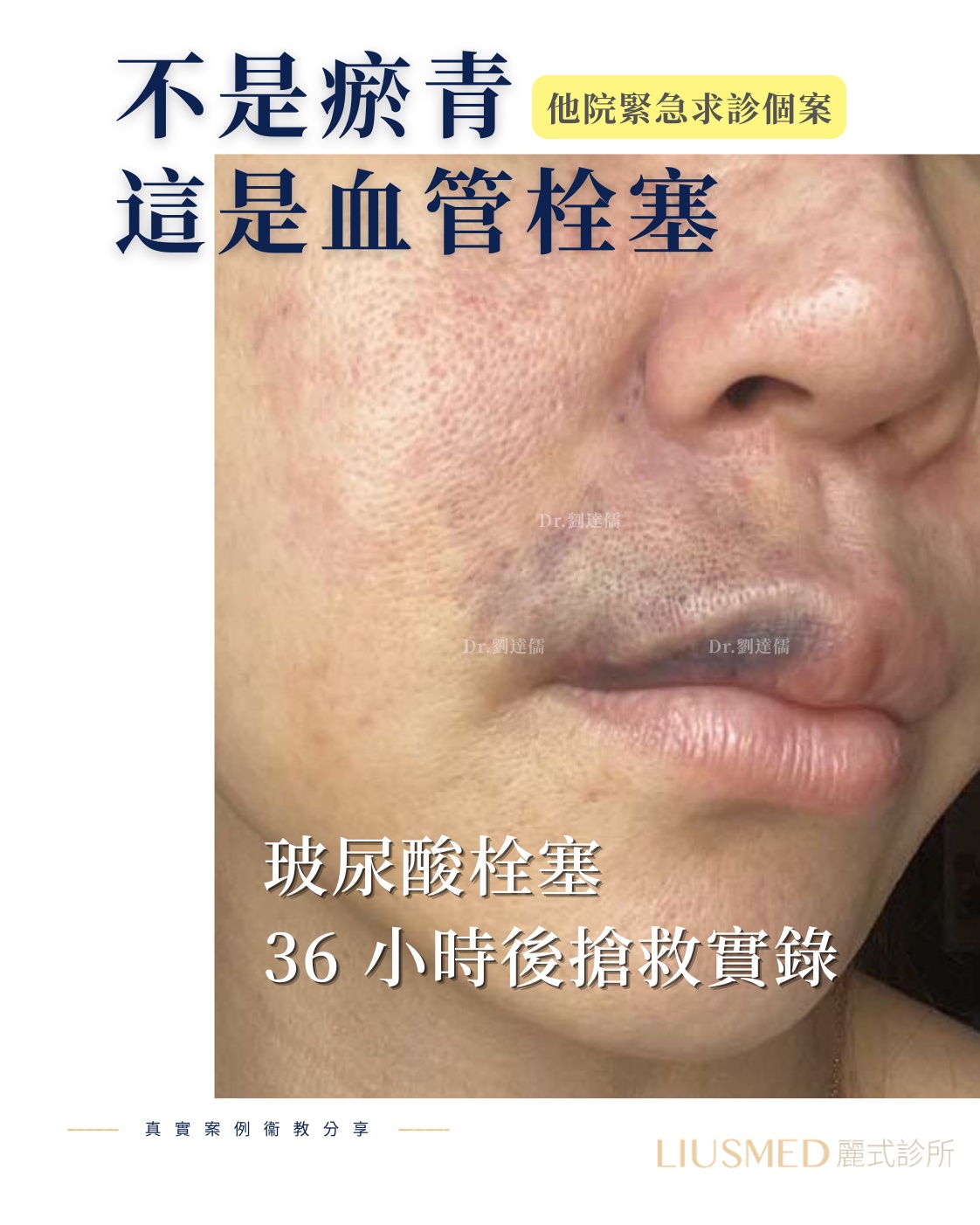
The same guideline adds a point that gets misread often. Facial swelling occurring on its own, with no systemic symptoms, is not anaphylaxis, and it is expected to settle within 12 to 24 hours (PMID 34840662). Plenty of people photograph themselves at exactly that moment and it looks alarming, but it is already on its way down by the next day.
Dose and route also set the scope of the reaction. Below 1,500 units at a local site, responses are generally confined to the area injected; the doses the literature links to more generalised symptoms are 1,500 to 200,000 IU and intravenous administration (PMID 34840662). Aesthetic injection sits a long way from the upper end of that.
Key Insight: Time is the cheapest discriminator you have. Local swelling and redness that begins to settle inside 24 hours does not deserve the allergy label. Swelling still spreading after 24 hours, or symptoms outside the injected area, is what justifies working it up as an immune reaction.
Signals worth watching in the first day
← Swipe to see more →
| Feature | More like a local irritant response | Needs to be managed as allergy |
|---|---|---|
| Extent of swelling | Confined to the injected zone and its margin | Beyond the injected zone, spreading elsewhere |
| Trajectory | Starts settling within hours to 24 hours | Persists or worsens beyond 24 hours |
| Skin findings | Red, warm, mildly itchy | Clear urticaria, papular rash |
| Systemic symptoms | None | Breathlessness, throat tightness, generalised rash, dizziness |
| What to do | Cold compress, observe, follow up | Seek care immediately, do not wait until tomorrow |
That last column deserves emphasis. Breathlessness, a tight throat, a hoarse voice, a generalised rash, a falling blood pressure: these belong in an emergency department, not an aesthetic clinic. Go straight there, and tell the staff exactly what was injected and how much.
How often real allergy actually happens
The numbers circulate in a confusing way, so it is worth laying out where they come from.
The figure usually quoted is "approximately 0.1 percent", but the same guideline notes that this covers all allergy, not specifically immediate type I hypersensitivity, and that the risk of anaphylaxis is lower than the quoted 0.1 percent (PMID 34840662).
Going one level deeper makes it more concrete. Since 1949, there have been four case reports of hyaluronidase allergy requiring adrenaline. Narrow it to allergy occurring after hyaluronidase was used to dissolve cross-linked hyaluronic acid filler, and there are three reports covering four patients in total. The guideline authors believe the real count is under-reported, because they have seen several localised reactions in their own practices (PMID 34840662).
So where does the alarming 33 percent come from? It appears in the setting of large intravenous doses above 200,000 units (PMID 34840662). That is not the same order of magnitude as the amount used to dissolve one nodule in a face, and applying it to aesthetic injection gives an entirely wrong impression.
Ophthalmology has mixed hyaluronidase into local anaesthetic for decades, so its denominator is far larger than aesthetic medicine's. Across the periocular series collated in that guideline, incidence falls between 0.006 percent and 0.69 percent (PMID 34840662). That is a wide range, but nothing in it approaches a third.
Key Insight: "0.1 percent" and "33 percent" get quoted side by side online, when they describe two completely different dosing situations. Whichever number you meet, ask first what dose and what route it came from.
Who carries more risk: sting history, and that second injection
A 2024 systematic review pooled 37 studies and 106 patients with a mean age of 54.2 years. Two of its findings are directly useful at the consultation (PMID 37145319).
First, among patients with repeated exposure, a substantial proportion became symptomatic at the second injection, and there was no statistically significant association between the time to allergy development and the number of exposures (P = 0.3). Put plainly: an uneventful first session does not promise an uneventful second one, but neither does risk simply pile up with each injection. Sensitisation does not count doses.
Second, the authors consider prior injections, or sensitisation by insect and wasp venom, to be the primary associated factor. The allergy histories reported in those patients included wasp venom, penicillin, insect bites, egg white and nickel, with asthma, dermatitis, atopy and rhinitis among the comorbidities.
The sting history has concrete figures attached. Someone who has had a large local reaction to a sting carries a risk of anaphylaxis greater than 5 percent on a subsequent sting, and someone who has had anaphylaxis to bee or vespid wasp stings carries a risk of at least 60 percent. Mapped onto hyaluronidase, those histories correspond to an anaphylaxis risk of up to 5 percent and up to 60 percent respectively (PMID 34840662).
So at consultation I ask more than "what drugs are you allergic to". Have you ever been stung? How large did it swell, and for how many days? Did you end up in an emergency department? Those answers change whether hyaluronidase goes into the plan at all, and if it does, the setting I want to be in when it is given.
One smaller practical point: recombinant human hyaluronidase (rHuPH20) has no documented allergy cases in the literature collated by that guideline (PMID 34840662). That is not the same as saying it cannot cause allergy, since the denominator is still small, but in someone with a risky history the choice of product is one of the variables worth discussing.
Sometimes the trigger is the diluent, not the enzyme
This is the part I find gets overlooked most often.
Hyaluronidase comes as a powder and has to be reconstituted. The bacteriostatic saline commonly used for that is preserved with benzyl alcohol, and benzyl alcohol carries an allergy rate of 1.3 percent, higher than the average allergy risk from hyaluronidase itself (PMID 34840662).
Which means a patient labelled "allergic to the dissolving injection" may never have been allergic to the enzyme at all. That changes what happens next: change the diluent and the option stays open, instead of being crossed off entirely.
Key Insight: Attributing a bad experience to the word "hyaluronidase" is too coarse. Separate out what was actually in that syringe, namely the enzyme, the diluent, the preservative, and anything else injected in the same session. Get the attribution wrong and the whole subsequent plan is wrong.
It is also the information I specifically ask for when reviewing records from another clinic: which brand, which diluent, what final concentration, how many units per point. With those, it becomes possible to reason backwards about what that reaction really was.
Does a skin test beforehand help?
People often ask whether a small test dose in the arm would settle the question. Reasonable idea, but the picture is not that clean.
The guideline states plainly that there is no validated concentration for intradermal hyaluronidase testing. Case reports have used 15 to 150 units/mL; in one, a positive result needed 150 units/mL, while 1.5 and 15 units/mL were both negative. A separate group recommends 15 units, and the European allergy criterion for positivity is read at 20 minutes, with the wheal at least 3 mm larger than the control (PMID 34840662).
The same guideline cites the position of the British Society for Allergy and Clinical Immunology: skin tests should not be used to screen for drug allergy in the absence of a clinical history compatible with it, and routine skin testing in aesthetic medicine runs against that position (PMID 34840662).
This is not "so don't test". It is "a negative result cannot reassure you, and a positive one may not be real". Pick the concentration too low and you miss it; too high and you irritate, and irritation looks a great deal like a positive. One group injected 10, 20 and 30 units and saw dose-dependent local reactions that the authors themselves thought might be irritation rather than allergy (PMID 34840662).
What genuinely carries weight is the history. Sting history, prior injection history, asthma and atopy: the information those questions produce is more reliable than a single intradermal test. For someone whose history raises a red flag, the right move is to arrange the injection somewhere an acute reaction can be managed, rather than running one test wheal for peace of mind.
What treatment looks like, and why the enzyme should not be the only road
Treatment itself is not complicated. The review of 106 patients puts it clearly: steroids, with or without antihistamines, produced rapid and predominantly complete reversal of symptoms (PMID 37145319). So the question was never whether something permanent is left behind. It is whether the reaction was recognised, and whether it was handled in the right place.
Another 2024 review tiers the situations in which hyaluronidase is used. Allergic and hypersensitivity reactions are non-emergent and are treated with low or moderate doses; what genuinely requires immediate high-dose treatment is vascular occlusion and visual emergency. The same paper notes that ultrasound guidance can increase the efficacy of these interventions (PMID 38231537).
That last sentence is, for me, the centre of the whole subject.
My own approach is to see what is in there before deciding whether to use the enzyme. Scan it: which layer the material sits in, how far it extends, whether a capsule has formed around it, how the surrounding vessels run. Once that is visible, it becomes possible to say whether this injection should be given, where, and how much. Hyaluronidase should be used only after an in-person medical assessment, and it is genuinely useful for fresh cross-linked hyaluronic acid with no capsule around it. But with filler that has become encapsulated, the enzyme cannot reach the material's surface, and repeat injections only accumulate irritation. Hyaluronidase fails for more than one reason, and the tissue cost of repeated dissolution does add up.
That is why this clinic's mainstay is ultrasound-guided single-pinhole physical extraction. Not because the enzyme is bad, but because some material was never going to be chased down chemically. Seeing it is what makes handling it safely possible.
Frequently asked questions
I'm on day three after hyaluronidase and the swelling hasn't gone. Is that normal?
That is outside the window the literature describes. Local swelling and redness that begins to resolve within 24 hours is classified as non-allergic, and isolated facial swelling is also expected to settle within 12 to 24 hours (PMID 34840662). If it is still there on day three, go back to the doctor who injected you so they can judge whether it is a delayed-type reaction, a problem other than swelling, or something related to the original filler. If it comes with breathlessness, throat tightness or a generalised rash, go to an emergency department.
I've been stung by a wasp before. Can I still have hyaluronidase?
Your history needs to be on the table before that is decided. A previous large local reaction to a sting maps to an anaphylaxis risk of up to 5 percent with hyaluronidase, and previous anaphylaxis to a sting maps to up to 60 percent (PMID 34840662). That is not an absolute contraindication, but it changes the setting and the preparation. Bring it up at the consultation rather than waiting to be asked.
Nothing happened the first time. Do I still need to worry about the second?
It is worth attention. In the review of 106 patients, a substantial proportion of those with two to four injections became symptomatic at the second one, and the time to allergy development showed no significant association with the number of exposures (P = 0.3, PMID 37145319). So an uneventful first session is not evidence that later ones are safe.
If I really am allergic to hyaluronidase, is my filler beyond help?
No. First establish whether the allergy is to the enzyme or to the diluent, since bacteriostatic saline preserved with benzyl alcohol carries an allergy rate of 1.3 percent on its own (PMID 34840662), and changing the diluent sometimes keeps the option open. If the enzyme truly cannot be used, physical extraction does not depend on hyaluronidase at all. Confirm the position and depth of the material on ultrasound first, then plan how to take it out. Results vary between individuals, and each case is decided after medical assessment.
See what is in there before deciding whether to dissolve
Turning one episode of swelling into "I'm allergic to hyaluronidase" costs you every future situation where it might be needed, including the genuinely urgent ones.
At Filler Revision Clinic, Dr. Ta-Ju Liu starts by taking the detail of that reaction: which product, which diluent it was mixed in, how many hours the swelling lasted, whether there were systemic symptoms. Then ultrasound over the injected area, to establish what is still in the face and which layer it sits in. With those two pieces, it becomes possible to say whether the next step is observation, a different approach to dissolving, or physical extraction. Vascular emergencies follow their own rules, and eye symptoms are counted in minutes, so go directly to an emergency department or an ophthalmologist.
To arrange a consultation, use contact us. Patients overseas can share their current condition, past history and medication record remotely first, to get a sense of the likely direction. Treatment outcomes vary between individuals, and each case is decided after medical assessment.
References
- Murray G, Convery C, Walker L, Davies E. Guideline for the Safe Use of Hyaluronidase in Aesthetic Medicine, Including Modified High-dose Protocol. J Clin Aesthet Dermatol. 2021;14(8):E69-E75. PMID: 34840662. PMCID: PMC8570661. (Commonly quoted hypersensitivity incidence of approximately 0.1% covering all allergy types; the 33% type I rate seen only with intravenous doses above 200,000 units; four case reports requiring adrenaline since 1949; only three reports covering four patients after dissolution of cross-linked HA; local swelling resolving within 24 hours classified as non-allergic; benzyl alcohol allergy rate of 1.3%; no validated intradermal test concentration, case reports using 15-150 units/mL; sting histories corresponding to up to 5% and up to 60%.)
- Guliyeva G, Huayllani MT, Kraft C, Lehrman C, Kraft MT. Allergic Complications of Hyaluronidase Injection: Risk Factors, Treatment Strategies, and Recommendations for Management. Aesthetic Plast Surg. 2024;48(3):413-439. PMID: 37145319. DOI: 10.1007/s00266-023-03348-5. (Systematic review: 247 articles screened, 37 eligible, 106 patients, mean age 54.2 years; many with two to four exposures symptomatic at the second injection; no significant association between time to allergy and number of exposures, P = 0.3; steroids with or without antihistamines gave rapid and predominantly complete reversal; prior injections or insect and wasp venom sensitisation as the primary associated factor.)
- Kroumpouzos G, Treacy P. Hyaluronidase for Dermal Filler Complications: Review of Applications and Dosage Recommendations. JMIR Dermatol. 2024;7:e50403. PMID: 38231537. DOI: 10.2196/50403. (Allergic and hypersensitivity reactions are non-emergent and treated with low or moderate doses; vascular occlusion and blindness require immediate high-dose treatment; ultrasound guidance can increase the efficacy of these interventions.)
Written and reviewed by Dr. Ta-Ju Liu. This article is medical education material and cannot replace an in-person consultation. Individual cases are assessed by a physician before any treatment decision, and outcomes vary between individuals.