The hardest question in my clinic is not "can this still be fixed". It is "what was in that vial".
People come in after being injected in a friend's living room, in the back room of a nail salon, in a hotel room by someone who calls themselves a teacher. Two days later swallowing feels odd. Or a month later there is a firm spot on the cheek that was not there before, and that is when they start looking for someone to see.
At that point, two separate problems need separating. One runs on hours. The other can wait for imaging. The urgent one is what the toxin is doing inside the body. The slower one is what got left under the skin. They are handled in different places by different people, and getting the order wrong delays the half that actually matters.
This article sets out the order.
What is different about an injection given outside a clinic
The same drug name does not mean the same event. In a non-healthcare setting, three things are removed at once.
The first is where the product came from. In a case announced by Taiwan's Ministry of Health and Welfare in April 2025, a woman in her forties bought botulinum toxin through an online platform, and the seller came to her home and injected her forehead and cheeks. A 2025 case report describes the same shape: a 35-year-old woman was injected in the forehead and periocular area at home by a friend who was not a medical practitioner, from a vial bought online that was later identified as an unlicensed imported preparation (PMID 41179004).
The second is dose conversion. In 2004, four adults in the United States developed botulism after injections from the same unlicensed, highly concentrated preparation of botulinum toxin A. Investigators estimated they may have received doses 2,857 times the estimated human lethal dose by injection, and pre-treatment serum toxin levels in three of the four were equivalent to 21 to 43 times that lethal dose (PMID 17119144). That is not "a bit too much". That is a conversion step that never happened.
The third is having someone to take over when things go wrong. In that same 2025 report, the woman's husband was injected from the same vial, deteriorated faster, and required intubation and intensive care. Both needed antitoxin and intravenous immunoglobulin before they stabilised (PMID 41179004). Deterioration at that speed only gets caught if someone is watching for it, and nobody in a living room is.
The US Centers for Disease Control and Prevention put it plainly in a health advisory issued on 23 April 2024: the injections behind that cluster of adverse effects were given by unlicensed or untrained individuals, or in non-healthcare settings such as homes or spas. The advisory counted 22 people across 11 states, 11 of them hospitalised, with no deaths, and symptom onset between 4 November 2023 and 31 March 2024.
Key point: The risk does not come from the needle. It comes from a vial nobody checked, a dose nobody converted, and no one on hand when it goes wrong.
An uneventful first day means very little
This is the part people get wrong most often. They go home, nothing happens that evening, and the injection drops off their own list of possible causes.
Taiwan's Centers for Disease Control states it clearly in its public health material: iatrogenic botulism can begin hours, days, or weeks after a botulinum toxin injection.
Neither documented case above began on the day. In the April 2025 case, symptoms appeared about three days after the injection: difficulty swallowing, impaired saliva production, drooping eyelids, and muscle weakness, followed by intubation and ventilation. In the published case report, the 35-year-old woman's symptoms began roughly two days after injection (PMID 41179004).
← Swipe to see more →
| Time since injection | What can appear in this window | What to do |
|---|---|---|
| Same day | Swelling, bruising, tenderness at the puncture sites | Ordinary observation; write down the date and the sites |
| Two days to one week | Difficulty swallowing, drooping eyelids, slurred speech, dry mouth, generalised weakness | Emergency room, and say up front that you were injected |
| One week to several weeks | The same symptoms can still appear for the first time | Emergency room again; do not rule it out because "it has been too long" |
| Weeks to months | A firm spot you can feel, recurring redness or swelling | This is the retained-material path; book an outpatient ultrasound |
One more thing worth knowing in advance: a negative test does not mean you are clear. In the 2025 case, serum and stool results were both negative, judged to reflect sampling more than a week after the injection, and the case was still classified as very likely botulism on symptoms and epidemiological grounds. So if your emergency-room results come back negative, do not treat that as the end of it.
These symptoms mean the emergency room
Read this part now rather than saving it for later.
Taiwan's Centers for Disease Control lists diarrhoea, abdominal pain, constipation, poor appetite, vomiting, fatigue, dizziness, drowsiness, double vision, drooping eyelids, dilated or non-reactive pupils, facial palsy, difficulty speaking, difficulty swallowing, loss of head control, low muscle tone, and generalised weakness, and notes it may progress to respiratory muscle failure. The 2024 US advisory lists blurred vision and ptosis near the injection site, along with dry mouth, slurred speech, shortness of breath, fatigue, and generalised weakness.
Where the two lists overlap is where you stop reading and go: swallowing, speech, breathing, the eyes, overall strength.
Say three things when you arrive: what was injected if you know, when it was injected, and who injected it and where. Those three sentences change the order in which a doctor works through the differential, because botulism and the other causes of similar weakness are treated in completely different directions.
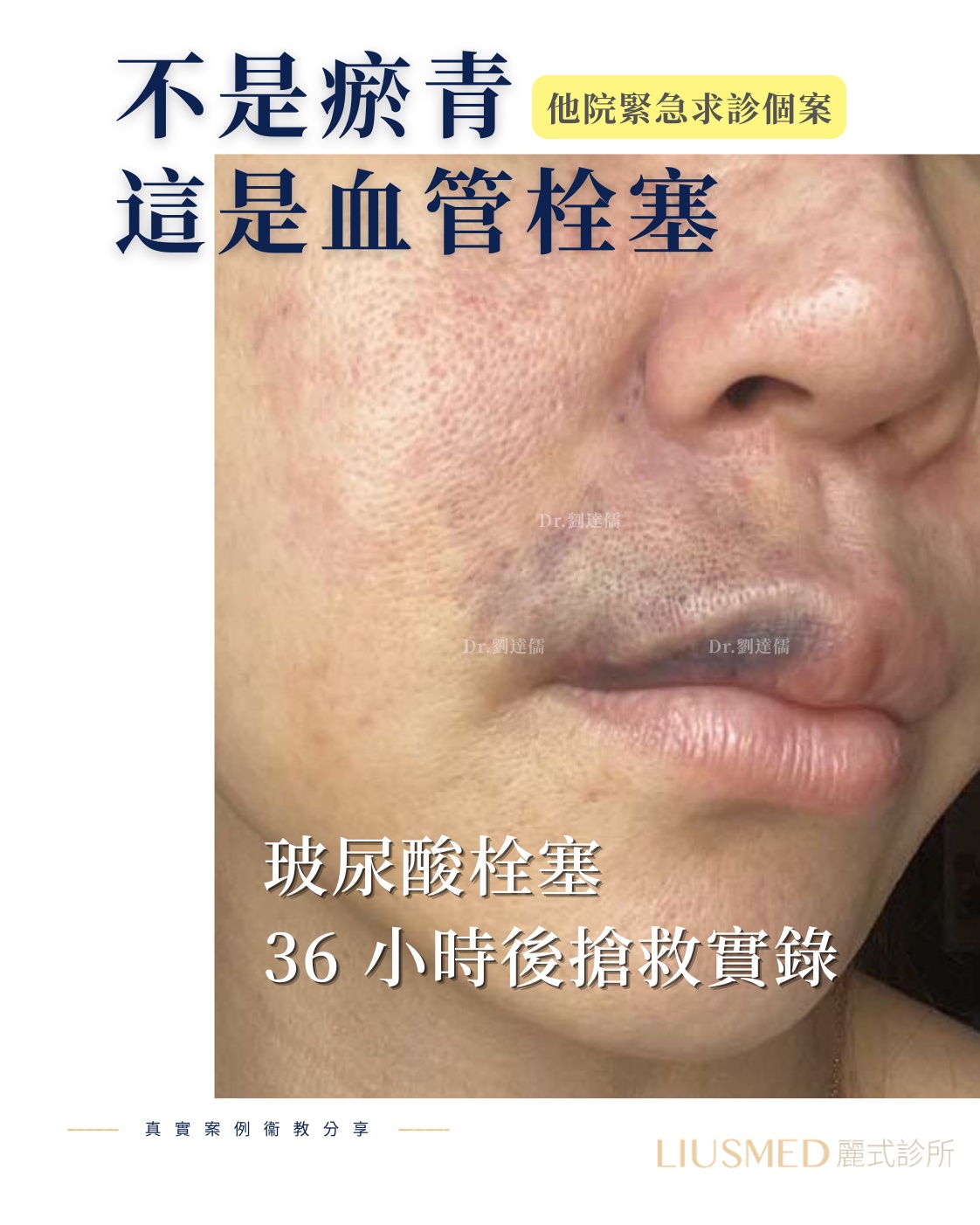
There is a separate urgent path that should not be confused with this one. Skin at the injection site turning pale, a dusky net-like pattern appearing, severe pain, or a sudden change in vision all point to a blocked vessel rather than the toxin, and that path runs on a much shorter clock. See vascular occlusion emergency care. Eye symptoms count in minutes: go straight to an emergency department or an ophthalmologist.
If you can feel a lump, the toxin is not what you are feeling
This is the version I see most in clinic: the acute phase passed, the person is fine, and there is now something on the face that was not there before.
Botulinum toxin acts at the junction between nerve and muscle and changes how hard that muscle pulls. The fluid volume that enters the skin is small and gets metabolised. It occupies no space and provides no support, so it does not leave behind a lump that persists. Feeling something usually means another material went in during the same session, or the vial did not contain what the label claimed. I have written that out in more detail in identifying the contents of an unknown-source injectable. If your complaint is that your expression looks wrong rather than that you can feel a lump, the way to tell those apart is in when your face feels off after botulinum.
Not being able to find out is not carelessness on your part. One cutaneous ultrasound study says so in its own introduction: filler injections are rising worldwide, and neither the details of the procedure nor the agent used are always reported to or remembered by patients (PMID 21418333). In a non-healthcare setting it goes further, because there is no record to go back to in the first place.
Ultrasound answers three questions here, and only three: which layer the material is in, how much of it there is, and whether it can be dissolved. It does distinguish echo patterns by material. One study scanned 60 patients with a history of filler injection and found 48 with a single well-defined pattern and 12 with mixed patterns (PMID 33641224). What it cannot do is report a brand. Brands come from the records or the packaging at the time, which is exactly what this situation tends not to have. The reading details are in ultrasound imaging for filler identification.
Whether it can be dissolved also needs to be seen first. Hyaluronidase works on hyaluronic acid only and is used after an in-person assessment by a doctor. Collagen stimulators and permanent materials fall outside what it acts on, and material wrapped in fibrous tissue responds less well. The reasons are in seven reasons hyaluronidase fails.
Key point: Not knowing what was injected is a condition to work with, not a blank to skip past. You have to see it before you can handle it safely.
Four things to confirm afterwards
Once the acute window has passed, four things are worth the time. Work through them in this order.
The premises. The first checkpoint Taiwan's Centers for Disease Control gives the public is to confirm the place is a registered medical institution. A living room, a studio, and the back room of a nail salon are not.
The injector. The second is to confirm the person injecting is a licensed, registered medical practitioner. Article 28 of the Physicians Act draws the line: practising medicine without qualifying as a physician is unlawful in itself and carries legal liability. What the proviso to that article permits is nurses, midwives, and other licensed practitioners performing auxiliary medical acts inside a medical institution under a physician's instruction. A nurse injecting on their own, or a teacher doing you a favour, is not inside that.
The product. Ask what the product contained and confirm it carries a drug permit number. Which parts of the carton and the vial to cross-check are listed item by item in identifying the contents of an unknown-source injectable.
The records. Keep whatever you still have: message threads, payment records, photographs of the carton or the vial, the sites injected, and the dates. Those become material a doctor can work with, and they are also what health authorities will need if the case goes to them.
Work through those four and you move from "I have no idea what happened" to "I know which parts I do not know". Those two states leave very different room to work with in clinic. What to ask the doctor who takes over, and what you should hear back, is in a checklist for choosing a doctor for filler revision.
Frequently Asked Questions
I was injected at home and nothing happened for a week. Does that mean I am safe?
It does not follow. Taiwan's Centers for Disease Control states that iatrogenic botulism can begin hours, days, or weeks after injection, so a quiet week means that week was quiet. What to watch is the symptoms themselves: swallowing, speech, breathing, the eyes, overall strength. Any change in those means the emergency room, and "it has already been several days" is not a reason to rule it out.
My emergency-room test was negative. Does that rule out botulism?
Not necessarily. In the case announced in April 2025, both serum and stool results were negative, judged to reflect sampling more than a week after the injection, and the case was still classified as very likely botulism on symptoms and epidemiological data. A negative result rules out only what that particular sample could detect. The clinical judgement still rests on symptoms and the timeline.
I can feel a lump after a botulinum injection. Should it be dissolved or removed?
Neither is the first step. The first step is seeing what it is. Botulinum toxin occupies no space, so a lump usually comes from a different material. Hyaluronidase works on hyaluronic acid only; collagen stimulators and permanent materials do not dissolve. Injecting hyaluronidase blind tends to end in "several attempts and it never broke up", while whatever is actually holding that shape was never seen at all. Confirm the layer, the extent, and the material pattern on ultrasound first, then decide between dissolving, removing, and watching.
If nobody knows what was in the vial, can anything still be done?
Yes, the starting point is just different. Ultrasound shows which layer the material sits in, how far it extends, which echo pattern it leans towards, and whether there is fibrous encapsulation or inflammation around it. That is enough to decide the next step without knowing a brand name. The real problem is not the missing brand. It is continuing to inject, or dissolving blind, while nobody knows.
See what is under the skin first, then decide whether to touch it
After an injection in a non-healthcare setting, the two most common reactions are "it is probably fine" and "this is a disaster". Neither helps. What helps is handing the urgent half to an emergency department and the slower half to imaging.
At Filler Revision Clinic, Dr. Ta-Ju Liu starts with the timeline: when it was injected, where, which day the symptoms began, and what has already been tried. Then ultrasound covers the injected area to confirm whether material is present, which layer it sits in, how much there is, whether it can be dissolved, and whether there is fibrous encapsulation or inflammation around it. Once those line up, it becomes clear whether to watch, dissolve, or remove. Results vary between individuals, and each case is decided after assessment by the doctor.
To arrange an in-person consultation, use contact us. The assessment process and the available options for filler revision can be discussed together at that visit. If you currently have any change in swallowing, speech, breathing, or vision, go to an emergency department first. The outpatient appointment can wait.
References
- Basit A. Iatrogenic Botulism Following Unregulated Cosmetic Botulinum Toxin Injection. Cureus. 2025;17(9):e93517. PMID: 41179004. DOI: 10.7759/cureus.93517 (A 35-year-old woman injected at home by a non-medical friend from an online-purchased vial later identified as an unlicensed imported preparation; symptoms began about two days after injection with facial weakness, hoarseness, dysphagia, bilateral ptosis and dry mouth; her husband, injected from the same vial, deteriorated faster and required intubation and intensive care; both improved with antitoxin and immunoglobulin, and she was discharged with mild residual ptosis and diplopia.)
- Chertow DS, Tan ET, Maslanka SE, et al. Botulism in 4 adults following cosmetic injections with an unlicensed, highly concentrated botulinum preparation. JAMA. 2006;296(20):2476-2479. PMID: 17119144. DOI: 10.1001/jama.296.20.2476 (Four patients injected from the same unlicensed, highly concentrated botulinum toxin A preparation; estimated doses up to 2,857 times the estimated human lethal dose by injection, with pre-treatment serum toxin levels in three of the four equivalent to 21 to 43 times that lethal dose.)
- Richardson J, Viviano S. From Beauty to Botulism: A Case Report Highlighting the Rare Risk of Botox Administration. Cureus. 2024;16(2):e54090. PMID: 38487143. DOI: 10.7759/cureus.54090 (A 47-year-old woman developed iatrogenic botulism after injections given in Istanbul, with marked improvement after prompt antitoxin; the authors note most reported cases occur outside the United States and call for tighter oversight.)
- Wortsman X, Wortsman J, Orlandi C, et al. Ultrasound detection and identification of cosmetic fillers in the skin. J Eur Acad Dermatol Venereol. 2012;26(3):292-301. PMID: 21418333. DOI: 10.1111/j.1468-3083.2011.04047.x (The introduction notes that as filler injections rise worldwide, neither the procedure details nor the agent used are always reported to or remembered by patients; the study evaluates cutaneous sonography for detecting and identifying filler deposits.)
- Urdiales-Gálvez F, De Cabo-Francés FM, Bové I. Ultrasound patterns of different dermal filler materials used in aesthetics. J Cosmet Dermatol. 2021;20(5):1541-1548. PMID: 33641224. DOI: 10.1111/jocd.14032 (Sixty patients with prior filler injection: 48 with a single well-defined pattern and 12 with mixed patterns, grouped into echo patterns by material.)
- US Centers for Disease Control and Prevention Health Alert Network advisory CDCHAN-00507, Adverse Effects Linked to Counterfeit or Mishandled Botulinum Toxin Injections, 23 April 2024. (22 people across 11 states, 11 hospitalised, no deaths; symptom onset 4 November 2023 to 31 March 2024; injections given by unlicensed or untrained individuals or in non-healthcare settings such as homes or spas; the advisory recommends receiving injections only from licensed and trained professionals in licensed or accredited healthcare settings.)
- Ministry of Health and Welfare, Taiwan, press release of 15 April 2025 on choosing qualified medical facilities, qualified practitioners and legally approved products for botulinum toxin cosmetic injections. (A woman in her forties in northern Taiwan bought the preparation through an online platform and was injected in the forehead and cheeks at home by the seller; symptoms of dysphagia, impaired saliva production, drooping eyelids and muscle weakness appeared about three days later, followed by intubation and ventilation; serum and stool tests were negative because sampling occurred more than a week after injection, and the case was classified as very likely botulism on symptoms and epidemiological data; eight suspected cases linked to cosmetic medicine have been counted since 2019.)
- Taiwan Centers for Disease Control public health material on choosing lawful medical institutions for cosmetic injections. (Iatrogenic botulism may begin hours, days or weeks after a botulinum toxin injection; symptom list; possible progression to respiratory muscle failure; advice to confirm the facility is a registered medical institution, the injector is a licensed registered practitioner, and the product's ingredients and drug permit number; 1922 hotline.)
- Physicians Act, Article 28, Laws and Regulations Database of the Republic of China (Taiwan). (Legal liability for practising medicine without physician qualification, and the six categories in the proviso, including nurses, midwives and other licensed practitioners acting under a physician's instruction within a medical institution.)
Written and reviewed by Dr. Ta-Ju Liu. This article is medical education and cannot replace an in-person consultation. Each case is decided after assessment by the doctor, and results vary between individuals.