"My nose feels tight, like something's lodged inside, and when I press it the lump slides a little. It actually looks fine, but that feeling never goes away."
A lot of people notice a nose filler problem not in the mirror, but from a feeling. A vague foreign-body sensation, tightness, or a day they suddenly feel "it has moved." These signals often show up before any visible change, and they're the easiest to dismiss as overthinking.
But these feelings are often retained or migrated filler talking to you.
What is "foreign-body sensation"? The body telling you something is there
Foreign-body sensation isn't some mystical term. It's the body registering "there's something here that shouldn't be."
Filler itself is foreign material. Most of the time it sits quietly and you barely notice it. But when the volume is on the high side, the placement is shallow, a fibrous capsule (encapsulation) starts to form around it, or it triggers mild chronic inflammation, that area develops tightness, pressure, or a "catching" feeling. The small subcutaneous space of the nose magnifies the sensation.
To be clear: foreign-body sensation doesn't necessarily mean there's a complication, but it's a signal worth taking seriously, especially when it persists or grows more obvious.
Key insight: Foreign-body sensation is the body flagging "something is here." It doesn't always mean a big problem, but persistent foreign-body sensation is worth seeing clearly on imaging rather than treating as imagination.
It "seems to have moved": filler migration is real
Many people describe it this way: "I feel like it shifted," "it used to be here, now it seems off to the side." That isn't an illusion. Filler migration is a documented phenomenon.
There are several causes of migration: too high a volume injected, pressure pushing material to the side, gravity drawing it slowly downward, massage or repeated muscle contraction carrying it away from its original site. The activity of the expression muscles around the nose is one such driver.
A 2023 case report illustrates this clearly: a patient who'd had HA in the nasal radix (the top of the bridge, near the glabella) developed a 15mm nodule there ten months later, briefly mistaken for a tumour. High-frequency ultrasound showed it was capsule-wrapped HA. The report attributed it to repeated muscle contraction around the glabella, which displaced the original material and gathered it into that nodule, ultimately aspirated under ultrasound guidance and resolved within a week.
In other words, "I feel like it moved" really can happen on the nose.
What these nose signals may each be saying
← Swipe to see more →
| What you feel | What it may be saying |
|---|---|
| Persistent foreign-body sensation, tightness | High residual volume, shallow placement, or encapsulation |
| A lump you can feel that slides when pressed | An encapsulated bolus or migrated material |
| Was symmetrical, now leans to one side | Migrated material, or more residue on one side |
| Red and swollen, flaring repeatedly | Keep granuloma or infection in mind |
If it's red and swollen and flares down and up repeatedly, keep filler granuloma in mind in particular; if it's mainly a widening, distorted nose shape, see filler displacement and a distorted nose shape.
Why these signals deserve attention on the nose
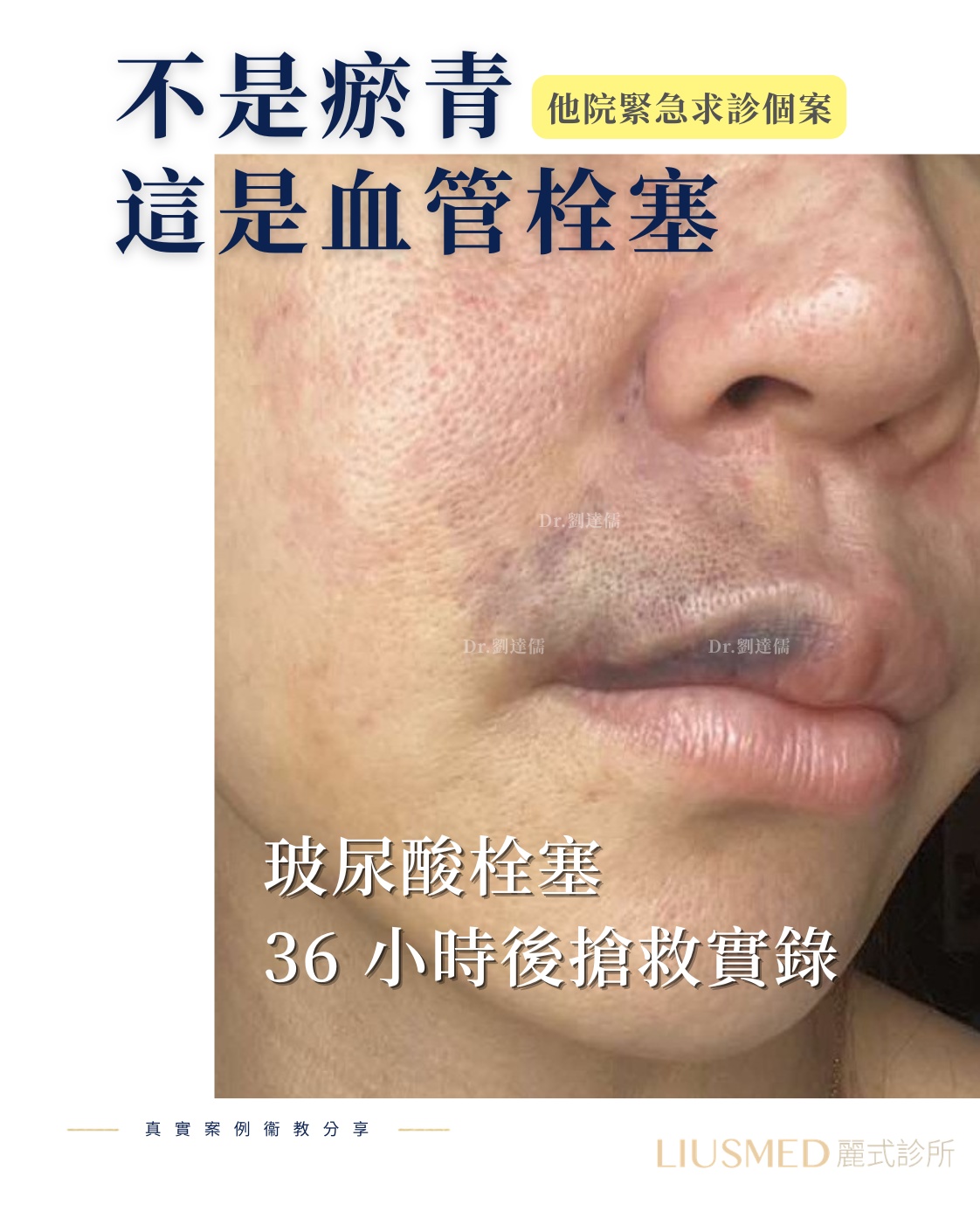
The nose carries a relatively high risk of vascular complications. If migrated material approaches or presses on a branch of the nasal artery, the risk is different from an ordinary site. And the nose is delicate and tight on space, so once material migrates and gathers, its effect on appearance and feel is magnified, and the nose shape easily distorts along with it.
So these signals aren't just "it feels uncomfortable." They may be telling you something is somewhere it shouldn't be.
Key insight: Foreign-body sensation, a mobile lump, a slowly developing asymmetry, these are all signals worth confirming on ultrasound. See the location and the migration path clearly first, and only then talk about safe treatment.
If you have these feelings, what's next
The first step, again, is to see it clearly, rather than rushing to top up to camouflage it, or massaging it yourself to push it back (massage may actually move it further away).
High-frequency ultrasound can map where the residue now sits, which layer, how big, and its relationship to the nasal vessels. On how ultrasound confirms residue when "I feel it but I'm told it's nothing," see how ultrasound confirms retained nose filler. Once confirmed, which can be dissolved and which can only be removed is laid out in the nose filler decision matrix.
Our removal, under ultrasound guidance, takes migrated or retained material out precisely through a very small entry point, while keeping the nose contour as even as possible. The whole procedure uses local anaesthesia plus gentle pain-relief anaesthesia, so the doctor and patient can talk in real time and adjust. To be honest about it: how much can be removed varies with material, time and degree of adhesion. The first session usually removes about 30–50%; with most fillers, two to three sessions can reach about 80–90%. It is not 100%, it varies from person to person, and we don't use a "guaranteed 100%" claim.
FAQ
Q: My nose has a foreign-body sensation but it doesn't show. Does it need treating? A: Not necessarily right away, but it's worth seeing clearly first. Persistent foreign-body sensation is the body flagging "something is here," and a single high-frequency ultrasound can tell whether it's residue, encapsulation or migration, then you decide whether to treat.
Q: Does filler really move? A: Yes. The literature documents filler migrating with injection volume, pressure, gravity, massage or muscle activity, and the expression muscles around the nose are one driver. "I feel like it shifted" really can happen clinically.
Q: Can I just massage it back into place myself? A: Not advisable. Self-massage not only struggles to push material back to its original place, it may move it further away or make it harder to localise. See it clearly on ultrasound first, then let the doctor decide the safer way to handle it.
Q: Can migrated filler be removed? A: Usually yes. Ultrasound can map where it has moved to and which layer it's in, then guide removal through a very small entry point. With most fillers, two to three sessions can reach about 80–90%; it varies from person to person, and we don't use a "guaranteed 100%" claim.
In closing
A nose filler problem is often something the "feeling" knows first. A foreign-body sensation, a mobile lump, a nose shape slowly leaning off, these signals shouldn't be brushed aside as overthinking. They may be retained or migrated material reminding you.
If you have these feelings, the first step isn't to endure it or push it yourself, it's to see it clearly. You're welcome to use an online personalised assessment or book a consultation, where Dr. Ta-Ju Liu can help confirm with ultrasound where the material in your nose now sits and what state it's in. For the complete picture of how retained nose filler and lumps are repaired, start with the retained nose filler and lumps overview.
References
- Magacho-Vieira FN, Santana AP. Displacement of Hyaluronic Acid Dermal Filler Mimicking a Cutaneous Tumor: A Case Report. Clin Cosmet Investig Dermatol. 2023. (A 15mm nodule 10 months after HA in the nasal radix; attributed to glabella muscle activity displacing it; 22MHz ultrasound confirmed encapsulated HA; removed under ultrasound guidance.)
- Bravo BSF, de Melo Carvalho R, Elias MC, et al. Nasal filling guided by high frequency ultrasound: Reducing risks. J Cosmet Dermatol. 2024. (Real-time high-frequency ultrasound locates nasal filler and the course of the vessels.)
Editorial Review: This article is educational information, not individual medical advice. Assessing nasal foreign-body sensation and filler migration, and whether to treat, must be decided case by case after an in-person physician assessment and ultrasound evaluation. Actual treatment and outcomes vary by individual.