
"The doctor said there's nothing there, but I can clearly feel it myself." That's how a lot of people with a nose lump begin. The nose has little tissue space and relatively low blood flow, so material clears far more slowly here than elsewhere: hyaluronic acid drifts sideways and widens the bridge (the so-called "Avatar nose"), while collagen stimulators (Ellansé/PCL, AestheFill/PDLLA, Radiesse/CaHA) and permanent fillers have no dissolving enzyme to match them and can sit on the bridge for well over a decade. So the problem usually isn't that the material "hasn't been absorbed yet" — it's that it was never going to disappear on its own. That's why I don't rush to re-inject, and I don't rush to dissolve either. I look first with high-frequency ultrasound — whether anything is still there, in which layer, and how close it sits to the vessels — and only then decide: dissolve what can be dissolved, and for what can't, remove it precisely under ultrasound guidance so the nose contour sits flat and even again.

Common Symptoms

Why nasal filler tends to persist for years
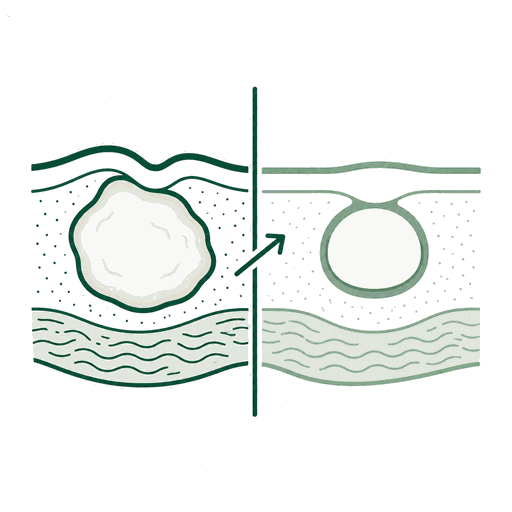
The subcutaneous space of the nose is small and its blood flow relatively low, so injected material is not easily carried away by metabolism. Although hyaluronic acid is theoretically absorbable, on the nasal bridge it is often placed as a bolus that forms a thicker capsule, and together with cross-linker residue, studies show it can still be detected years after injection; HA also draws water and spreads, gradually widening the bridge. Collagen stimulators (PCL/PDLLA/CaHA) are designed to remain long-term to stimulate collagen and have no dissolving enzyme like HA does; Radiesse can also calcify and adhere to surrounding tissue. As long as the material and capsule remain, the lump and distortion tend to persist and do not resolve on their own over time.

Why Traditional Treatments Fail
Why dissolving, massage, and waiting often aren't enough
If it is hyaluronic acid, hyaluronidase only works on gel it can actually reach — material sealed inside a thick capsule is largely shielded, which is why some people inject dissolver repeatedly yet the lump remains, while repeated dissolving can also damage surrounding healthy tissue. Collagen stimulators and permanent fillers have no injection that can dissolve them. Massage cannot open a mature capsule or break up a stubborn nodule, and "just keep watching" rarely changes the outcome for residue that has been present for years. When material is genuinely still there and causing a visible or palpable problem, ultrasound-guided physical removal is often the most direct option.
“The nose is an easy area to brush off — "it'll absorb on its own," "there's nothing there." But many people can feel it, and have remembered it for years. What changes things is that clear patch of residue on the ultrasound: once a patient sees with their own eyes that it really is still there, and in which layer, they understand what actually needs to be dealt with — instead of living alongside a lump no one will acknowledge.”
Dr. LiuConfirm first, then remove — and the shape must be smooth
Ultrasound-Guided Pinhole Micro-Extraction
With nasal filler, the core question isn't "can it be taken out" but "can it be seen, found, and removed cleanly and evenly." We build trust on imaging: first we show you the residue really exists, then remove it under ultrasound guidance, with a standard that is not just removal but a smooth, natural nasal shape.
Confirm with imaging, not guesswork
Nasal residue is often denied or underestimated. High-frequency ultrasound first maps objectively where it is, how large it is, and its relationship to vessels before any decision.
Higher vascular risk means more precise mapping
The nose carries a higher risk of vascular complications. Image guidance lets us avoid key vessels and aim precisely at the residue, making the procedure safer.
Remove it cleanly — and evenly
The nose is small and delicate. We aim not only to take the material out but to leave the nasal shape smooth and natural, without new irregularity.
Ultrasound-guided minimally invasive nasal filler removal
We address the problem itself: the filler or nodule still sitting in the nose. Before doing anything, high-frequency ultrasound maps the location, depth, and extent of the residue and its relationship to the branches of the nasal artery — the nose is a higher-risk area for vascular complications, so imaging makes the procedure both more precise and safer. Through a very small entry point, the material is removed under image guidance, with the goal of clearing it cleanly and leaving the tissue planes smooth without new irregularity. The nose is a small, delicate structure, so we aim not just to "take it out" but for a smooth, natural nasal shape.
High-frequency ultrasound mapping
Local + gentle pain-relief anesthesia
Image-guided minimally invasive removal
Confirm clean removal & smooth planes
Before & After Results
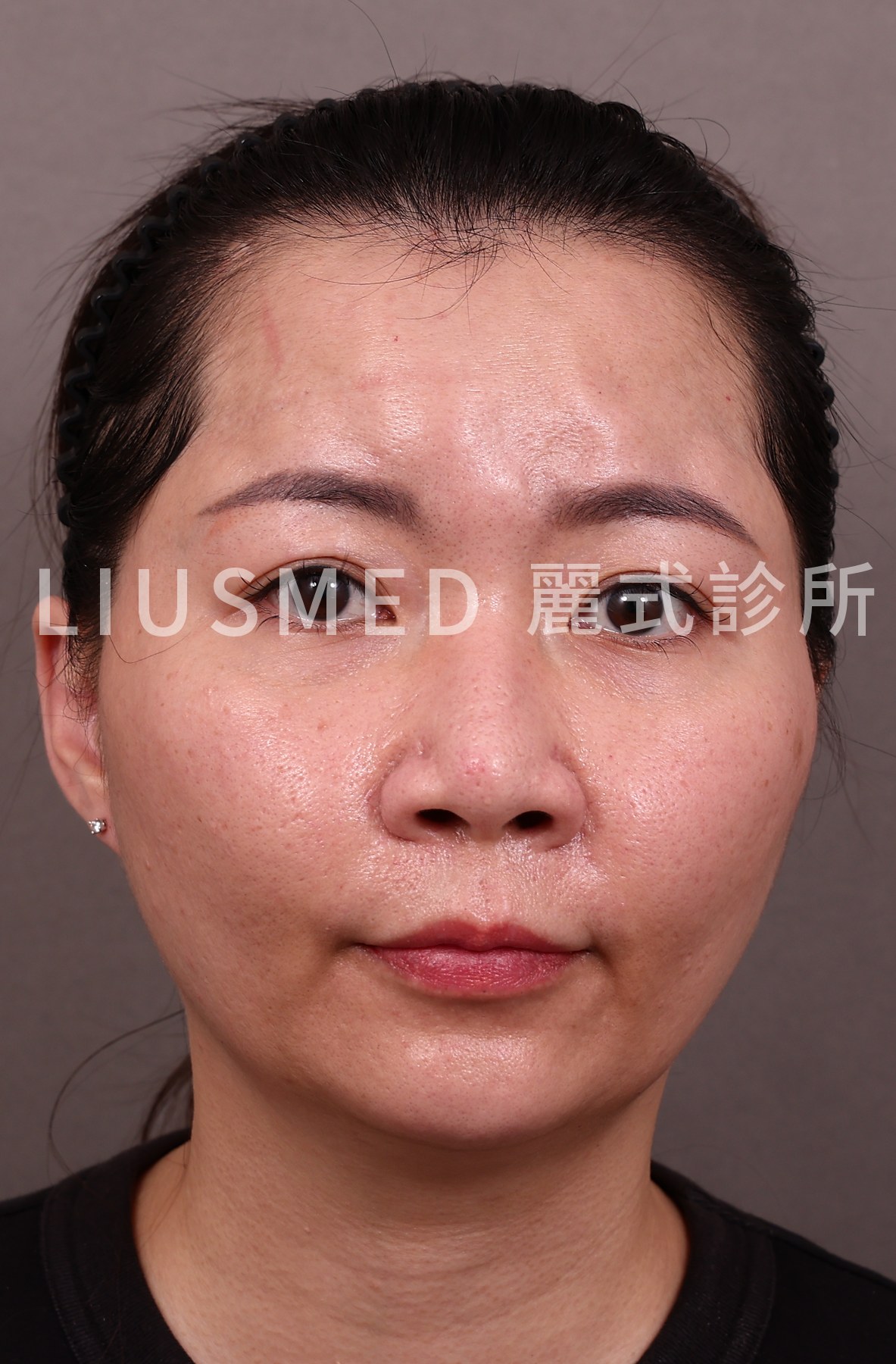
View real patient results for this condition, including ultrasound imaging before and after extraction.
View All Case ResultsCommon Questions
Palpation plus high-frequency ultrasound settles it objectively. Many "I can feel it but was told it's nothing" cases simply had no imaging done at the time. Ultrasound clearly shows which layer the residue is in and how large it is; if one side has a hypoechoic lesion and the other is clean, it confirms the residue is real, not imagined.
It depends on the material. Only hyaluronic acid has a matching enzyme — and even then it often won't fully clear when sealed in a thick capsule. Collagen stimulators (Ellansé, AestheFill, Radiesse) and permanent fillers have no dissolving enzyme and cannot be injected away; for this kind of long-standing residue or stubborn nodule, ultrasound-guided physical removal is the more direct route.
A widened bridge is often the result of HA spreading and accumulating sideways. Confirming the residue distribution on ultrasound and then removing the excess material to bring the shape back addresses the root problem more closely than "injecting even more HA to camouflage it."
Yes. Residue does not disappear on its own just because time has passed; as long as ultrasound can localize it, removal can be evaluated. How long it has been there is not the deciding factor — precise localization and clean, smooth removal are.
Not sure what is going on? Write it down and ask.
Describe what was injected, when, and what you are seeing now. Dr. Liu replies in the thread with an educational explanation of what it might be, what needs to be told apart, and which signs mean you should be seen soon. Posting can be anonymous, and other patients with the same problem can read the answer too.
Replies are general health education, not a diagnosis, and do not replace an in-person examination.

Read next: how we actually handle it
Case-by-case decisions, written by Dr. Ta-Ju Liu
Nose Filler Won't Dissolve? Which Melt, Which Must Come Out
Only HA nose filler can be dissolved, and even HA often lingers in the nose. Collagen stimulators and silicone can only be removed. How to tell which you have.
HA Nose Filler Still There Years Later? Why It Isn't Gone
Told HA would absorb in a year, yet you still feel it years later? MRI studies show HA can persist far longer, and enzyme often leaves residue. How to check.
Doctor Says 'Nothing There'? Ultrasound Finds Nose Filler
Feel a nose filler lump but told there's nothing there? High-frequency ultrasound can show retained filler that palpation alone misses.
Nose Lump Years After Filler: Delayed Filler Granuloma
A red, swelling nose lump months to years after injection is usually a filler granuloma: an immune reaction, not leftover material, so treatment differs.
Nose Filler That Feels Like It Moves: Signs It Has Migrated
A tight nose or a lump that slides when pressed, with nothing visible, is often retained or migrated filler. When to get checked and what ultrasound reveals.
Related Real Cases
Documented ultrasound-guided extraction and rescue cases by Dr. Ta-Ju Liu.
The information on this website is for educational purposes only and does not constitute medical advice. Individual results may vary depending on personal conditions; actual outcomes cannot be guaranteed. All medical procedures carry potential risks and complications. Please consult a qualified physician before making any treatment decisions.
Featured Poster
Three rounds of dissolver. Still there?
Hyaluronidase only works on hyaluronic acid. If the filler is encapsulated, mixed, or not HA at all, it may not help. An ultrasound shows what is really there before you decide on removal.

Dissolved — and it still hurts?
Only a little filler left, hyaluronidase several times, and still the headaches, facial pain, neck and shoulder aches. We look for what remains on ultrasound, and a board-certified neurologist on our team assesses the pain with us.