Taiwan: An Emerging Global Hub for FILLER REVISION
If you are researching filler revision options and wondering whether traveling to Taiwan makes sense for your situation, you are asking the right question. The decision to seek treatment abroad should be based on a clear-eyed evaluation of what is available locally versus what a specialized center can offer — not marketing promises.
In recent years, increasing numbers of patients from Japan, Korea, Southeast Asia, Europe, and North America have traveled specifically to Taiwan seeking filler revision. This is not coincidental — it reflects Taiwan's accumulated technical expertise, cost advantages, and systemic strengths in this highly specialized medical field.
Analysis of Taiwan's Core Advantages
Advantage 1: Maturity of Ultrasound (Ultrasonography)-Guided Micro-Extraction
Taiwan has a relatively early history of applying ultrasound in aesthetic medicine, particularly in filler revision:
← Swipe to see more →
| Comparison | Taiwan | Some Other Regions |
|---|---|---|
| Ultrasound for filler assessment | Routine use, standard protocol | Only some physicians use it |
| Ultrasound-guided surgery | Mature technique, daily practice | Still being promoted |
| Minimally invasive extraction concept | Pinhole extraction with extensive case volume | More reliance on traditional open excision |
| Intra-operative real-time monitoring | Full ultrasound guidance throughout | Partial reliance on tactile judgment |
Key Insight: In filler revision, technical maturity is not just about "being able to do it" — it is about "having done enough cases." Taiwan has accumulated substantial clinical experience in ultrasound-guided filler revision, resulting in the kind of procedural stability and predictability that complex revision cases demand.
Advantage 2: International Cost Competitiveness
Compared to equivalent-level treatments in Europe, the US, Japan, and Korea:
← Swipe to see more →
| Cost Category | Taiwan vs. Western Countries | Taiwan vs. Japan/Korea |
|---|---|---|
| Consultation fee | ~1/3 to 1/4 of Western pricing | ~1/2 to 2/3 of Japan/Korea pricing |
| Surgical fee | ~1/3 to 1/5 of Western pricing | ~1/2 to 2/3 of Japan/Korea pricing |
| Post-op follow-up | Usually included in treatment fee | Sometimes charged separately |
| Accommodation + flights | Short-haul flights within Asia | Similar pricing |
Important note: Cost advantage does not mean quality compromise. Taiwan's lower medical costs primarily stem from overall cost-of-living differences, not from downgraded technology or equipment.
Advantage 3: Robust Medical System
← Swipe to see more →
| System Aspect | Taiwan's Features |
|---|---|
| Physician training | Rigorous specialist training requiring national board examination |
| Equipment standards | Well-regulated medical equipment import and management |
| Pharmaceutical oversight | Strict government supervision of medications and medical devices |
| Medical dispute resolution | Comprehensive medical legal framework protecting patient rights |
| International accreditation | Multiple institutions with JCI international accreditation |
Advantage 4: Geographic and Cultural Convenience
- Geographic location: Central to the Asia-Pacific region, with convenient flight times for Asian patients
- Cultural affinity: Shared aesthetic sensibilities with East Asian culture
- Language support: Medical services in Chinese, English, Japanese, and Korean
- Visa convenience: Visa-free or simplified visa procedures for many nationalities
- Living infrastructure: Quality accommodation, dining, and transportation
Why Patients from Different Countries Choose Taiwan
Patients from Japan
Common reasons Japanese patients choose Taiwan:
- Limited options for ultrasound-guided extraction within Japan
- More reasonable costs compared to Japan
- Lower cultural and dietary adjustment barriers
- Only ~3-hour flight
Patients from Korea
Korean patient considerations:
- Korea is renowned for injection aesthetics, but revision specialties may differ
- Resonance with minimally invasive extraction concepts
- Taiwan's ultrasound-guided technique maturity
- Only ~2.5-hour flight
Patients from Southeast Asia
Southeast Asian patient needs:
- Limited local options for ultrasound-guided revision
- Taiwan's international reputation for medical quality
- Relatively reasonable costs
- Chinese language communication convenience (in some countries)
Patients from Europe and North America
Western patient motivations:
- Long wait times and high costs at home
- Taiwan's minimally invasive approach aligning with Western aesthetic standards
- Opportunity to combine with travel
- Total costs (including flights and accommodation) remain competitive
Key Insight: Each international patient may have different reasons for choosing Taiwan, but the common thread is: Taiwan offers ultrasound-guided minimally invasive revision technology that may be difficult to access locally, with reasonable costs and assured medical quality.
When Traveling for a FILLER REVISION Specialist Makes Sense
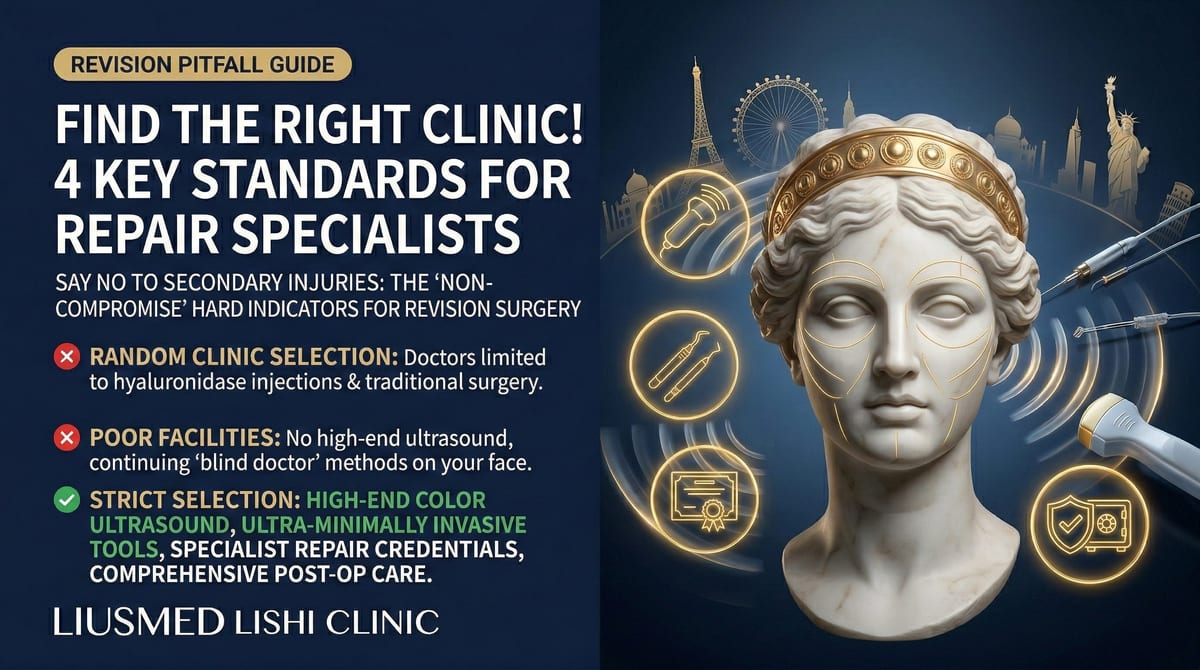
The decision to travel for filler revision should not be taken lightly — but there are clear indicators that it is the right move. If your local providers do not offer ultrasound-guided extraction, if repeated dissolution or steroid treatment has not resolved your issue, if your filler type cannot be identified locally, or if you have been told surgery is needed but no one nearby specializes in minimally invasive revision, these are situations where seeking a specialist center abroad addresses a genuine gap in available care. Taiwan's advantage is not just lower cost — it is the combination of mature technique, high case volume, and systematic ultrasound integration that many regions have not yet developed.
Technical Features of Taiwan's Ultrasound-Guided Extraction
The "See Before You Treat" Philosophy
The core philosophy behind Taiwan's ultrasound-guided extraction approach:
- Complete pre-operative assessment: Comprehensive ultrasound mapping of filler distribution
- Real-time intra-operative guidance: Instruments guided precisely under ultrasound visualization
- Objective post-operative confirmation: Imaging check of what was extracted and what remains, not reliance on tactile assessment alone
Advantages of Minimally Invasive Pinhole Extraction
← Swipe to see more →
| Comparison | Minimally Invasive Pinhole | Traditional Open Excision |
|---|---|---|
| Wound size | 1-2mm pinhole | Multi-centimeter incision |
| Scarring | Usually barely visible | May leave visible scar |
| Stitches | None needed | Required |
| Tissue damage | Less | More |
| Precision | Ultrasound-guided, precise targeting | Relies on surgeon's experience |
Related reading: Ultrasound-Guided Pinhole Extraction Explained
Recommendations Before Choosing Taiwan for Revision
Do Your Research
- Understand your filler type and injection history
- Gather complete medical records
- Start with an online evaluation to understand the severity of your situation
- Read educational articles to build baseline knowledge
Set Realistic Expectations
- Filler revision is not "returning to pre-injection state" but "maximizing improvement"
- Complex cases may require staged procedures
- Post-operative recovery requires time and patience
- Minimally invasive does not mean zero pain or zero swelling
Related reading: Filler Lump Extraction Technique
Conclusion: Evaluate Taiwan for FILLER REVISION on the Merits
Choosing where to undergo filler revision fundamentally involves finding the optimal balance between technical capability, cost burden, and physician-patient trust. Taiwan demonstrates strong competitiveness across all three dimensions — not because of marketing, but because of years of accumulated clinical experience in ultrasound-guided filler revision that many other regions are only beginning to develop.
Related reading: International Patient Guide to Taiwan
Frequently Asked Questions
How is ultrasound-guided pinhole extraction different from traditional open surgery to remove filler?
Minimally invasive pinhole extraction uses only a 1-2mm wound, compared with a multi-centimeter incision for traditional open excision. This means no stitches, a pinhole that heals in about 2 weeks with scarring that is usually barely visible, and less tissue damage — but it is still an extraction, so swelling and bruising usually take about 2–3 weeks to settle, and the final result takes about 3 months, varying from person to person. Because instruments are guided under real-time ultrasound rather than relying on the surgeon's tactile experience alone, targeting can be more precise.
When does it actually make sense to travel abroad to Taiwan for filler revision?
The article points to clear indicators: your local providers do not offer ultrasound-guided extraction, repeated dissolution or steroid treatment has not resolved the issue, or your filler type cannot be identified locally. It also applies when you have been told surgery is needed but no nearby clinic specializes in minimally invasive revision. In these situations, seeking a specialist center abroad addresses a genuine gap in available care rather than just chasing lower cost.
Is minimally invasive filler removal pain-free and swelling-free?
No. The article is honest that minimally invasive does not mean zero pain or zero swelling. While the pinhole approach reduces tissue damage, this is still an extraction: some discomfort is normal, swelling and bruising are expected and usually settle in about 2–3 weeks, the final result takes about 3 months (varying from person to person), and recovery requires time and patience. Setting realistic expectations is part of preparing well for revision.
Will filler revision return my face exactly to how it was before the injections?
The article frames revision realistically: the goal is not "returning to the pre-injection state" but "maximizing improvement." Complex cases may need to be handled in staged procedures rather than a single session, and post-operative recovery takes time. Understanding your filler type and gathering complete medical records beforehand helps the team plan the most appropriate approach.
Why does ultrasound matter so much in filler revision instead of just feeling for the lumps?
The approach follows a "see before you treat" philosophy. Ultrasound is used beforehand to map where the filler is distributed, during the procedure to guide instruments precisely under visualization, and afterward to check what was extracted and what remains using imaging rather than relying on touch alone. This objective imaging at every stage supports more stable, predictable results in complex cases.
Does Taiwan's lower cost mean lower-quality equipment or technique?
No. The article states that cost advantage does not mean quality compromise — the lower medical costs stem mainly from overall cost-of-living differences, not downgraded technology or equipment. Taiwan's system also features rigorous specialist board examinations, strict oversight of medications and devices, and multiple JCI-accredited institutions. Exact fees are explained case-by-case during an online or in-person consultation, since they depend on your specific situation.