One Philosophy, Woven Through Every Stage of Revision
If you are evaluating filler revision options, you have probably noticed that many clinics describe their approach in similar terms — "minimally invasive," "advanced technology," "experienced team." But what actually separates one revision outcome from another? Often, it comes down to the principles guiding every clinical decision.
In the highly specialized field of filler revision, technology and equipment certainly matter — but what truly determines long-term quality is the team's core principles and medical philosophy. Dr. Liu's team's commitment to "Precision Vision, Maximum Minimalism" is not marketing packaging — it is a set of clinical practice principles that run through every stage from diagnosis to surgery to post-operative care.
Why Filler Removal Is Harder Than the Injection: The Brand Film "The Filler Exorcist"
Filler can be placed in minutes. Removing material that has migrated, clumped, or grown into the surrounding tissue is another story. Revision is harder than the first procedure — what a doctor faces is not only the technical problem someone else left behind, but the anxiety, the disappointment, and the confidence in their own appearance that a patient may have been losing for years.
So this time we did not make a standard educational video. We imagined migrated, clumped filler as an uninvited guest living beneath the skin — and a doctor who walks into a dark hospital corridor at night, carrying a medical bag and a lighter, to bring it out. It is not a hero story. What makes difficult revisions possible is the skill, the patience, and the quiet coordination a doctor and team build over many years.
Dramatized creative work, not a depiction of actual medical practice. All characters and events are fictional; no scene represents a real consultation, device, or treatment. Individual conditions still require professional assessment.
"If It Could Go In... It Should Come Out.": A Standard for Filler Revision, Not a Promise of Outcome
The line is about attitude rather than result. Facing something another clinic left behind, we do not close the case by assuming it cannot be taken out — we scan first, establish which layer it sits in and what it has bound itself to, and only then judge what is and is not achievable. It is not a promise. Whether material can be removed, how much of it, and in how many stages depends on what the material is and on the state of the tissue around it; in some situations the reasonable course is to observe first and bring inflammation under control. Realistic expectations: what can be achieved and what cannot sets out that boundary in more detail.
The film stops at the level of principle; the clinical difficulty has a more concrete shape. Re-treating a case after a failed repair is more complex than the first revision (secondary revision after failed repair), and extracting without imaging tends to turn a still-reversible problem into an irreversible one (blind extraction made it worse?). And the patient sitting on the bench in the film stands for the part of the consultation that comes up most often but is discussed least — rebuilding confidence after an aesthetic failure.
"Precision Vision": Diagnosis Is the Foundation of Revision
Why "Seeing" Matters So Much
In traditional filler revision, many physicians rely on palpation, patient descriptions, or even educated guesses to assess problems. But filler distribution in tissue is often far more complex than expected — it may spread, layer, integrate with tissue, or even become encapsulated.
"Precision Vision" means:
← Swipe to see more →
| Principle | Practice | Clinical Significance |
|---|---|---|
| Don't guess, see | All assessments based on ultrasound imaging | Avoiding errors from subjective judgment |
| See everything, miss nothing | Systematic scanning of all potentially affected areas | Avoiding treating only surface-level problems |
| See depth, determine layers | Confirming which tissue layer contains the filler | Determining the safest extraction pathway |
| See changes, assess reactions | Evaluating tissue response to the filler | Deciding whether inflammation control is needed first |
| See vessels, ensure safety | Marking all important vascular locations | Ensuring surgical safety |
Key Insight: In filler revision, "Precision Vision" does not mean "having ultrasound is enough." It means the physician must have sufficient anatomical knowledge and clinical experience to correctly interpret every signal on the ultrasound screen. Seeing is the first step; understanding what you see — and knowing how it changes the surgical plan — is what defines a revision specialist.
From Seeing to Understanding
Dr. Liu's ultrasound examination practice includes:
- Complete scanning: Not just the area the patient identifies, but systematic scanning of the entire face
- Material identification: Determining filler type based on echo characteristics
- Extent mapping: Precise measurement of filler boundaries and depth
- Vascular localization: Pre-operatively confirming all structures that must be avoided
- Image documentation: Preserving complete ultrasound records for surgical planning and post-operative comparison
Related reading: Ultrasound (Ultrasonography)-Guided Pinhole Extraction Explained
"Maximum Minimalism": Achieving Maximum Results with Minimum Impact
Minimally Invasive Means More Than "Small Wounds"
Many equate "minimally invasive" with "small incisions," but in Dr. Liu's philosophy, maximum minimalism encompasses far more:
← Swipe to see more →
| Dimension | Conventional Understanding | True Meaning of Maximum Minimalism |
|---|---|---|
| Wound | Smaller incision is better | Choose the smallest entry point while ensuring adequate operative space |
| Tissue | Avoid cutting | Precisely target objectives, maximally preserve surrounding normal tissue |
| Time | Faster surgery is better | Reduce tissue exposure time while ensuring quality |
| Frequency | Staged rather than forced into one session | Remove roughly 30–50% in the first session and reassess once swelling settles; clearing everything at once risks depressions |
| Recovery | Quick recovery | Minimize overall trauma for smoother natural healing |
Technical Implementation of Maximum Minimalism
← Swipe to see more →
| Technical Element | Practice |
|---|---|
| Pinhole entry | Operating through a 1-2mm pinhole, with no incision |
| Ultrasound guidance | Full image guidance ensuring every step is precise |
| Selective extraction | Removing only the filler, not damaging surrounding tissue |
| Real-time verification | Continuous scanning to confirm extraction progress |
| Minimized manipulation | Avoiding unnecessary tissue exploration and flap creation |
Key Insight: The core of maximum minimalism is not "daring to operate through a small wound" — it is "having the ability to achieve precision, smoothness, and safety through a small wound." This requires both ultrasound guidance technique and deep anatomical foundation.
Related reading: Filler Lump Extraction Technique
How Philosophy Translates to Clinical Decisions
Decision Principles
In every clinical case, "Precision Vision, Maximum Minimalism" translates to these decision principles:
← Swipe to see more →
| Scenario | Decision Principle | Practical Example |
|---|---|---|
| Conservative if possible | If the issue can resolve with medication or time, don't rush to surgery | Control mild inflammation with medication first |
| Pinhole only, never open | Extraction is always through pinholes of about 2 mm, never open excision; extensive cases are treated zone by zone over several sessions | Ultrasound-guided pinhole extraction |
| Remove less when possible | Only extract what must be removed, preserve harmless material | Selective extraction of problematic areas |
| Staged rather than emptied at once | Aim for a smooth, even contour, not total removal in one go | About 30–50% in the first session, reassess after the tissue settles |
| Don't risk uncertainty | Prefer cautious observation over operating with uncertainty | Pause and re-evaluate |
Honest Communication with Patient Expectations
In the revision field, patients often arrive with strong expectations. The "Precision Vision" philosophy extends to communication:
- Honestly communicate what can and cannot be achieved
- Never over-promise to retain a patient
- If outcomes are uncertain, recommend observation
- Respect the patient's autonomy in decision-making
When to Seek a Revision Specialist with a Defined Philosophy
Many patients arrive for filler revision after one or more attempts that fell short — not necessarily because of poor technique, but because the treating physician lacked a consistent framework for making difficult decisions. If your previous revision left residual material, caused unexpected tissue damage, or required multiple follow-up procedures, it may indicate that the approach was reactive rather than principled. A filler revision team guided by a clear philosophy — one that prioritizes seeing before acting and achieving maximum results with minimum disruption — is better equipped to navigate the unpredictable challenges that complex cases present.
The Formation of This Philosophy
From Clinical Observation to Core Beliefs
Dr. Liu's revision philosophy did not appear from nowhere — it emerged from years of clinical observation:
- Seeing too many patients requiring second or third surgeries due to careless first revisions
- Cases where blind extraction damaged tissue that should not have been touched
- The surface meaning of "minimally invasive" being misused while actual procedures lacked precise guidance
- Patients whose trust in medicine collapsed after multiple failures
These observations drove a conviction: Revision should not create more problems. It should proceed with maximum caution, guided by what can be seen, achieving the best results at the lowest possible cost.
Applying the Philosophy Across Different Scenarios
Simple Cases
Even in relatively straightforward cases, "Precision Vision, Maximum Minimalism" is never compromised:
- Complete ultrasound assessment is still performed
- Vessels and safe pathways are still marked
- The smallest possible wound still achieves the extraction
Complex Cases
For complex cases, this philosophy provides a decision framework:
- If findings are more complex than anticipated, stage the procedures rather than risk doing everything at once
- If ultrasound shows vessels too close, adjust the extraction pathway rather than force the approach
- If mixed materials are discovered, identify each separately and treat accordingly
International Patients
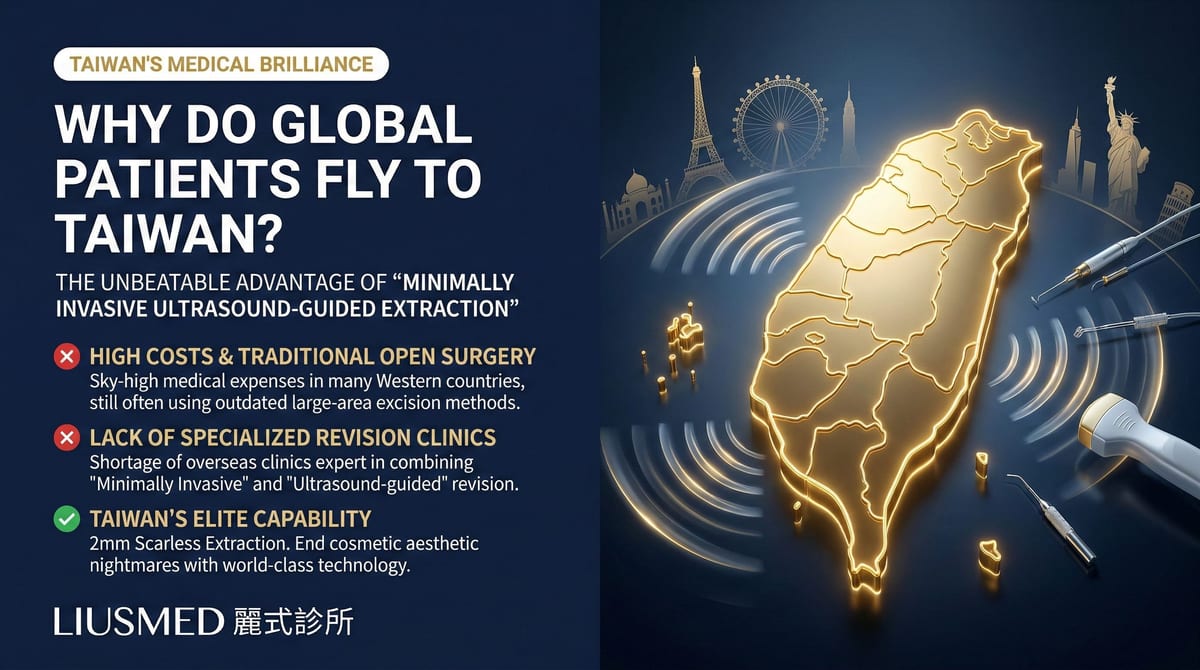
For patients who travel specifically to Taiwan:
- Thorough pre-trip communication to reduce expectation gaps
- Extra surgical caution, as patients cannot return for frequent follow-ups
- Comprehensive remote follow-up protocols established post-operatively
Conclusion: In FILLER REVISION, Philosophy Determines Quality
In medicine, techniques can be learned, equipment can be purchased, but philosophy cannot be replicated. "Precision Vision, Maximum Minimalism" is Dr. Liu's team's commitment to filler revision — we do not pursue maximum surgical volume, but rather optimal quality for every single case. This philosophy exists because revision patients deserve a team that treats their situation with the precision and restraint it demands.
Related reading: Why You Need a Dual-Specialty Team
Frequently Asked Questions
Why does Dr. Liu rely on ultrasound imaging instead of just feeling the filler by hand?
Filler in tissue can spread, layer, integrate with tissue, or become encapsulated, so palpation and guesswork are often unreliable. Dr. Liu's "Precision Vision" principle bases every assessment on ultrasound imaging — seeing depth and layers, mapping the filler's extent, and marking vessels before acting. Imaging alone is not enough, though: the physician must have the anatomical knowledge and clinical experience to correctly interpret what the screen shows.
Does the ultrasound only check the spot I am worried about, or my whole face?
The scan is not limited to the area you point out. Dr. Liu performs systematic scanning of the entire face so that potentially affected areas are not missed and treatment is not limited to surface-level problems. The exam also identifies the filler type from echo characteristics, measures its boundaries and depth, and confirms which structures must be avoided — and these records are kept for surgical planning and post-operative comparison.
How small is the entry point, and will the surrounding normal tissue be damaged during extraction?
The procedure works through 1-2mm pinholes under full ultrasound guidance. The goal is selective extraction — removing only the filler while preserving surrounding normal tissue — with continuous real-time scanning to confirm progress and minimal manipulation to avoid unnecessary tissue exploration. The core of this approach is the ability to achieve precision, smoothness, and safety through a small wound, not simply daring to use one.
If a procedure might be avoidable, will Dr. Liu still recommend one right away?
No — the philosophy prioritizes conservative decisions. If an issue can resolve with medication or time, surgery is not rushed; for example, mild inflammation may be controlled with medication first. Extraction is done only through pinholes, never by open excision (extensive cases are treated zone by zone over several sessions), and only what must be removed is taken out, preserving harmless material. If the outcome is uncertain, cautious observation is preferred over operating with uncertainty.
Will I be told honestly what can and cannot be fixed, even if it means I might not proceed?
Yes. Honest communication is a core principle: the team honestly tells you what can and cannot be achieved and never over-promises just to retain a patient. If the outcome is uncertain, observation may be recommended rather than treatment, and your autonomy in the final decision is respected.
I would travel to Taiwan from overseas for this — how are international patients handled differently?
For patients traveling specifically to Taiwan, the team does thorough pre-trip communication to reduce expectation gaps before you arrive. Because frequent in-person follow-ups are not possible, extra surgical caution is applied, and comprehensive remote follow-up protocols are established after the procedure.