Autologous Fat: Natural Does Not Mean Risk-Free
If you chose fat grafting because it seemed like the safest, most natural option — and now you are feeling hard lumps where the fat was placed — you are experiencing one of the least-discussed complications in aesthetic medicine. You may have been told this was impossible because it was "your own tissue." But a natural source does not guarantee a natural outcome. The survival rate of grafted fat is never 100%, and the fat that does not survive is where problems begin.
When fat cells cannot establish adequate blood supply in their new environment and die, the body must process this necrotic tissue. The outcome may be harmless absorption, but it can also be oil cysts, fibrous encapsulation, or — most troublingly — calcification.
Key Insight: At FILLER REVISION, our clinical experience confirms that the core challenge of autologous fat grafting is not the "injection" itself but "survival." Grafted fat survival rates typically range from 30-70%, meaning a significant proportion of fat cells will die after transplantation. The fate of necrotic fat — absorption, cyst formation, or calcification — depends on the volume of necrosis, its location, and individual tissue response.
The Science of Fat Graft Survival
Why Doesn't All Grafted Fat Survive?
Survival of grafted fat depends heavily on one factor: how quickly new blood vessels form. After fat cells are transplanted to a new location, their survival hinges on re-establishing a blood supply (neovascularization) with the surrounding tissue during the early post-transplant window — commonly cited as roughly the first 48-72 hours. Cells that remain unperfused beyond this period are prone to dying from oxygen deprivation, though the exact timing varies with graft size, injection technique, and the recipient site's vascularity. The structural fat grafting technique itself is detailed in Coleman's foundational work (Coleman, 2006).
Factors Affecting Survival Rate:
← Swipe to see more →
| Factor | Favorable for Survival | Unfavorable for Survival |
|---|---|---|
| Injection technique | Small volumes, multiple points, fan distribution | Large bolus, concentrated injection |
| Fat processing | Gentle centrifugation, maintained viability | Excessive processing, prolonged exposure |
| Recipient site vascularity | Well-vascularized tissue bed | Scarred tissue, irradiated areas |
| Injection plane | Multi-layer injection | Single-plane large volume |
| Patient factors | Non-smoker, good nutrition | Smoking, diabetes, vascular disease |
| Volume | Appropriate (matched to recipient capacity) | Excessive (beyond recipient nourishment capacity) |
The Three-Zone Theory (Coleman Theory)
A grafted fat bolus can be divided into three concentric zones:
Surviving Zone: The outermost layer, closest to surrounding blood vessels. Fat cells obtain oxygen and nutrients through diffusion before new vessels form, achieving the highest survival rate.
Regenerating Zone: The middle layer. Some fat cells die, but adipose-derived stem cells (ADSCs) may survive and participate in tissue regeneration, a concept further explored in cell-assisted lipotransfer research (Yoshimura et al., 2008).
Necrotic Zone: The center of the bolus. Too far from blood vessels to receive any oxygen supply. All fat cells die within days of transplantation.
Key Insight: This is why large-bolus injection carries far higher calcification risk than small-volume multi-point technique — the larger the bolus, the larger the central necrotic zone, and the higher the probability of complications. Understanding this principle is key to prevention.
From Necrosis to Calcification: The Pathological Progression
Phase 1: Fat Necrosis (Days to Weeks)
Fat cells that fail to survive rupture, releasing intracellular lipids (primarily triglycerides). These free lipids accumulate as oil droplets, stimulating surrounding macrophages to initiate a clearance response.
Phase 2: Oil Cyst Formation (Weeks to Months)
When the volume of necrotic fat exceeds macrophage clearance capacity, free lipids become encapsulated by fibrous tissue, forming oil cysts. The cyst contents are liquid oil, and they feel soft or fluctuant on palpation.
Phase 3: Fibrosis and Saponification (Months to Years)
The oil cyst wall gradually undergoes fibrous thickening. In some cases, fatty acids combine with calcium ions in tissue fluid, undergoing saponification — a precursor step to calcification.
Phase 4: Dystrophic Calcification (Months to Years)
Calcium salts deposit in the necrotic tissue, forming dystrophic calcification. This is not caused by systemic calcium metabolism abnormalities but is a local response in necrotic tissue. Calcification patterns include:
- Eggshell calcification: Calcium deposits on the cyst wall, forming a hard shell
- Coarse calcification: Irregular calcified masses
- Microcalcification: Fine, scattered calcification points
Clinical Presentation and Concerns
Palpable Changes
The most common complaint is feeling a hard lump. Unlike lumps from other fillers, fat calcification feels much harder — closer to bone — because it is essentially calcium salt deposition.
Imaging Characteristics
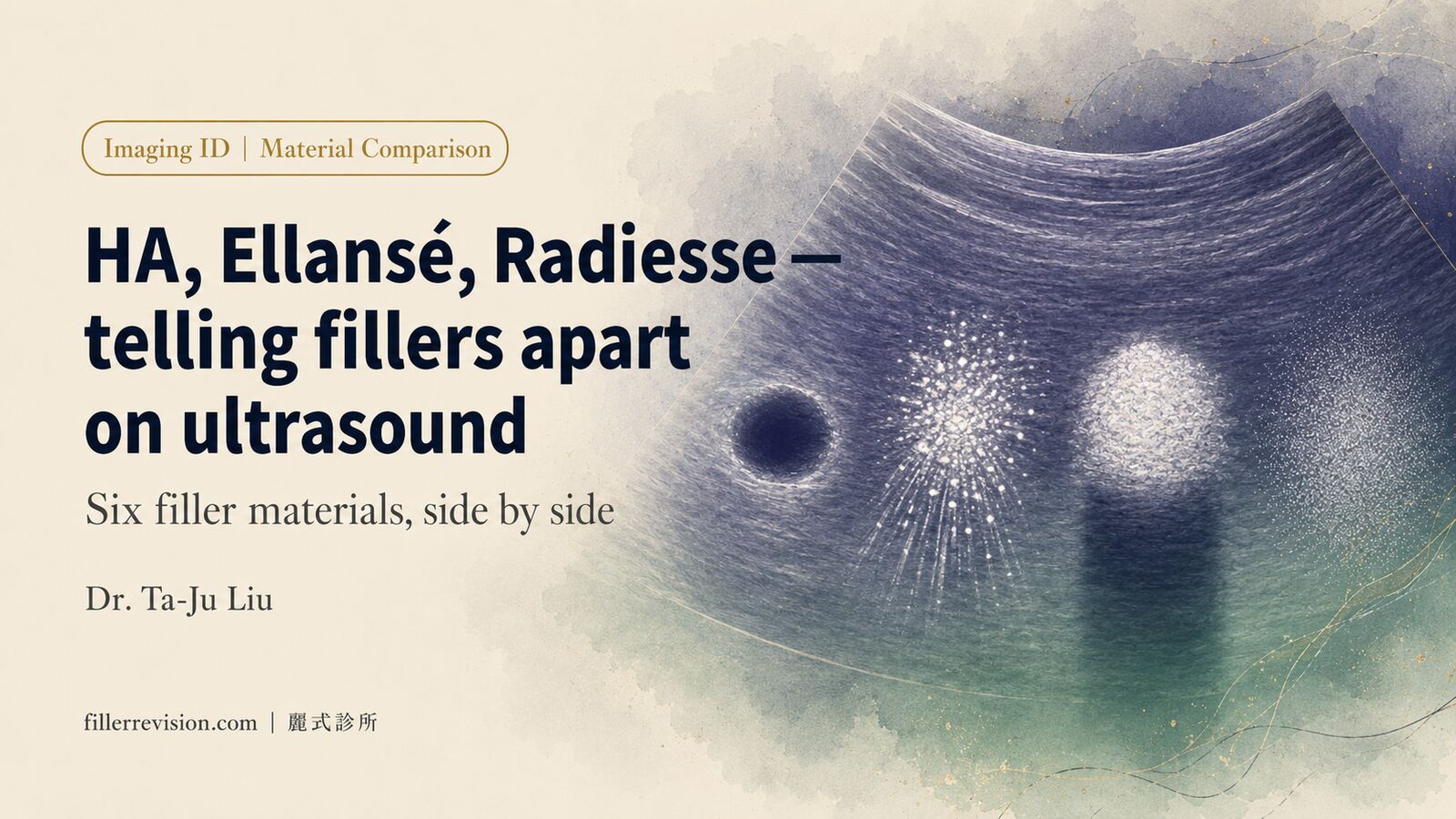
- Ultrasound (Ultrasonography): Hyperechoic with posterior acoustic shadowing, similar to calcium-based filler appearance on ultrasound
- X-ray/CT (Computed Tomography): Calcification is directly visible, more intuitive than ultrasound
- MRI (Magnetic Resonance Imaging): Calcification appears as low signal on all sequences; MRI and ultrasound each have advantages
Breast Screening Cross-Interference
Calcification after fat grafting to the breast is a particularly sensitive issue. Fat calcification on mammography can mimic microcalcifications associated with breast cancer, potentially leading to unnecessary biopsies or surgery.
Clinical Implications for Revision Patients
Fat calcification presents unique challenges that differ fundamentally from synthetic filler complications. At FILLER REVISION, patients with calcified fat deposits often arrive after being told nothing can be done short of open surgery. However, ultrasound-guided minimally invasive approaches can precisely locate calcified deposits — even when they are small and scattered — and address them without the scarring risks of traditional surgical excision. The key is accurate imaging: calcification produces a distinctive ultrasound signature that allows precise localization and targeted treatment planning. For patients concerned about breast calcification after fat grafting, ultrasound assessment can also help distinguish fat-related calcification from suspicious findings, potentially avoiding unnecessary biopsies.
Treatment Challenges of Fat Calcification
Why Is Calcification Especially Difficult to Treat?
Unlike hyaluronic acid, which can be dissolved with hyaluronidase, calcification has no pharmaceutical solution. Treatment options are limited:
Conservative Observation: If calcification is small and asymptomatic, observation is reasonable. However, calcification typically does not resolve spontaneously.
Surgical Excision (traditional approach): Larger calcified masses are traditionally removed by open excision. But facial surgery carries scarring risks, and widely distributed calcification is difficult to completely remove this way. We do not perform surgical excision; when calcification is extensive, widespread or deep, we treat it zone by zone over several sessions, still through pinholes of about 2 mm.
Ultrasound-Guided Precision Treatment: Under high-resolution ultrasound guidance, calcification can be precisely located and treated through minimally invasive approaches. This is currently the most accurate method, but requires the operator to have experience in ultrasound-guided intervention. Learn more about filler extraction techniques.
← Swipe to see more →
| Treatment | Indicated For | Advantages | Limitations |
|---|---|---|---|
| Conservative observation | Small, asymptomatic | Non-invasive | No improvement |
| Surgical excision (traditional; not offered here) | Large, localized | Complete removal possible | Scarring risk |
| Ultrasound-guided minimally invasive | Most situations | Precise, minimally invasive | Requires specialized equipment and skill |
Prevention Strategies
The core of preventing fat calcification is improving fat survival and reducing necrosis:
- Small-volume, multi-point injection technique: Small amounts at each injection point to increase vascular contact surface area
- Multi-layer injection: Avoid forming large boluses in a single plane
- Appropriate volume: Avoid overfilling; consider the recipient site's vascular nourishment capacity
- Gentle fat processing: Minimize ex-vivo damage to fat
- Post-operative care: Avoid compressing the grafted area; maintain good blood circulation
Learn more about pillow face correction and the filler repair evaluation process. If you are experiencing hard lumps after fat grafting, FILLER REVISION provides ultrasound-guided assessment to determine the exact nature and location of the problem — because when no dissolving enzyme exists, precision imaging is the essential starting point.
Key Insight: Managing autologous fat grafting complications is often more challenging than synthetic filler complications — there is no dissolving enzyme available, and once calcification forms, it cannot be treated with medication. This does not mean fat grafting is bad, but reminds us: any filling method has its own unique risk profile, and the precision of technique directly influences complication rates.
Frequently Asked Questions
Will calcified fat eventually go away or be metabolized on its own?
No. Calcification is dystrophic calcium-salt deposition — an end-stage tissue product. Once it forms, the body has no mechanism to metabolize it away. Unlike temporary post-procedure swelling, a calcified focus stays put and can even harden further as the surrounding fibrosis matures. Simply waiting leaves the palpable, imaging-visible lump unchanged.
Can calcified fat be dissolved with an enzyme or medication?
No. HA fillers have hyaluronidase to dissolve them, but neither fat nor calcified fat can be broken down by any enzyme or injectable. Steroids may help with inflammation but cannot remove deposited calcium, and repeated injections risk atrophy of the surrounding fat and thinning skin. Addressing a calcified focus relies mainly on physical extraction.
How is a calcified fat lump treated, and will removal leave a scar?
Under high-resolution ultrasound guidance, the location, size, and depth of each calcified focus can be precisely mapped and then extracted through a pinhole-sized entry — without the long incision of conventional surgery. The pinhole heals in about 2 weeks and in most cases then sits unobtrusively in the skin's natural texture (how it heals still depends on the individual). The pinhole is small, but this is an extraction, so swelling and bruising are expected; they usually settle in about 2–3 weeks, and the final result takes about 3 months, varying from person to person.