Two kinds of "minimally invasive" that often get mixed up
"Minimally invasive" is used for both lipoma surgery and filler removal, but it means different things. A lipoma is a whole mass of tissue under the skin; getting it out means cutting, and "minimally invasive" describes how much smaller than the tumour the incision can be. A filler lump is injected material plus the tissue reaction around it. It can come out through a pinhole, with no incision at all.
So when you read claims like "incision under 20%" or "a 5 cm lump through a 1 cm wound", first work out which kind of procedure they are describing.
"20%" is a lipoma surgery standard
In surgery that has to cut, such as lipoma removal, the aim is to keep the incision as small as possible relative to the tumour. With a large lipoma, a lipoma of 10 cm or more needs a wound of only about 2 cm, roughly 20% of its size. That ratio is where the "incision under 20%" rule comes from.
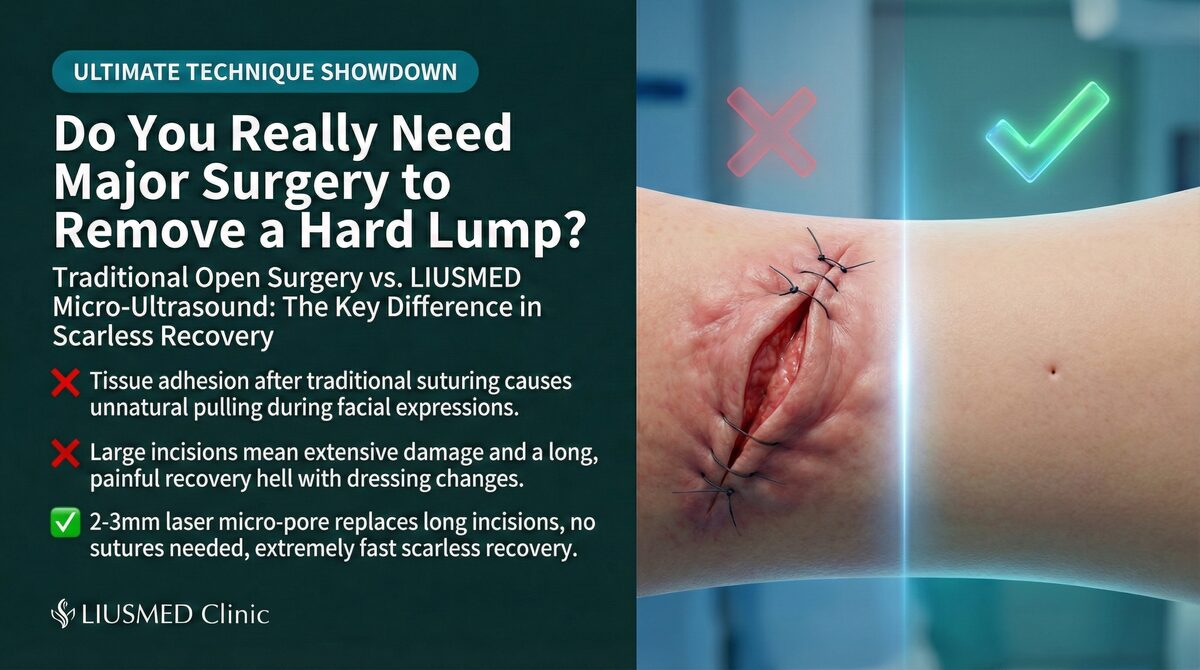
Traditional excision often opens an incision close to the length of the tumour so it can be seen and lifted out whole. Bringing that down to around 20% depends on planning, instruments and surgical technique working together.
Filler lumps: no incision, a single pinhole of about 2 mm
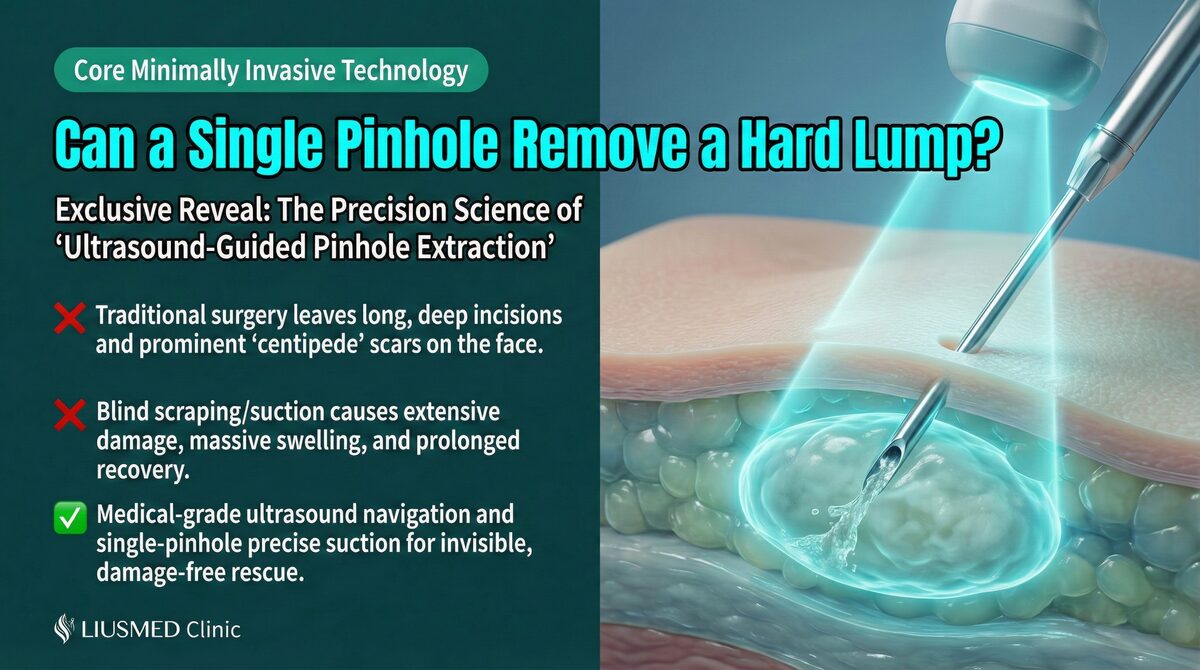
Filler removal is a different matter. We remove filler with no incision, through a single pinhole of about 2 mm, under real-time ultrasound guidance.
This works because ultrasound shows the position, depth and edges of the lump, and the vessels and nerves around it, from outside the skin, so there is no need to open the skin to see. The instrument goes in through the pinhole and the work is checked on the ultrasound screen as it goes. When a deposit is very large or spread over several areas, it may be handled through 2–3 pinholes, zone by zone, or over more than one session; each one is still a pinhole, not an incision.
For how ultrasound guidance works, see Ultrasound-Guided Pinhole Extraction Explained; for pinhole extraction compared with traditional surgery, see Minimally Invasive Ultrasound Extraction vs. Traditional Open Surgery.
Key point: Before asking how big the wound will be, ask whether this is an incision or a pinhole. The 20% rule belongs to lipoma surgery, which cuts; filler lumps are removed through a pinhole, and the two can't be compared.
Recovery after pinhole extraction
The pinhole is small, but this is an extraction, so swelling and bruising are expected, and we do not claim a short recovery. Swelling and bruising usually settle in about 2–3 weeks, the pinhole heals in about 2 weeks, and the final result takes about 3 months, varying from person to person. What you see in the first few weeks is not the final picture; after extraction there is a period in which the swelling settles and firmness gradually softens, and we go through the details at your consultation.
Where the pinhole goes, and scarring
Even a pinhole is placed with care. Where possible it goes in a natural crease, near the hairline or somewhere inconspicuous. How visible any mark is also depends on your skin; if you tend to form keloids or hypertrophic scars, say so at the consultation.
Frequently Asked Questions
Does the "incision under 20%" rule apply to filler removal?
No. The 20% rule is a standard for surgery that has to cut, such as lipoma removal, where a lipoma of 10 cm or more needs a wound of only about 2 cm. We remove filler with no incision, through a single pinhole of about 2 mm.
Can such a small pinhole get the filler out properly?
In most cases the majority can be removed, but not 100%, and it varies from person to person. How much comes out depends on the material, how fibrotic it is and how firmly it is attached to the surrounding tissue. Ultrasound lets each area be checked during the procedure. For more on technique, see Filler Lump Extraction Technique.
What if the lump is very large or widespread?
When a deposit is very large or spread over several areas, it may be handled through 2–3 pinholes, zone by zone, or over more than one session, letting the swelling in each area settle before deciding the next step. The actual plan depends on the ultrasound assessment.
Will the pinhole leave a scar?
The pinhole heals in about two weeks and is usually barely visible afterwards. Scarring still depends on your skin, so tell your doctor beforehand if you tend to form keloids.
Questions to ask at a consultation
- "Is this a pinhole extraction, or will you need to make an incision?": confirm which kind of procedure it is
- "Will you use ultrasound guidance?": confirm how the filler will be located
- "Where will the pinhole be, and how many will there be?": think about where any mark will sit
- "How soon can I get back to normal, and when will I see the final result?": understand the recovery
- "If it can't all come out in one session, what happens next?": understand the staged plan
Conclusion
"Minimally invasive" only makes sense once you know which procedure is meant. A lipoma has to be cut out, and 20% is the standard for keeping that cut small. A filler lump does not need cutting; we use a single pinhole of about 2 mm. If you are considering filler removal and worried about the wound or a scar, bring your photos and past injection records to a consultation.