The Fundamental Difference Between Two Surgical Paths
"My previous doctor said the primary way to get this filler out is through open surgery — but I'm terrified of the scarring." At FILLER REVISION, we hear this dilemma regularly. When filler complications cannot be resolved through non-surgical methods such as dissolving enzyme injections, surgical intervention becomes necessary. Currently, there are two primary surgical approaches: Ultrasound (Ultrasonography)-Guided Minimally Invasive Extraction and Traditional Open Surgical Excision.
These two methods are not simply a matter of "old versus new technology" — they represent fundamentally different treatment philosophies:
- Minimally invasive ultrasound extraction: Aims for minimal tissue damage, precisely removing filler under real-time ultrasound guidance through a pinhole of about 2 mm
- Traditional open excision: Aims for complete exposure, directly visualizing and excising the lesion through a larger incision
Key Insight: At FILLER REVISION, we've built our entire practice around this principle: choosing a surgical method should not focus solely on "can the filler be removed" but must also evaluate "what is the cost of removal." A successful revision surgery should maximize preservation of normal tissue structure and appearance while clearing the filler.
Comprehensive Comparison Across Core Dimensions
Surgical Method Comparison Table
← Swipe to see more →
| Dimension | Ultrasound-Guided Minimally Invasive Extraction | Traditional Open Excision |
|---|---|---|
| Wound size | Pinhole of about 2 mm, no incision | Incision sized to the lesion |
| Localization method | Real-time ultrasound guidance | Direct visual inspection |
| Anesthesia | Local anesthesia plus gentle pain-relief anesthesia | Local or general anesthesia |
| Operating time | 30 minutes to 2 hours | 1 to 4 hours |
| Blood loss | Minimal | Moderate to significant |
| Tissue preservation | High preservation of normal tissue | Normal tissue may be excised along with filler |
| Post-operative scarring | Pinhole-sized, nearly invisible | Linear scar, visibility depends on location |
| Recovery period | Swelling and bruising settle in about 2–3 weeks; final result in about 3 months (varies by person) | Incision, plus suture removal and scar care |
| Need for secondary reconstruction | Lower | Higher |
| Repeatability | Can be staged across sessions | Repeat surgery significantly more difficult |
Wound Size: Why It Matters So Much
Our approach: a pinhole of about 2 mm, no incision
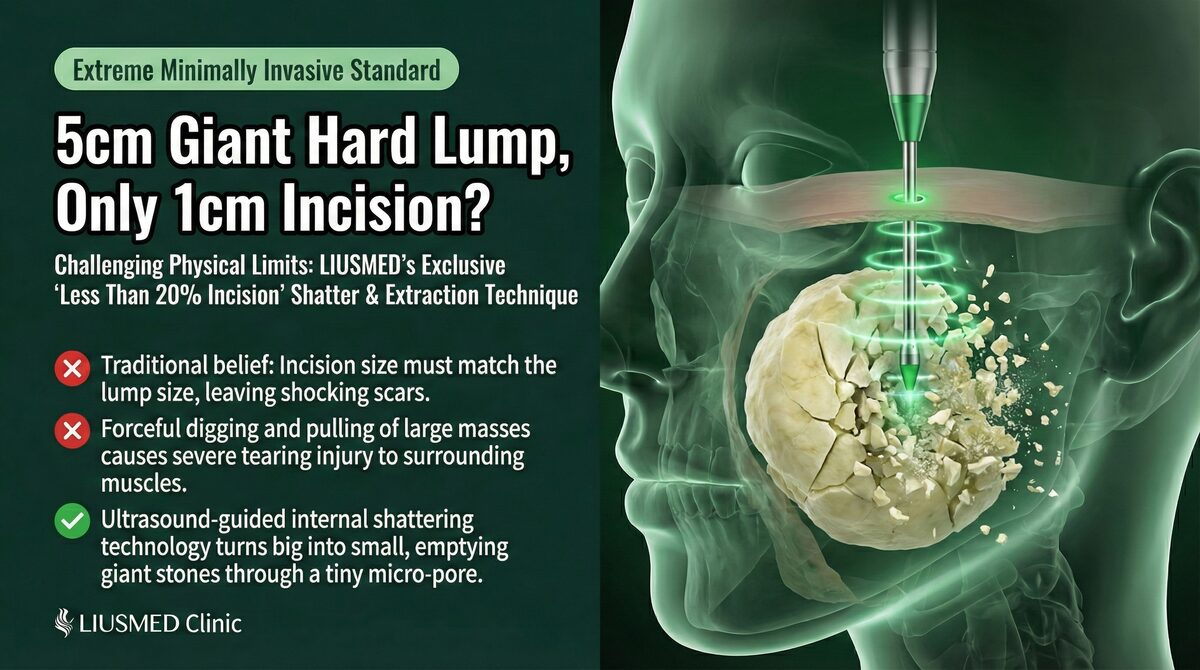
Filler extraction here involves no incision. The material is removed through a single pinhole of about 2 mm under real-time ultrasound guidance.
The "incision no larger than 20% of the lesion" rule you may see quoted is a standard for surgery that does require an incision, such as lipoma removal. It does not apply to filler extraction.
Traditional Excision Incisions
Traditional surgery requires sufficient exposure to "see directly":
- Incisions are typically equal to or larger than the lesion
- Skin flaps must be elevated to visualize the pathology
- Deep fillers require even wider dissection
Key Insight: Incision size directly determines the visibility of scarring and the degree of normal tissue damage. On the face — an area extremely sensitive to appearance — every millimeter of incision requires careful deliberation.
The Fundamental Difference in Localization Accuracy
Ultrasound Guidance: Seeing Everything Beneath the Skin
The greatest advantage of ultrasound-guided extraction is real-time intra-operative imaging:
← Swipe to see more →
| Function | Clinical Significance |
|---|---|
| Real-time localization | Knowing exactly where the filler is |
| Depth assessment | Knowing which tissue layer the filler occupies |
| Boundary delineation | Distinguishing filler from normal tissue |
| Vascular avoidance | Visualizing vessel positions in real time to prevent bleeding |
| Nerve protection | Identifying nerve pathways to reduce injury risk |
| Residual confirmation | Intra-operative check of what has been removed and what remains |
Traditional Excision: Relying on Naked-Eye Judgment
Traditional surgery relies on the surgeon's direct visual observation:
- Only pathology within the exposed incision area can be seen
- Boundaries of deep or peripheral filler are difficult to discern with the naked eye
- Certain fillers that resemble normal tissue color cannot be distinguished visually
- There is no real-time ability to confirm residual clearance
For more on the risks of operating without imaging, see The Danger of Blind Extraction Without Ultrasound.
Post-Operative Recovery Comparison
Recovery Timeline
← Swipe to see more →
| Recovery Phase | Ultrasound-Guided Extraction | Traditional Open Excision |
|---|---|---|
| Early days | Swelling and bruising are most noticeable; you can go home | Swelling and bruising, plus an incision and stitches; observation may be needed |
| Wound | The pinhole heals in about 2 weeks; no stitches to remove | Suture removal, then the scar begins to mature |
| About 2–3 weeks | Swelling and bruising mostly settled | Scar still visible, ongoing care required |
| About 3 months | The final result, varying from person to person | Scar gradually fading |
Key Insight: We do not claim a shorter recovery than open surgery — both involve swelling and both take time. The difference is whether the wound is a pinhole or an incision, and whether a linear scar is left. After extraction there is a period in which the swelling settles and firmness gradually softens; we go through the details at your consultation.
Scarring Comparison: Every Line on the Face Matters
Scarring from Minimally Invasive Extraction
- No incision, only a pinhole of about 2 mm
- Natural creases are used to conceal the entry point
- Heals in about 2 weeks and then usually becomes hard to see (skin type still matters)
- No special scar management required
Scarring from Traditional Excision
- Linear scar with length comparable to the lesion
- Even with meticulous suturing, a visible mark may remain
- Scar revision surgery may be needed subsequently
- Higher risk for patients with keloid tendencies
Tissue Preservation and Functional Maintenance
Why Tissue Preservation Is Critical
The purpose of filler revision is not merely to "remove foreign material" but to restore normal appearance and function. If too much normal tissue is destroyed during extraction:
- Post-operative depression or asymmetry may result
- Facial expression muscle function may be affected
- Local blood circulation may be compromised
- The difficulty of secondary reconstruction increases dramatically
Tissue Preservation Comparison
← Swipe to see more →
| Preservation Indicator | Ultrasound-Guided Extraction | Traditional Open Excision |
|---|---|---|
| Skin integrity | Highly preserved | Partially sacrificed |
| Subcutaneous tissue | Precisely preserved | May be excised alongside filler |
| Vascular network | Protected via ultrasound avoidance | May be damaged |
| Nerve branches | Real-time identification and protection | Avoided by experience only |
| Fascial structures | Preserved whenever possible | May be disrupted |
What Ultrasound Adds When Open Surgery Has Left Residue
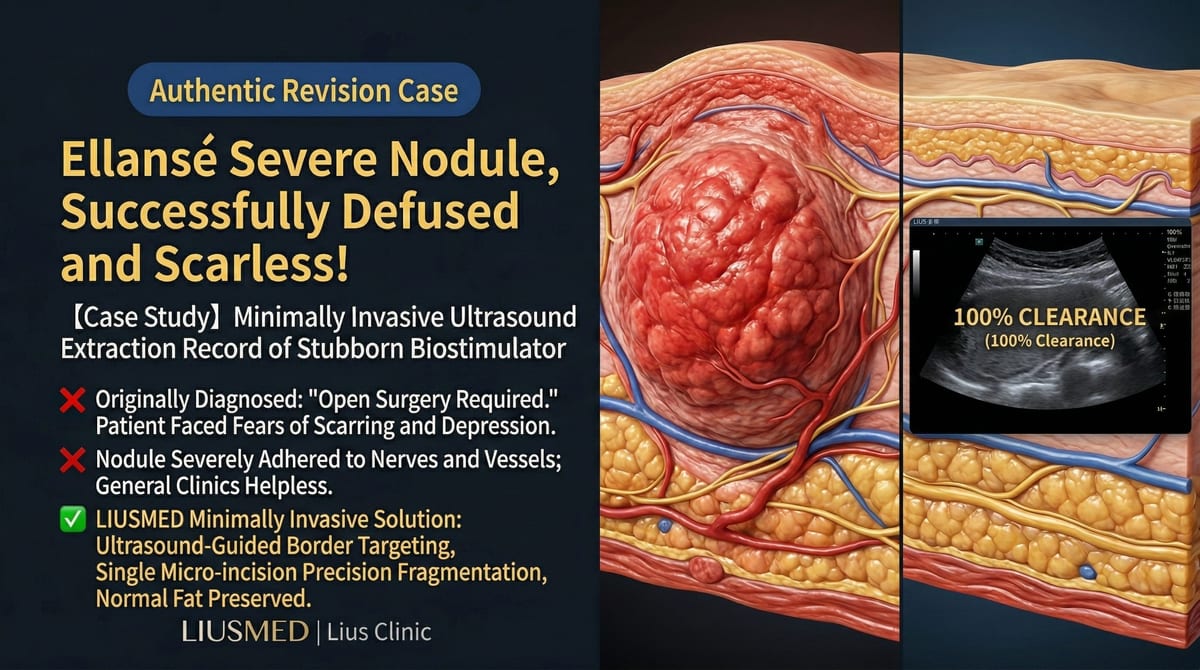
It is not unusual for residue to remain after open surgery and need further treatment. Ultrasound shows scattered material that the naked eye cannot see, and that is where pinhole extraction can help. Continuous ultrasound monitoring maps where the filler sits throughout the procedure, so deposits outside an incision's field of view can be located and removed through a pinhole of about 2 mm — zone by zone, and over more than one session when needed. We can't guarantee 100% removal; the goal is as much improvement as can be achieved safely. If you were previously told you needed open excision, an ultrasound assessment can show whether pinhole access suits your case.
Clearance: How Much Can a Pinhole Remove?
This is the question most patients worry about. It is not unusual for residue to remain after open surgery and need further treatment; ultrasound shows scattered material the naked eye cannot see, and that is where pinhole extraction can help. We can't guarantee 100% removal; the goal is as much improvement as can be achieved safely, and a return to natural contours:
How Pinhole Extraction Works Toward a Clean Result
- Real-time ultrasound confirmation: Each portion is scanned immediately after removal, so residue is less likely to be missed
- Deep accessibility: Deep fillers can be reached through a pinhole, with no incision
- Multi-angle access: The same area can be approached from different directions
- Staged treatment: Complex cases can be treated precisely across multiple sessions
Limits of Relying on Direct Vision
- Limited visual field: Only pathology within the exposed area can be addressed
- Deep residual: The naked eye may miss all residual deposits
- Marginal residual: Diffuse filler beyond incision margins may be overlooked
- Confirmation difficulty: No real-time verification comparable to ultrasound scanning
For more on extraction techniques, see Filler Lump Extraction Technique.
Clinical Scenario Analysis
Scenarios Where Minimally Invasive Extraction Is Preferred
- Filler revision in any facial area
- Multi-point distributed filler residual
- Deep-layer fillers
- Patients with high expectations regarding scarring
- Complex cases requiring staged treatment
- Cases requiring re-treatment after prior surgical failure
Large, Widespread or Infected Cases
We do not switch to open excision for these. Very large encapsulated masses, widely distributed or deep multi-layer material, and cases with concurrent infection are treated zone by zone (possibly with 2–3 pinholes of about 2 mm), over more than one session when needed; an active infection is brought under control first. If reconstruction is needed afterwards, it is planned as a separate step.
Frequently Asked Questions
"Can minimally invasive methods really handle large areas of filler?"
It can, although depending on the extent and depth, it may need to be done zone by zone, in stages, or over more than one session. With ultrasound guidance, the physician can address a considerable area from a single pinhole. Very widespread cases are treated zone by zone (possibly with 2–3 pinholes of about 2 mm), over more than one session when needed.
"What if the filler isn't completely removed?"
This is where real-time ultrasound helps. During the procedure, the physician repeatedly scans to check what has been removed, and residual material that is found is removed as far as can be done safely. Even so, we can't guarantee 100% removal; the goal is as much improvement as can be achieved safely, and depending on the extent and depth, more than one session may be needed.
"Is it more expensive than traditional surgery?"
Costs depend on the extent of each case and are explained individually at consultation. Contact Liusmed Clinic for a detailed evaluation.
Conclusion: Key Considerations in Choosing a Revision Method
Choosing a surgical method for filler revision should not focus solely on "whether it can be removed" but must comprehensively consider:
- Extraction: How much can be removed safely
- Tissue cost: How much normal tissue must be sacrificed
- Aesthetic impact: Whether scarring affects appearance
- Recovery cost: How long until normal life resumes
- Long-term outcome: Whether additional repair or reconstruction is needed
At FILLER REVISION, pinhole extraction is the only approach we use to remove filler; we do not perform open excision, and extensive cases are treated zone by zone over several sessions. We aim to remove as much as can be done safely without an incision scar — we do not promise a shorter recovery: swelling and bruising usually settle in about 2–3 weeks, and the final result takes about 3 months, varying from person to person.
If you have been told open surgery is your primary option, we encourage you to explore what FILLER REVISION's minimally invasive technique can achieve for your specific case.
For details on the pre-operative evaluation, see Filler Repair Evaluation Process.