Juvelook & Lenisna (PDLLA + HA Composite) — Collagen-Stimulating Skin Booster, Nodules & Removal
Juvelook · Lenisna · VIVABELLA
A collagen-stimulating injectable that combines PDLLA (poly-D,L-lactic acid) microspheres with non-cross-linked hyaluronic acid. It is marketed as a "skin booster": the HA phase gives light immediate hydration and volume, while the PDLLA phase stimulates the body's own collagen over the following months. Made by VAIM Co. (South Korea). Lenisna is a higher-concentration version, also known as Juvelook Volume.

Composition
Poly-D,L-lactic acid (PDLLA) microspheres combined with non-cross-linked hyaluronic acid. A typical Juvelook vial carries roughly 42.5 mg PDLLA plus about 7.5 mg HA; the higher-concentration Lenisna (Juvelook Volume) carries roughly 170 mg PDLLA plus about 30 mg HA. Note: PDLLA (poly-D,L-lactic acid) is a distinct polymer from the PLLA (poly-L-lactic acid) used in Sculptra — the "PLA" shorthand hides a real difference. Taiwan also carries VIVABELLA (TFDA 036506 and 038000), which comes out of the same Korean manufacturer, VAIM, under a different local distributor. One thing is worth knowing before you compare numbers: VIVABELLA has no published specification of its own. The active-ingredient field on its TFDA licence is blank, and searching PubMed, Europe PMC and Crossref for the name returns zero papers. The milligram figures circulating for it are Juvelook and Lenisna specifications carried across. Its approved Taiwanese indication is a single one: the nasolabial folds, in adults 19 and over.
Common Complications
Delayed PDLLA-related nodules, papules, and uneven or bumpy texture — especially when placed too superficially or overdosed. Because it is injected shallowly as a "skin booster," superficial papules and a beaded, uneven surface are a recognized pattern. Crucially, the HA phase can be partly reduced by hyaluronidase, but nodules driven by the PDLLA microspheres persist regardless.
Extraction / Removal Method
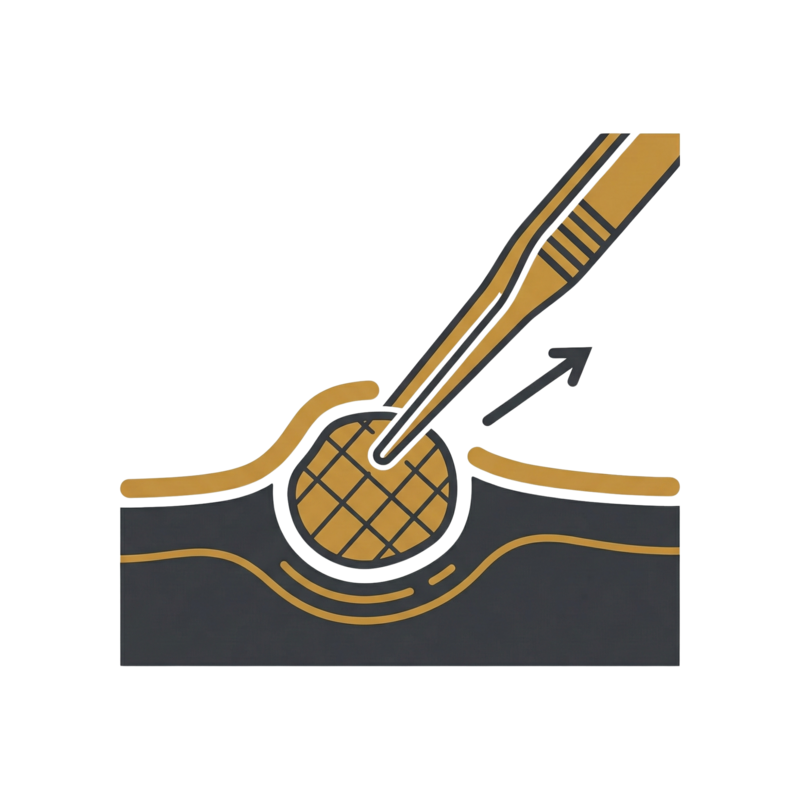
Because this is a composite, removal has two halves. Hyaluronidase can address the non-cross-linked HA component only — it cannot touch the PDLLA. Residual PDLLA nodules must be dealt with physically: ultrasound-guided micro-extraction to break the fibrous capsule and remove the embedded microspheres plus the excess stimulated tissue. In most cases this two-step logic — enzyme for the HA phase, micro-extraction for the PDLLA phase — is the practical route.

Why Traditional Methods Fail
The reassuring story is "it has HA, so hyaluronidase can undo it." In practice the enzyme only shrinks the HA phase and leaves the PDLLA microspheres — the actual driver of late nodules — completely intact. Massage displaces and can traumatize superficial papules. Steroid injections calm inflammation temporarily but risk fat atrophy and permanent dents while the stimulating particles remain. Simply waiting lets the collagen response mature into firmer, more organized fibrosis.

The Liusmed Repair Strategy
A two-phase, phase-matched approach. Pre-op high-resolution ultrasound separates the residual HA phase (darker/anechoic) from the PDLLA-driven nodules and fibrosis (different echo pattern) and maps depth and capsule thickness. Where a discrete HA component remains, targeted hyaluronidase can reduce that phase first. The PDLLA nodules are then addressed physically: through a 1-2mm pinhole, instruments rupture the fibrous capsule and crush and extract the embedded microspheres along with the excess stimulated tissue. Removing the trigger, not just the surrounding HA, is what breaks the cycle.
Dr. Liu's Clinical Perspective
"Patients come in relieved, saying 'at least it has HA, so it's reversible.' I have to gently correct that. The HA is the part that fades on its own anyway — the PDLLA is what left the lump, and no enzyme touches it. On ultrasound the two phases look completely different. We treat each phase for what it actually is, rather than pretending one enzyme solves the whole thing."

Recovery Timeline
The pinhole is small, but this is an extraction, so swelling and bruising are expected. Swelling and bruising usually settle in about 2–3 weeks, the pinhole heals in about 2 weeks, and the final result takes about 3 months, varying from person to person. Depending on the extent and depth, it may need to be done zone by zone, in stages, or over more than one session.
FAQ
Juvelook is a "skin booster" — is it reversible if I do not like it?
Only partly, and this is the most important point to understand. Juvelook and Lenisna are composites: the non-cross-linked HA phase can be reduced with hyaluronidase, but the PDLLA microspheres cannot be dissolved by any enzyme. Calling the product "half-reversible" is misleading — the collagen-stimulating half that most often causes late nodules is exactly the half no enzyme can undo. If a firm nodule has already formed, dissolving the HA around it does not remove the PDLLA that is driving it.
Is Juvelook the same as Sculptra? Both mention "lactic acid."
They belong to the same collagen-stimulator family but use different polymers. Sculptra uses PLLA (poly-L-lactic acid); Juvelook uses PDLLA (poly-D,L-lactic acid), a different arrangement of the lactic-acid building blocks, and it is co-formulated with hyaluronic acid so it is injected more superficially as a "skin booster." Do not treat "PLA" as one thing — the shorthand hides a real difference. What they share is the part that matters most for a removal clinic: neither the PDLLA nor the PLLA microspheres can be dissolved by an enzyme.
I was told the PDLLA "just dissolves over time" — should I wait out the nodules?
The PDLLA microspheres are gradually broken down over roughly a year, but the collagen and fibrotic tissue they stimulated do not disappear on the same schedule. A nodule that has already firmed up will not reliably soften by waiting, and because the collagen response is delayed, papules or lumps can first appear months after a session that seemed to settle fine. Once a firm nodule or fibrotic capsule has formed, ultrasound-guided extraction of the embedded microspheres and excess tissue is the practical route to resolution rather than open-ended waiting.
Real patient questions
Questions from the patient Q&A forum, answered by Dr. Liu.
Ask your own question in the forum
Related Symptoms
This information is for educational purposes only. Treatment options depend on individual circumstances. Consult a qualified physician.

Read next: when this material goes wrong
Case-by-case decisions, written by Dr. Ta-Ju Liu
Collagen Stimulator Booster Lumps: Why They Won't Dissolve
Collagen-stimulator skin boosters can leave dermal nodules hyaluronidase cannot act on. Why microdroplet lumps resist dissolving, and how to remove them.
Collagen Stimulator Lumps After Failed 5-FU? Extraction
Steroids and 5-FU failed on your collagen stimulator lumps? Ultrasound-guided extraction removes what medications cannot, with imaging-led planning.
AestheFill Nodules & Lumps: PDLLA Treatment Ladder, Removal
AestheFill gone wrong? PDLLA lumps and nodules: the treatment ladder from massage and lavage to ultrasound-guided removal, and when to stop injecting.
How Collagen Stimulators Work: Why 'Growing Your Own Collagen' Can Go Wrong
The molecular science behind collagen stimulators — and why the 'natural' collagen they produce can become the hardest complication to reverse.