
"I told my new dermatologist about the lumps and she said she's never even heard of Zyderm. Where do I go for something this old?" At FILLER REVISION, we hear this from patients whose collagen filler complications predate most modern practitioners' careers. Legacy collagen fillers from the 1980s-2000s are resurfacing as complications decades later. Bovine collagen (Zyderm, Zyplast), porcine collagen (Evolence), and human-derived products (CosmoDerm, CosmoPlast) were the original soft-tissue fillers. Although replaced by HA in modern practice, millions of patients still carry residual deposits. These products inject actual foreign protein into tissue, and the body's immune system can mount a delayed attack years or decades later — especially after immune-triggering events like illness or vaccination.

Common Symptoms

Foreign Protein Immune Response
Collagen filler patients who find FILLER REVISION share the same bewilderment: 'How can something from 25 years ago still be causing problems?' The answer lies in the unique biology of these legacy products — and explains why their current doctors, who've never used these fillers, have no idea how to treat the complications. Bovine collagen (Zyderm/Zyplast) contains cow-derived protein that 3-5% of patients develop antibodies against—even after passing pre-treatment skin tests. Porcine collagen (Evolence) similarly triggers immune recognition. The body's immune system identifies these foreign proteins and mounts a sustained inflammatory response: macrophages surround the collagen deposits, attempting to degrade and isolate them. This foreign body response leads to granuloma formation—organized immune cell aggregates that create firm, palpable nodules. Over time, the chronic inflammation stimulates fibrosis and calcification, transforming soft collagen deposits into hard, permanent masses. Even human-derived collagen products (CosmoDerm) can trigger reactions when injected into tissue planes where the processing has altered the protein's native structure.

Why Traditional Treatments Fail
Why Steroids and Dissolution Fail
Standard treatment protocols for collagen filler complications rely on intralesional steroid injections to suppress the immune response and 5-fluorouracil to slow fibroblast activity. While these treatments may temporarily reduce inflammation and swelling, they do not remove the foreign protein that is triggering the immune response. Steroids carry significant risks with repeated use: skin atrophy, telangiectasia, fat atrophy, and depigmentation. The immune system will reactivate once steroid effects wear off, because the antigenic stimulus—the foreign collagen—remains in place. There is no enzyme equivalent to hyaluronidase for collagen fillers; collagenase is not approved for facial soft-tissue use. This leaves patients in a cycle of steroid-suppress-flare-repeat that never achieves resolution.
“At FILLER REVISION, collagen filler patients often arrive after being dismissed by 2-3 modern practitioners who've never even seen these products. 'I had this done in 1998 — how can it still be there?' The body encapsulated it rather than absorbing it, and now an immune trigger has reawakened the response decades later. The irony is that these legacy deposits are some of the most straightforward cases we treat — well-encapsulated, clearly visible on ultrasound, and highly responsive to extraction.”
Dr. LiuRemove the Antigen, Resolve the Reaction
Ultrasound-Guided Pinhole Micro-Extraction
Collagen filler complications are fundamentally immune-mediated — the body recognizes foreign protein and mounts a sustained attack against it. Steroid suppression treats the symptom (inflammation) but not the cause (foreign protein). Addressing the cause requires removing the antigenic material, not suppressing the body's natural defense response.
Your Doctor Has Never Seen This Product — We See It Weekly
At FILLER REVISION, legacy collagen filler cases are a core specialty. Most modern practitioners have never treated Zyderm, Zyplast, or Evolence complications because these products predate their careers. Revision demands both ultrasound imaging and specific experience with how biological fillers behave differently from the HA and synthetic products used today.
The Inflammation Is a Signal, Not the Disease
Steroids suppress your immune system's correct identification of foreign protein — treating the alarm, not the fire. At FILLER REVISION, we remove the antigenic target itself, as much as can be done safely — addressing the cause, while steroid relief is always temporary.
25-Year-Old Deposits, Still Extractable
The irony of legacy collagen complications is that the very encapsulation that makes them persistent also makes them excellent extraction candidates. Well-defined capsules, clear ultrasound visibility, and predictable tissue planes — FILLER REVISION patients are often surprised that extraction is possible after decades of being told nothing could be done. Depending on the extent, it may take more than one session, and 100% removal can't be guaranteed.
Ultrasound-Guided Micro-Extraction
We directly remove the collagen deposits and their surrounding fibrous capsules through pinhole entries under real-time ultrasound guidance. By physically extracting the foreign protein material, we reduce the antigenic stimulus driving the immune response—addressing the cause rather than temporarily suppressing it. We can't guarantee 100% removal; the goal is as much improvement as can be achieved safely. For calcified deposits, we use specialized techniques to fragment and aspirate the hardened material. The ultrasound allows us to distinguish between active inflammatory tissue, fibrotic capsule, and residual collagen product, enabling precise extraction with minimal disruption to surrounding healthy tissue.
Ultrasound Deposit Mapping
Capsulotomy & Protein Extraction
Calcification Fragmentation
Anti-Inflammatory Irrigation

Before & After Results
View real patient results for this condition, including ultrasound imaging before and after extraction.
View All Case ResultsCommon Questions
Yes. Collagen filler deposits can remain in tissue for decades, particularly when they become encapsulated by fibrous tissue or calcify. The immune system continues to recognize the foreign protein indefinitely, which is why delayed reactions can appear years or even decades after the original injection. Many patients we treat had their injections in the 1990s or 2000s.
When your immune system is activated by illness, vaccination, or stress, the heightened immune response also amplifies the reaction against the foreign collagen protein in your tissue. This cross-activation causes the characteristic flare-up pattern—the deposits swell and become painful during periods of immune stimulation, then partially subside as the acute immune response resolves.
No. There is no FDA-approved enzyme for dissolving collagen fillers in facial soft tissue. Unlike hyaluronic acid, which can be broken down by hyaluronidase, collagen filler deposits must be physically removed. This is why ultrasound-guided extraction addresses the cause—it removes the source material rather than attempting chemical dissolution, though 100% removal is not guaranteed.
Calcified collagen deposits are common in long-standing cases. These hardened masses can be fragmented using specialized needle techniques under ultrasound guidance, then aspirated through pinhole entries. The calcification actually makes the deposits easier to identify on ultrasound, allowing very precise targeting.
Historical data shows that approximately 1-3% of patients who passed the standard double skin test still developed hypersensitivity reactions after injection. The skin test detected only immediate-type reactions, missing delayed-type hypersensitivity that could manifest weeks to months later. This is one reason bovine collagen fillers fell out of favor.
Once the foreign collagen protein is physically extracted, the immune stimulus is reduced and the inflammatory response usually settles. Unlike steroid suppression, which leaves the triggering material in place, extraction addresses the cause. If some material remains, further treatment may be needed — we can't guarantee 100% removal.
The pinhole is small, but this is an extraction, so swelling and bruising are expected: they usually settle in about 2–3 weeks, the pinhole heals in about 2 weeks, and the final result takes about 3 months, varying from person to person. Once the foreign protein is removed, the immune system has less to react to, so the inflammatory flare-ups usually calm down over time.
This is common — collagen fillers haven't been widely used since the mid-2000s, so many current practitioners have no experience with their complications. You need a specialist with both ultrasound imaging capability and experience with legacy filler extraction. This is exactly the type of case our clinic specializes in — we regularly treat complications from products that most modern injectors have never even seen.
Yes — though prolonged steroid use does create additional challenges. At FILLER REVISION, we commonly treat collagen filler patients who've endured years of steroid management. The steroids may have caused local fat atrophy, skin thinning, or telangiectasia around the deposit, but the foreign protein core remains extractable. In fact, ending the steroid cycle is one of the most immediate benefits of extraction — patients are often as relieved to stop the steroids as they are to have the lump removed.
Not sure what is going on? Write it down and ask.
Describe what was injected, when, and what you are seeing now. Dr. Liu replies in the thread with an educational explanation of what it might be, what needs to be told apart, and which signs mean you should be seen soon. Posting can be anonymous, and other patients with the same problem can read the answer too.
Replies are general health education, not a diagnosis, and do not replace an in-person examination.

Read next: how we actually handle it
Case-by-case decisions, written by Dr. Ta-Ju Liu
Foreign Body Granuloma: Why Your Immune System Is Fighting Your Filler
Why granulomas form, why medications only provide temporary relief, and how removing the foreign body is the primary way to end the immune war.
Your Body vs. Injectables: Why Your Immune System Never Stops Reacting to Filler
The full immune cascade from filler injection to chronic fibrosis — why your body never truly accepts filler and what this means for revision.
No Idea What's in Your Face? Ultrasound Identification of Unknown Filler
Cannot remember what was injected years ago? Specialized ultrasound identifies unknown filler materials — the essential first step before any treatment.
What Happens to Fillers After 5–10 Years: Why Filler Is Still There Years Later & Doesn't Fully Dissolve
What happens to fillers over 5-10 years: degradation, migration, encapsulation, and calcification, and why these changes matter for revision.
References
- Lemperle G, et al. Foreign body granulomas after all injectable dermal fillers: part 1. Possible causes. Plast Reconstr Surg. 2009;123(6):1842-1863.
- Duranti F, et al. Injectable hyaluronic acid gel for soft tissue augmentation. A clinical and histological study. Dermatol Surg. 1998;24(12):1317-1325.
- Requena L, et al. Adverse reactions to injectable soft tissue fillers. J Am Acad Dermatol. 2011;64(1):1-34.
Related Real Cases
Documented ultrasound-guided extraction and rescue cases by Dr. Ta-Ju Liu.
The information on this website is for educational purposes only and does not constitute medical advice. Individual results may vary depending on personal conditions; actual outcomes cannot be guaranteed. All medical procedures carry potential risks and complications. Please consult a qualified physician before making any treatment decisions.
Featured Poster
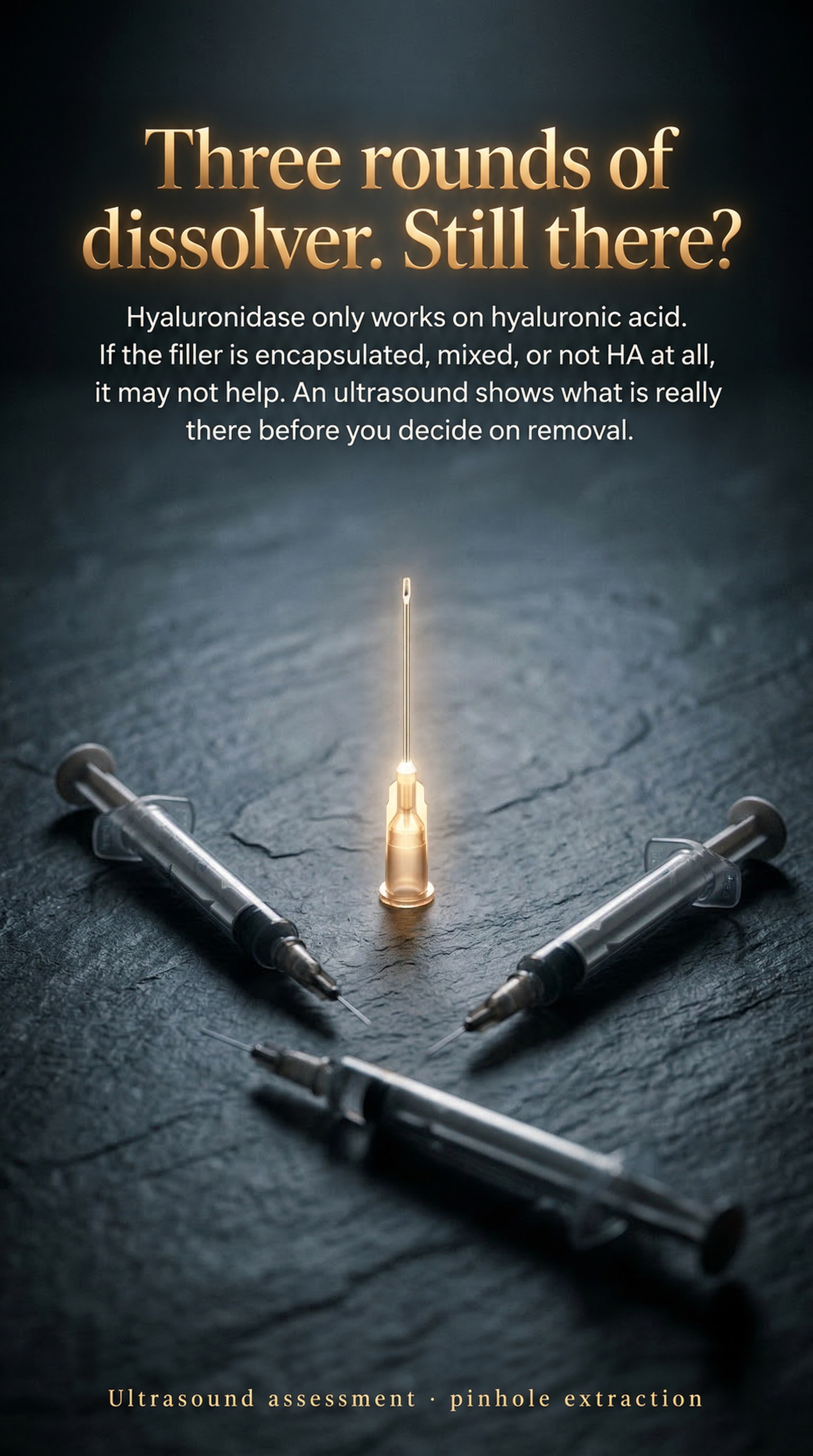
Three rounds of dissolver. Still there?
Hyaluronidase only works on hyaluronic acid. If the filler is encapsulated, mixed, or not HA at all, it may not help. An ultrasound shows what is really there before you decide on removal.

Dissolved — and it still hurts?
Only a little filler left, hyaluronidase several times, and still the headaches, facial pain, neck and shoulder aches. We look for what remains on ultrasound, and a board-certified neurologist on our team assesses the pain with us.