Do Hyaluronic Acid Fillers Really Dissolve Completely?
You were told your HA (Hyaluronic Acid) filler would dissolve on its own in 6 to 18 months. Yet here you are — months or years past that window — still feeling or seeing the material in your face. You may be wondering whether something went wrong, or whether you were simply given incomplete information. You are not alone in this experience, and the science explains exactly why it happens.
The reality is considerably more nuanced. A growing body of clinical and radiological evidence demonstrates that hyaluronic acid fillers can persist in tissue for years—sometimes indefinitely—long after they were expected to be fully metabolized. Understanding why this happens is essential for any patient considering filler treatment or dealing with unwanted filler that refuses to go away.
The Science of HA Degradation: What Should Happen
Natural Hyaluronic Acid vs. Dermal Filler HA
The human body produces and degrades approximately 5 grams of hyaluronic acid every day. Natural HA in the skin has a half-life of roughly 24 hours—it is continuously produced and broken down in a dynamic cycle. This rapid turnover is what makes natural HA such an effective hydrating molecule: it is always being refreshed.
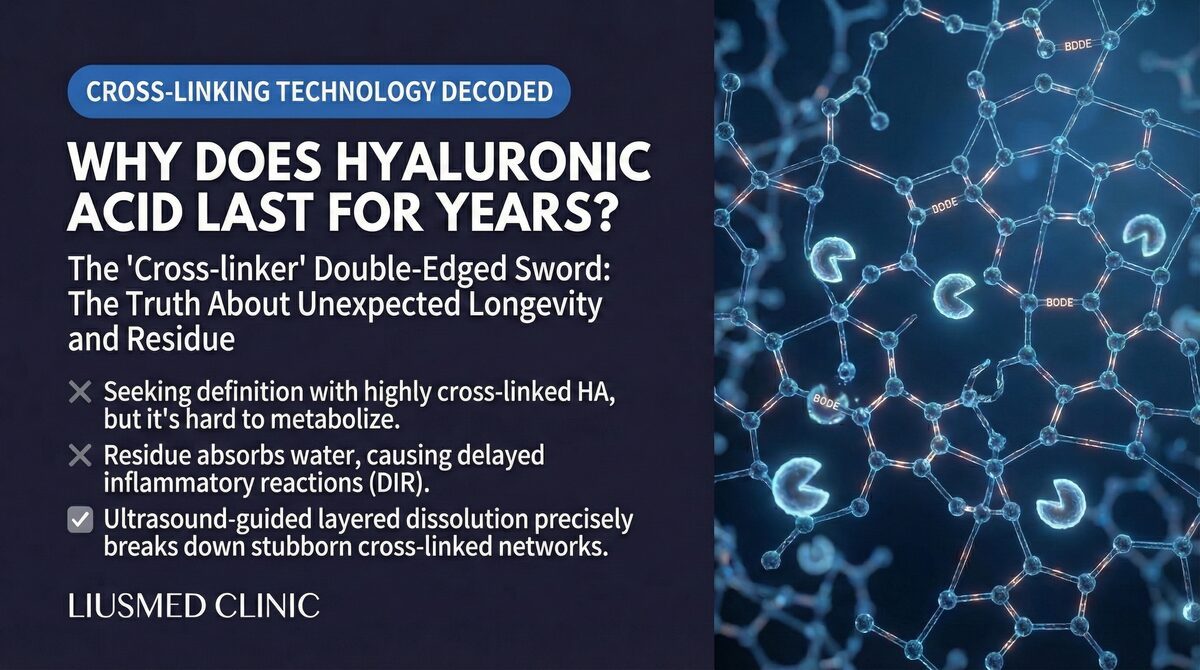
Dermal filler HA is fundamentally different from the hyaluronic acid your body produces naturally. The critical modification is cross-linking—a chemical process that connects HA chains together into a three-dimensional network. This cross-linking is what transforms a rapidly degradable molecule into a persistent gel that can maintain volume for months or years.
Key insight: At FILLER REVISION, our clinical experience confirms that when patients are told HA filler is "the same substance your body already makes," this is technically true at the molecular level but functionally misleading. Cross-linked HA behaves very differently from natural HA in terms of degradation, persistence, and tissue interaction — and this distinction is central to understanding why your filler is still present.
How Cross-Linking Changes Everything
Cross-linking creates chemical bonds between adjacent HA chains using agents such as BDDE (1,4-Butanediol Diglycidyl Ether). The degree of cross-linking determines:
- Persistence: Higher cross-linking = slower degradation
- Firmness: More bonds = stiffer gel (higher G-prime)
- Resistance to enzymes: Denser network = harder for hyaluronidase to access and cleave the chains
Different commercial products use different cross-linking technologies and densities, which is why some HA fillers last 6 months while others claim longevity of 18 months or more. However, even these timelines often underestimate actual persistence.
Why HA Fillers Persist Beyond Their Expected Lifespan
Evidence of Long-Term Persistence
Multiple MRI (Magnetic Resonance Imaging) and ultrasound studies have documented HA filler material present in tissue 3, 5, and even 10 or more years after injection. In a landmark 2019 study, researchers performed MRI scans on patients who had received HA filler to the nasolabial folds and found that filler material was still clearly visible on imaging years after it should have been completely metabolized.
These are not isolated findings. Clinicians who routinely perform ultrasound-guided filler assessments regularly identify HA deposits in patients who received their last injection many years prior and were told the filler had "dissolved on its own."
Why Does This Happen?
Several biological mechanisms explain HA persistence beyond the expected timeframe:
1. Tissue Integration
Over time, injected HA becomes increasingly integrated into the surrounding tissue matrix. Collagen fibers, fibroblasts, and blood vessels grow into and around the filler deposit. This integration physically shields the HA from enzymatic degradation and immune-mediated clearance.
Think of it like a tree growing around a fence post. Initially, the post and the tree are separate entities. Over years, the tree's bark and wood grow around the post, incorporating it into the tree's own structure. Removing the post at that point requires cutting into the tree itself.
2. Fibrous Encapsulation
The body recognizes injected filler as a foreign body and, over time, may form a fibrous capsule around it. This capsule—composed of dense collagen fibers produced by fibroblasts—creates a physical barrier that isolates the filler from the surrounding tissue, enzymatic degradation, and immune surveillance.
Once encapsulated, HA filler can persist indefinitely. The capsule prevents the body's natural degradation pathways from reaching the material inside.
3. Residual Cross-Linking Core
As HA filler degrades, the outer, less cross-linked portions of the gel break down first. This leaves behind a progressively more concentrated core of highly cross-linked material that resists further degradation. The remaining material may be small in volume but dense and persistent.
4. Inflammatory Stabilization
Chronic low-grade inflammation around filler deposits can paradoxically promote tissue remodeling that stabilizes the filler in place. Inflammatory mediators stimulate fibroblast activity, which produces collagen that encases the filler, further protecting it from degradation.
The "Wait It Out" Fallacy
Why Patience Is Not Always the Answer
One of the most common pieces of advice given to patients unhappy with their HA filler is: "Just wait. It will dissolve on its own." This advice is based on the assumption that all HA filler will eventually be completely metabolized by the body.
For the reasons described above, this assumption is frequently wrong. Patients who "wait it out" may find that:
- The filler volume decreases partially but never completely disappears
- The remaining material becomes increasingly firm and resistant to degradation
- Encapsulation develops, making eventual removal more difficult
- The surrounding tissue remodels around the persistent filler, altering facial anatomy
Key insight: Waiting can actually make the problem worse. The longer HA filler remains in tissue, the greater the degree of tissue integration and encapsulation, and the more difficult eventual removal becomes.
Why It Sometimes "Won't Dissolve"
Hyaluronidase (the enzyme used to dissolve HA filler) acts on hyaluronic acid itself however long it has been in place. There is no cut-off after which it simply stops working.
What makes it fail is what often happens to filler over time: a capsule forms around it, the tissue becomes fibrotic, or it is mixed with other materials. These become more common the longer filler has been there, but they do not happen at a fixed month. So whether it will dissolve depends not on how long ago it was injected but on its current state, and that needs to be seen on ultrasound first.
Clinical Implications for Revision Patients
For patients seeking revision, the persistence of HA filler has direct practical consequences. At FILLER REVISION, we routinely identify HA deposits on ultrasound in patients who were told their filler dissolved years ago. These residual deposits may be contributing to visible asymmetry, an unnatural contour, or an unexplained firmness that the patient attributed to aging. Knowing that HA can persist — and that this persistence worsens over time through tissue integration and encapsulation — underscores why early assessment matters. The sooner persistent filler is identified, the more treatment options remain available and the better the expected outcome.
Why Hyaluronidase Does Not Always Work
Understanding the Limitations
Hyaluronidase works by cleaving the chemical bonds within the HA polymer chain. However, its effectiveness depends on several factors:
Physical access: The enzyme must physically contact the HA material. If the filler is encapsulated within a fibrous capsule, hyaluronidase cannot penetrate the capsule wall to reach the HA inside.
Cross-linking density: Highly cross-linked HA presents fewer accessible cleavage sites per unit volume. The enzyme must work harder and longer to break down densely cross-linked material, and in some cases, it simply cannot achieve complete dissolution.
Tissue integration: HA that has become integrated into the surrounding tissue matrix is partially shielded from enzymatic access by the collagen and cellular components that have grown through it.
Dosing limitations: While higher doses of hyaluronidase can improve dissolution rates, there are practical limits to how much enzyme can be safely administered. Excessive hyaluronidase can damage native HA in the surrounding tissue, leading to volume loss, skin laxity, and textural changes.
Key insight: Hyaluronidase is not a guaranteed eraser. It works well on fresh, accessible, moderately cross-linked HA but has significant limitations against old, encapsulated, or heavily cross-linked material.
What Are the Real Options for Persistent HA?
When hyaluronidase fails to completely dissolve persistent HA filler, the remaining options include:
Multiple Dissolution Attempts
Some practitioners attempt repeated hyaluronidase sessions, spaced weeks apart, to progressively break down resistant HA. This approach can be partially effective but carries increasing risk of collateral tissue damage with each session.
Ultrasound (Ultrasonography)-Guided Extraction
For HA filler that has become encapsulated or resistant to enzymatic dissolution, physical extraction under ultrasound guidance offers a more root-cause solution. The physician can visualize the encapsulated material, access it through a targeted approach, and physically remove it along with the encapsulating fibrous tissue.
Combined Approach
In many cases, the most effective strategy combines hyaluronidase to soften accessible HA with physical extraction for encapsulated or resistant deposits. This combination maximizes material removal while minimizing tissue trauma.
What Should Patients Know Before Getting HA Filler?
Understanding the potential for long-term persistence does not mean that HA fillers should be avoided entirely. They remain among the safest and most versatile aesthetic treatments available. However, patients should be informed that:
- HA filler may not fully dissolve on its own. The claim of complete natural absorption is an oversimplification.
- Hyaluronidase is not infallible. It works best on recent, accessible filler and has limitations against old or encapsulated material.
- Volume management matters. Conservative treatment with modest volumes reduces the risk of persistent deposits.
- Early intervention is easier. If you are unhappy with your filler, addressing the issue sooner rather than later usually makes it simpler to manage and improves the chances of meaningful improvement.
Get an Honest Assessment at FILLER REVISION
If you have HA filler that you expected to dissolve but has not, or if previous hyaluronidase treatments failed to fully resolve your concerns, FILLER REVISION can show you exactly what remains. Dr. Ta-Ju Liu uses high-resolution ultrasound to visualize persistent deposits and develop an evidence-based plan tailored to your specific situation — because effective revision starts with seeing the truth.
Frequently Asked Questions
My doctor said my HA filler would dissolve in 6 to 18 months, but I can still feel it after years. Is that normal?
What you are feeling is real. A growing body of clinical and radiological evidence shows that hyaluronic acid fillers can persist in tissue for years — sometimes indefinitely — long after they were expected to be fully metabolized. The claim of complete natural absorption is an oversimplification, so it does not mean something necessarily went wrong with you.
If injected HA is just the same substance my body already makes, why does it stay so long?
At the molecular level that statement is technically true, but functionally misleading. Dermal filler HA is modified by cross-linking — a chemical process that links HA chains into a three-dimensional network and transforms a rapidly degradable molecule into a persistent gel. Your natural skin HA has a half-life of roughly 24 hours, whereas cross-linked filler HA can maintain volume for months or years.
I am unhappy with my filler — should I just wait for it to dissolve on its own?
Waiting is often poor advice and can actually make the problem worse. The longer HA filler remains in tissue, the greater the tissue integration and encapsulation, and the more difficult eventual removal becomes. Patients who wait it out may find the volume decreases only partially, the remaining material becomes firmer and more resistant, and the surrounding tissue remodels around it. Addressing the issue sooner generally improves the chances of meaningful improvement.
When is hyaluronidase (the dissolving enzyme) most effective, and does it always work?
Hyaluronidase acts on hyaluronic acid itself however long it has been in place; there is no cut-off after which it stops working. When it fails, it is usually because a capsule has formed, the tissue has become fibrotic, or other materials are mixed in. These become more common the longer filler has been there, but not at any fixed month. It is not a universal eraser: it works well on HA it can reach, and has real limits on encapsulated, fibrotic or highly cross-linked material, which is why checking the current state with ultrasound first is more reliable.
If hyaluronidase cannot fully dissolve my old filler, what are my options?
When hyaluronidase fails to fully dissolve persistent HA, the remaining options include multiple spaced dissolution attempts, ultrasound-guided physical extraction, or a combined approach. For filler that has become encapsulated or resistant, extraction under ultrasound guidance lets the physician visualize and physically remove the material along with the fibrous tissue around it. Often the most effective strategy combines hyaluronidase to soften accessible HA with physical extraction for encapsulated deposits, maximizing removal while minimizing tissue trauma.
Does this mean HA filler is dangerous and I should avoid it completely?
No. Understanding the potential for long-term persistence does not mean HA fillers should be avoided entirely — they remain among the safest and most versatile aesthetic treatments available. The key is being informed: HA may not fully dissolve on its own, hyaluronidase has limits, conservative treatment with modest volumes reduces the risk of persistent deposits, and addressing any concerns early improves the chances of meaningful improvement.