Temple Filler Migration: Shifting Permanent Fillers and Temporal Anatomy
劉達儒醫師 · 10/26/2026
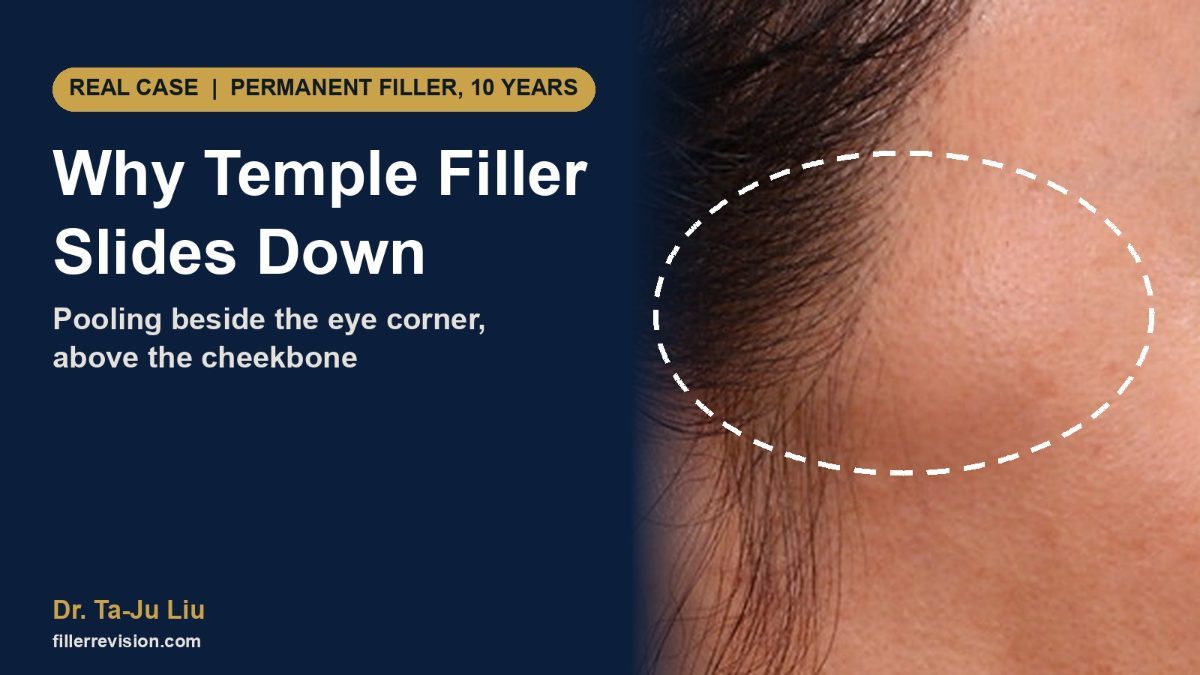
When you press down, the filler actually shifts around.
This patient received permanent filler injections in the temples ten years ago. The initial results were beautiful, but a month or two later, the filler began to gradually sag, and now it has accumulated above the zygomatic arch and at the outer corner of the eye.
During clinical palpation, pressing the lower edge of the accumulated filler feels soft; if pushed upward, the filler material underneath flows upward along the space.
Temporal Anatomy and Migration Mechanism
From an anatomical perspective, the temple is shaped like a shallow bowl. A layer of loose connective tissue exists between the superficial temporal fascia and deep temporal fascia, which is inherently an interconnected potential space.
In many past cases of temple filler removal—including hyaluronic acid, Ellansé, collagen stimulators, Aquamid, Amazingel, and liquid silicone—there is a possibility of accumulation at the base of the temple due to gravity, though different materials react differently, and some materials gradually form lumps over time.
Differences Between Mobility and Fixation
Only a few specific components of permanent fillers exhibit a mobile state when pressed; the vast majority of injectables remain in a relatively fixed position within the tissue. However, whether it is hyaluronic acid or various collagen stimulators, they can still slowly migrate downward months to years after injection.
Full case record: https://www.fillerrevision.com/en/articles/temple-filler-migration-pooling
※ Real case health education sharing from Liusmed Clinic | Case shared with consent; actual conditions vary from person to person