Dissolving Hyaluronidase for Over a Year, Yet Cheek Depressions and Lumps Persist: The Filler Truth Revealed by Ultrasound
劉達儒醫師 · 9/20/2026
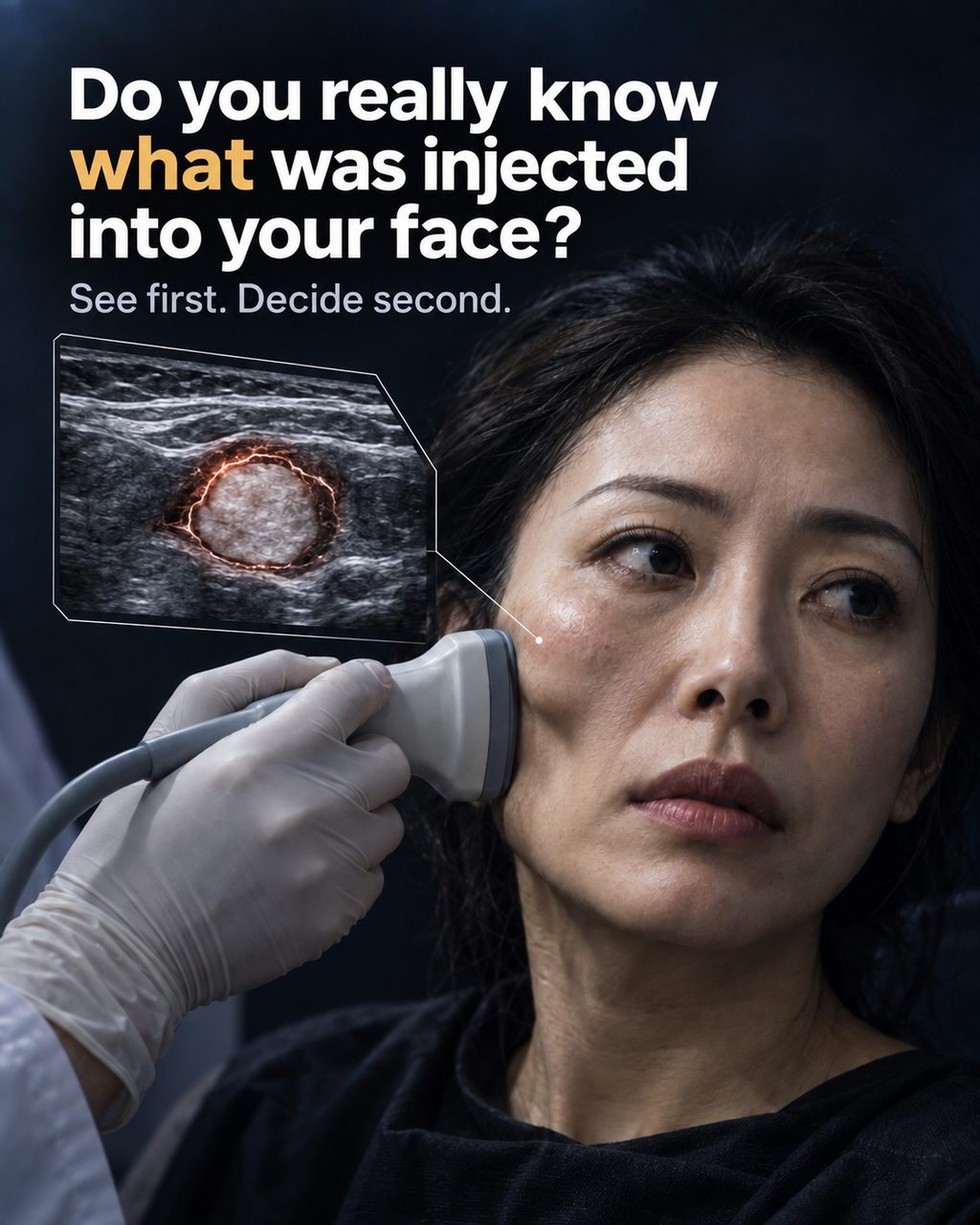
I looked at her deeply sunken cheeks, the ultrasound probe resting in place.
I fell into deep thought internally...
Should I tell her about this?
Many people believe one thing: If hyaluronic acid goes wrong, just get a shot of hyaluronidase to dissolve it.
She believed this too, and diligently underwent dissolution for over a year, receiving multiple rounds of injections.
Until that day, what I saw on the ultrasound screen made me hesitate whether to speak up.
---
The Cycle of Recurrent Swelling, Finding No Way Out
She had received hyaluronic acid injections for over a decade, across multiple areas from the upper to mid-face, without any issues.
Later, feeling her cheeks had sunken again, she saw a physician for cheek augmentation. The physician noted she always metabolized it quickly, so this time they would inject deeper for longer-lasting results.
Unexpectedly, this procedure was different.
Shortly after the injection, hard nodules could be felt deep within the left and right cheek depressions, painful to the touch. They would swell periodically, edema spreading to surrounding tissues, making her whole face look like bread soaked in water.
And that was only the beginning. Previously trouble-free areas began to swell in turn. Swelling here today, shifting there in two or three days, moving around her face.
She went back to the original physician for a round of hyaluronidase, with no improvement. Later, that physician left the clinic, and she could no longer find them.
---
Multiple Rounds of Dissolution: Blindly Targeting Based on Photos
She turned to another physician. That physician was very diligent, instructing her to take photos every time swelling occurred. After accumulating them over time, the photos were overlaid to deduce where hyaluronic acid might be subcutaneously, and injections were administered accordingly.
Nearly every area of her entire face underwent multiple rounds of injections this way. It relied on experience, tactile feel, and those comparison photos saved in her phone during flare-ups.
Over a year passed, and the frequency of swelling did indeed decrease somewhat. But a few spots still swelled repeatedly, especially that initial hard lump in the cheek depression, which refused to dissolve no matter what, accompanied by a dull ache.
Looking at her deeply sunken cheeks, I understood something.
Hyaluronidase not only dissolves filler but also breaks down some autologous tissue. Based on my clinical observations, large-scale, repeated, blind hyaluronidase injections without a visible target will dissolve a normal face into depressions. Part of her hollowing was actually caused by the dissolving enzyme itself.
It was that same physician who ultimately referred her to me.
---
The Truth Under Ultrasound: Not Hyaluronic Acid at All
Surprisingly, that lump in the cheek depression was never hyaluronic acid.
When the ultrasound probe was placed on it, the imaging characteristics I saw completely mismatched hyaluronic acid—it was a collagen stimulator nodule encapsulated by fibrous tissue.
It is a completely different material from hyaluronic acid, and hyaluronidase has zero effect on it.
Several rounds of hyaluronidase dissolved the residual hyaluronic acid originally in her face and depleted her local autologous tissue, yet completely failed to budge this hard lump.
Suddenly the logic fell into place: her body had developed an immune-inflammatory reaction to this material, and this chronic inflammatory state was very likely the "fuse" that triggered the recurrent redness and swelling of her old, previously trouble-free hyaluronic acid over the past decade. Tissues fine for over a decade were continuously activated, and this most crucial clue had been consistently missed without imaging assistance.
I hesitated for a moment, but decided to tell her the truth.
Why she ended up with an unexpected material initially, I was not present and cannot conclude for anyone. But the most urgent task at hand was: blind dissolution must be stopped.
Next, I plan to perform minimally invasive ultrasound-guided pinhole extraction to gradually reduce and extract this lump tissue. The percentage of reduction depends on its distribution plane, borders, and degree of fibrosis. The goal is to minimize the allergenic source as much as possible, interrupting the cycle of recurrent inflammation; once tissue repair stabilizes, the severe cheek hollowing can be evaluated for secondary restoration via autologous fat grafting.
---
Blindly Wiping Only Wears Through the Paper
What deeply touched me about this case was that this patient cooperated fully with treatment and photographic records from start to finish; she simply never knew what had been placed inside her face.
We often expend great effort "handling problems" without first confirming "what the problem actually is." Operating on guesses without seeing subcutaneous conditions leads to using larger doses of hyaluronidase when it won't dissolve.
A shot of hyaluronidase is often viewed as a universal eraser, but wiping the wrong target will only wear a hole through the paper underneath.
True revision begins with seeing the truth; blind intervention must come second. Only by accurately identifying material characteristics and depth via soft tissue ultrasound can we discuss safe and effective treatment strategies.
Not knowing what is inside your face is often more dangerous than what is inside your face. Only by confronting the truth can losses be stopped in time and the correct path to revision be taken.