When "20 Syringes of Filler" Becomes a Number, Not a Solution: A Woman's Filler Revision Story
劉達儒醫師 · 5/2/2026
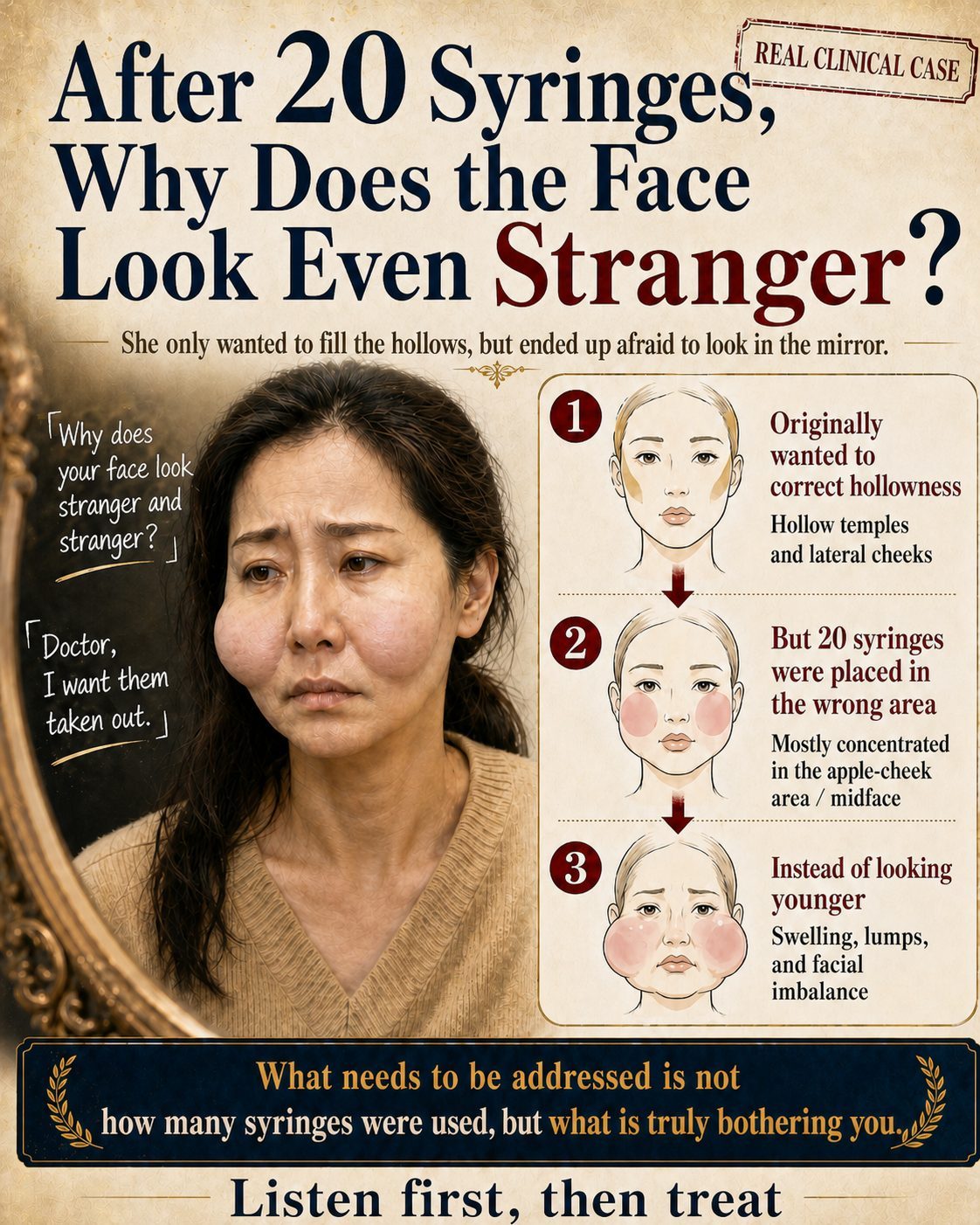
A woman in her early forties came into the clinic today. As she sat down, what first caught my attention were the two prominent bulges on her cheeks, resembling freshly baked pineapple buns. Her apple cheeks were so excessively filled that they didn't look like natural flesh, but rather two foreign objects distending her face. Curiously, her temples and lateral cheeks were deeply sunken, as if scooped out with spoons. The overall proportion of her face was so distorted that she barely dared to look in a mirror.
Her first words after settling in were: "Doctor, I want to have them removed."
I asked her to tell her story slowly.
She recounted that about a year ago, due to her deeply sunken face, colleagues would repeatedly express concern: "Your face is so hollow, it's unsettling." Such recurring comments gradually fostered anxiety within her. She sought consultation with a doctor who, after examining her face, gave a very specific recommendation: 20 syringes of filler were needed to lift her entire face and make her look more energetic.
20 syringes is no small amount. She hesitated and asked if she could start with 10 syringes. The doctor agreed but insisted: "You really need the full 20 syringes for it to be effective." She nodded and proceeded with the first round of 10 syringes.
The subsequent development of her story left me silent for quite some time after hearing it.
First Round of 10 Syringes: Injected in the Wrong Areas
To my surprise, the first 10 syringes were not injected into the "hollow areas" that were her original concern. Instead, almost all of them were concentrated in the mid-face and apple cheek regions. When she looked in the mirror at home, she found her mid-face protruding, making her cheeks appear even more sunken. She returned for a follow-up, and the doctor told her: "I told you from the beginning that you needed 20 syringes. Once the remaining 10 syringes are added, it will balance out."
Second Round of 10 Syringes: Still Not Injected in the Hollow Areas
Half-persuaded, she unknowingly received another 10 syringes in the second round. These 10 syringes were again mostly injected into her apple cheeks, tear troughs, and mid-face. Her most sunken areas remained virtually untouched.
During her third follow-up, the doctor once again told her: "Look, your temples are so hollow, your cheeks are so hollow. I recommend you get another 10 syringes to fill them." She said at that moment, she froze in the consultation room. Over this period, friends and family had repeatedly commented: "Your face is getting stranger and stranger." She finally mustered the courage to refuse the third round.
Over time, those fillers in her mid-face gradually "grew larger" (a common delayed augmentation reaction seen with some fillers), resulting in the face I saw before me.
I turned on the ultrasound and carefully scanned her mid-face, observing the fillers had formed cysts and lumps of varying sizes, distributed in subcutaneous layers where they shouldn't be. I told her: "We will use ultrasound-guided pinhole extraction to carefully remove these unnatural lumps little by little. As for your truly sunken areas, I will help you correct them appropriately."
Upon hearing this, her eyes welled up. She said: "I trusted and believed in that doctor, which is why I let him put 20 syringes into my face."
It was then that I understood: what she lost was never just money. It was the courage to look at herself.
To be honest, it's only in recent years that I've slowly come to understand something:
The most valuable aspect of medical care is often not found in superficial options like "plans," "treatments," or "packages." What is truly precious is whether a doctor, the moment you sit down, is willing to listen to you completely before answering "what your real problem is."
This lady's initial concerns were sunken temples and lateral cheeks. These areas required precise filling. But the doctor's answer was "20 syringes are effective," shifting the focus from "the problem you need solved" to "the number I want you to buy." The gap here has nothing to do with medical technique. It's about the position of the scales in one's heart when facing a patient.
At a certain age, one slowly realizes something: whether seeing a doctor, buying insurance, hiring a lawyer, or an accountant, there is only one truly alarming question: Did they first address what you genuinely care about? The price, high or low, is secondary.
When dealing with a professional, true value is never about how much they can sell you. It's about whether they dare to tell you: "You don't need this."
Over the years, I've seen too many patients who, dissatisfied with one aspect of themselves, were led to treatments they never intended to undergo. After completing a full course, they didn't become more beautiful; instead, they became someone they no longer recognized.
Hippocrates, the father of medicine, left a core principle over two millennia ago that contemporary physicians still uphold: "To benefit the patient, and do no harm." (Later condensed into the Latin: Primum non nocere, meaning "First, do no harm.") This statement, after two thousand years, remains the most crucial reminder for every doctor before entering the consultation room.
For anyone currently considering any medical treatment, I hope this article serves as a small reminder.