How Much Can One Face Hold?
劉達儒醫師 · 4/2/2026
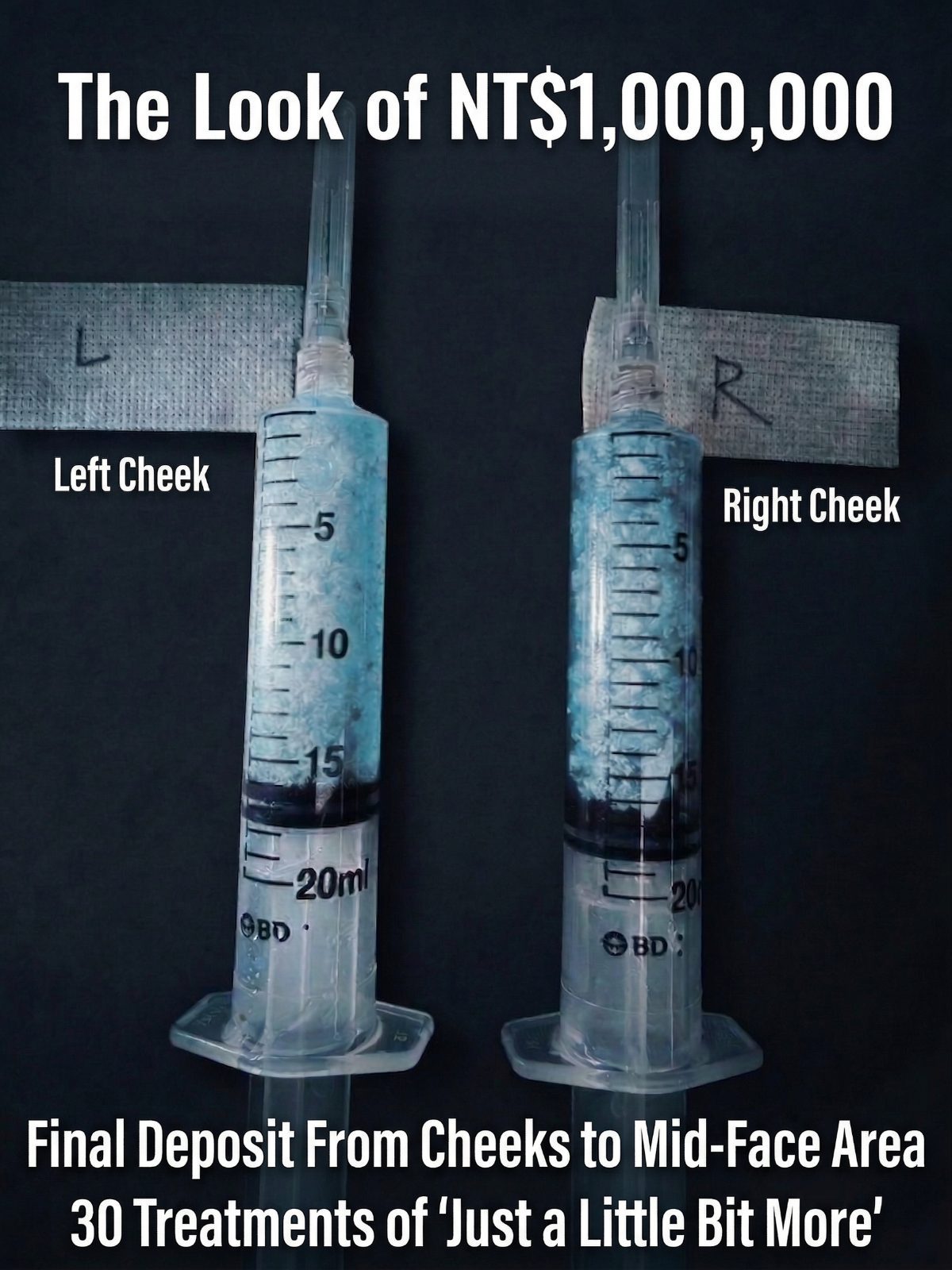
The answer is: much more than you imagine, so much that the body starts to protest.
A patient came to our clinic today with puffy cheeks and apple cheeks, making her smile look unnatural, as if something was stuck under her skin. But what concerned her more wasn't her appearance.
She said that whenever she caught a cold or stayed up late, her face would swell and hurt. The recurrent inflammation had become so frequent that she habitually carried painkillers with her.
She sat down calmly, but her eyes held a sense of exhaustion – not the kind from lack of sleep, but the profound weariness that comes after being utterly disappointed by something.
She shared that over three years, she had spent approximately one million NTD. She had received over a dozen to twenty syringes of Ellansé and more than twenty syringes of Hyaluronic Acid. Each time, it was "just a little more," and each time, she thought, "this should be enough."
Initially, she did look better, and her friends complimented her. But at some point, the added substances stopped enhancing her beauty and instead became a way to compensate for previous dissatisfactions.
Later, her face began to suffer from recurrent inflammation. She thought about undergoing a facelift to solve everything at once. She spent nearly another five hundred thousand NTD, but after the surgery, the fillers inside were not completely removed. The facelift was done, but the material remained.
One and a half million NTD spent, her face didn't improve, and her body started to break down.
Due to long-term recurrent pain and painkiller use, she underwent a health check-up and discovered that her kidney function indices had started to show abnormalities. She didn't cry when she told me this; she just looked at me quietly and asked, "Is there still a way?"
The symptoms she described are actually not uncommon clinically: subcutaneous fillers can trigger a foreign body reaction, which the body constantly tries to reject. Normally, the immune system can suppress it. However, once immunity declines, whether due to a cold, staying up late, or stress, inflammation flares up. This isn't "sensitive skin"; this is the body crying for help.
I performed an ultrasound examination for her, and the screen showed everything clearly. Beneath her cheeks and apple cheeks were numerous irregular hyperechoic masses, layered one upon another, like geological sedimentation. Some were completely encapsulated by fibrous capsules, while others had spread to surrounding tissues.
This is why her previous facelift couldn't clear them completely, and why hyaluronidase injections had no effect. It wasn't that the enzyme was useless; it simply couldn't penetrate that fibrous wall.
We used a precise, minimally invasive approach, entering through a pinhole of about 0.1 to 0.2 centimeters, and, under ultrasound guidance, removed those substances bit by bit.
The removed material was spread on gauze. She glanced at it, said nothing. That pile of material was where her one and a half million NTD had gone over three years.
The aesthetic medicine industry has a peculiar cycle. Dissatisfied after injection? Inject more. Problems after injection? Inject somewhere else. Eventually, the face swells, hardens, becomes inflamed, leading to surgery. If surgery doesn't solve it, then finally one might start to wonder: "Should I have added so much in the first place?"
But very few people are told during their first injection: "The amount your face can tolerate is limited." Each "just a little more" compresses future options.
We are too accustomed to using "addition" to solve anxieties about appearance, but rarely consider that sometimes what's truly needed is "subtraction."
When the body starts to rebel because of excess, whether it looks good or not is no longer important. What matters is how much health you have left to squander. Your body is not a container; it keeps accounts. Everything you put into it, it remembers, and one day it will settle the score with you.
Does each filler injection truly serve your expectations for life, or is it feeding an anxiety that can never be filled?
When do you think the investment in "just a little fuller" should stop?