The Doctor's "Secret Formula": When Aesthetic Creativity Lacks Accountability
劉達儒醫師 · 4/11/2026
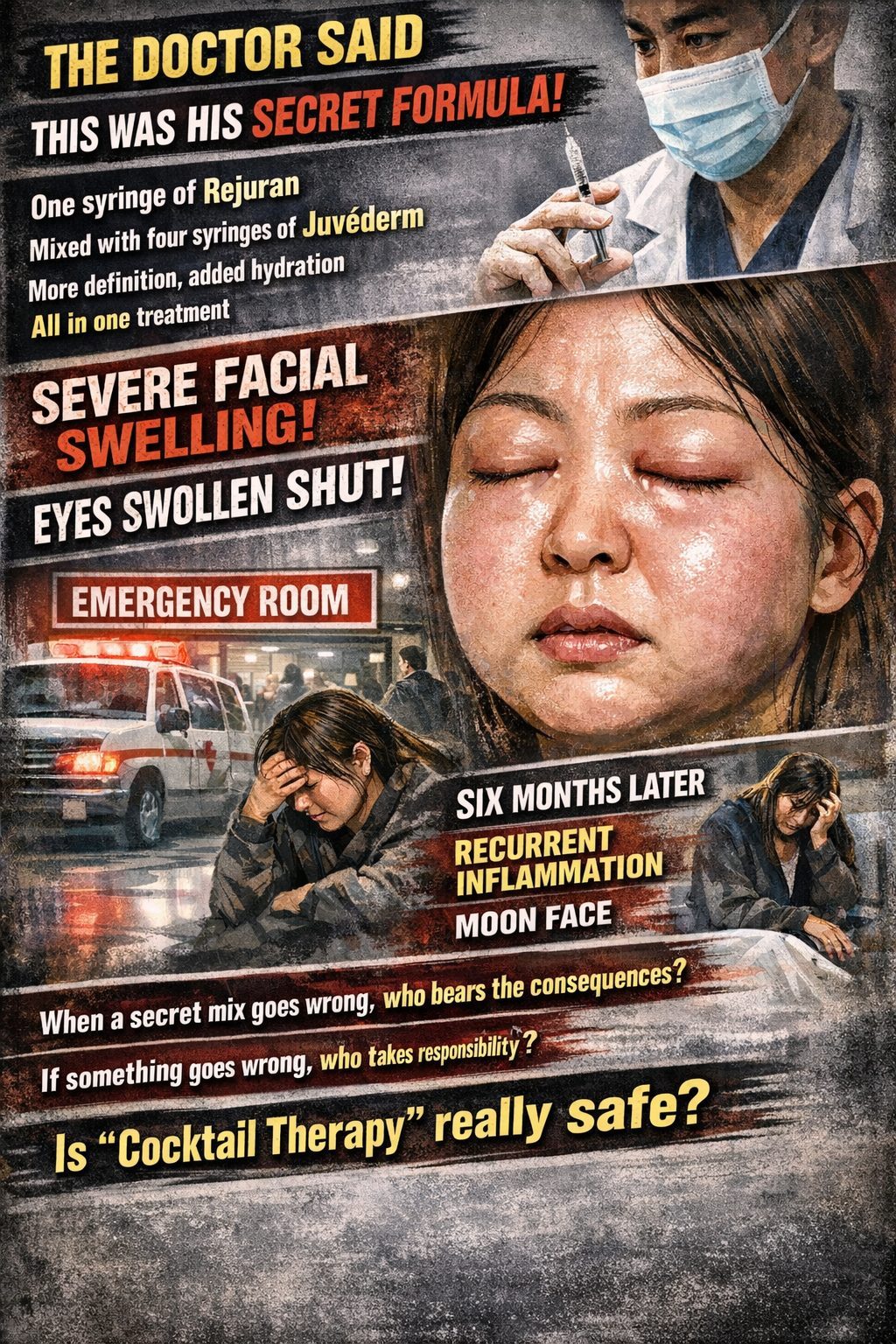
The doctor said, "This is my secret formula."
One syringe of Nishi-shin, mixed with four syringes of Juvéderm. He claimed the results would be more立体 (three-dimensional), hydrating, and achieve everything in one go. She found it reasonable. She had received Juvéderm injections several times before without issues, so adding just one more ingredient should only make it better, right?
After the injection, her face began to swell. It wasn't the normal post-procedure swelling; it was her entire face distending, as if something was pushing it from within, making it almost impossible to open her eyes. On New Year's Eve, she sat in the emergency room waiting area. The diagnosis read: Cellulitis. She spent that New Year's in the hospital. She stayed for a week, receiving daily intravenous antibiotics. She said she didn't even hear the countdown from the hospital corridor; she just kept crying.
After discharge, she thought it was over. It wasn't. Every time before her period, every time she stayed up late, every time she ate seafood, or even just walked a few more steps than usual, her face would start to swell again. She went to the infectious disease department, where she was prescribed antibiotics and steroids to suppress the swelling, only for it to return after a while. This cycle had continued for half a year by the time she found me. The infectious disease specialist said he had never seen a case like this.
After taking steroids for half a year, her face became increasingly swollen, gradually developing a moon-face appearance, and new depressions appeared under her eyes that weren't there before. She went back to the doctor who performed the initial injection. The doctor said, "Dissolving injections shouldn't be given indiscriminately. Now, we can only wait for natural absorption, and it will be fine once it's absorbed." She asked me, "How long will I have to wait for natural absorption?" I couldn't give her a definite answer.
I've been pondering something.
The design logic of Nishi-shin (a type of hyaluronic acid) is to allow it to rapidly diffuse under the skin and stimulate tissue regeneration; it's not primarily intended for structural support. Juvéderm, on the other hand, is a highly cross-linked hyaluronic acid, designed to stay in place and provide specific volume. When two materials with completely different physical properties are injected into the same space, their degradation rates differ, their diffusion ranges vary, and their metabolic pathways are distinct. How is the immune system supposed to identify them? If something goes wrong after such a cocktail injection, how should it be managed? I suspect no one seriously considered these questions before the injection.
"The infectious disease specialist said he had never seen a case like this." I paused at that sentence for a long time. An infectious disease doctor, who deals with all sorts of strange infections daily and has seen many unexpected cases, said he had never seen this. What does that imply?
In the aesthetic medicine circle, terms like "cocktail injection" sound very professional, customized, and like an upgraded treatment tailored just for you. But their essence is: taking several products, each with its own indications and dosage designs, and mixing them into the same syringe based on the doctor's intuition and "secret formula," then injecting them into your face. Does this secret formula have clinical follow-up? If a reaction like hers occurs, what are the criteria for stopping? If something goes wrong, who is responsible for the aftermath? Her doctor had a secret formula but lacked the ability to manage the subsequent complications. These two facts coexisted, yet no one informed her before the injection.
The aesthetic medicine market loves to package the word "creativity." Exclusive formulas, clinic director's secret recipes, limited treatments—these make consumers believe they are getting something better than others. Creativity itself isn't the problem. The problem is whether that creativity is backed by the ability to bear the consequences. Her doctor dared to say "This is my secret formula" in the consultation room, yet after she swelled up like that and suffered recurrent issues for half a year, he gave the answer, "Just wait for natural absorption." That phrase, "wait for natural absorption," frankly, means doing nothing.
British neurosurgeon Henry Marsh, in his book Do No Harm, recounted something that stayed with him for many years. He said that the longer he practiced medicine, the more he realized that the most dangerous moments in medicine are often not those when you know you are uncertain. The most dangerous moments are when you are completely convinced you know what you are doing. Because in those moments, you won't stop to ask: What if I'm wrong, what then?