It’s Not a Bruise, It’s a Vascular Occlusion—A Friday 8 PM Message
劉達儒醫師 · 5/23/2026
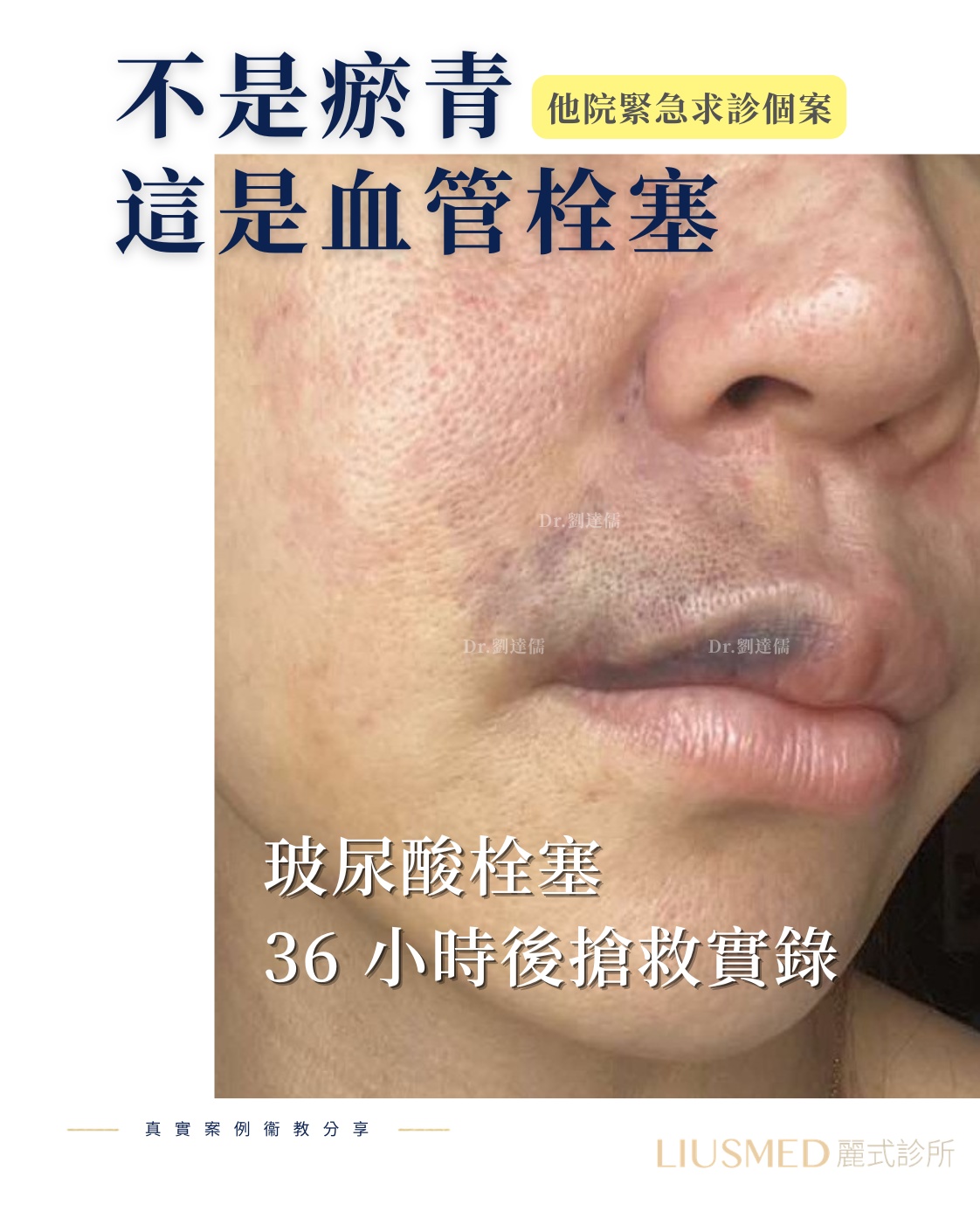
One Friday evening, a message suddenly popped up on my fan page, which I happened to catch:
"I would like to ask, are you able to treat a Hyaluronic Acid Vascular Occlusion? 😭"
Seeing this sentence sent a jolt through me.
Because this was an urgent matter, I clicked on it immediately. I asked her right away:
"How long has the occlusion been present? What is your current situation? This is very urgent; please take a photo and show me the location."
The photo arrived: a reddish-purple, reticulated pattern near the upper lip and nasolabial fold.
The color and distribution were different from a typical bruise. I knew at a glance: This is a reaction to skin ischemia; it is a Vascular Occlusion.
I then asked her: "Has your vision been affected?" Because once facial fillers cause a vascular blockage, the concern is not just skin necrosis; in rare cases, it can involve risks to the eyes. Fortunately, she said her vision was currently normal.
I asked her to come over immediately. However, it was already near the end of clinic hours, and she lived in Taichung; she couldn't make it on the high-speed rail that day.
I gathered more details. The areas injected at the other clinic were the lips and nasolabial folds. After the procedure, there was significant, widespread bruising, throbbing pain, and a numb sensation from the start. By the second day, small pustules began to appear on the nasolabial fold near the nose. She had already received large amounts of hyaluronidase and hyperbaric oxygen therapy for two consecutive days. Yet, the reddish-purple discoloration and skin symptoms continued to spread and worsen.
Looking at the photos, I knew: this situation could not be delayed any further. I asked her to arrive at the clinic first thing the next morning, the sooner the better.
I did not have clinic hours the next day, but I canceled my plans to wait specifically for her.
Because after a Hyaluronic Acid Vascular Occlusion, what we are truly racing to save is not just the skin that is already injured or destined for necrosis—more importantly, it is the "penumbra" surrounding the necrosis that still has a chance to be salvaged. Doing a little more might save a little more. Treating it earlier might mean less necrosis and fewer scars.
After she arrived at the clinic, I used ultrasound to locate the branches of the facial artery near the nasolabial fold. Under imaging, I carefully tracked the path of the blood vessels and looked inside the lumen to identify the exact location where the filler was obstructing blood flow.
This is why I always emphasize: in such situations, treatment is not just about "blindly injecting hyaluronidase" or "injecting a lot of hyaluronidase." What I care about more is:
Under ultrasound guidance, I performed precise treatment on the suspected blockage and the related ischemic areas—intravascular hyaluronidase injection to directly dissolve the Hyaluronic Acid obstructing the facial artery.
When I saw the condition gradually stabilize after the treatment, I was able to tell her with some relief:
"The most dangerous phase should be over now."
While still on the examination table, she burst into tears. I could feel that she had held it in until the very last moment, finally releasing all her emotions. She said the pressure over the past two days had been immense. She was terrified that her skin would rot, that she would be left with scars, and that she might go blind, having missed the golden window for treatment.
I was deeply moved. For many aesthetic complications, what is most torturous is not just the changes to the skin, but the fear of not knowing if it will worsen, if your face will be ruined, or if it will leave permanent marks.
Two weeks later, she sent me a photo. The skin had recovered very well, leaving no traces. Only a slight numbness remained on the upper lip.
Looking at the photo, I was truly happy for her. Because I know that we did a little bit more in that process:
And sometimes, that little bit can change a person's outcome.
---
I am sharing this case not to make everyone afraid of Hyaluronic Acid. Hyaluronic Acid itself is a very common and valuable filler treatment. But with any injection treatment, as long as it involves facial blood vessels, you must be aware of the risks and know which situations require extra caution.
After receiving Hyaluronic Acid injections, if you experience the following, please do not just dismiss it as a normal bruise:
Be aware that these are warning signs that will not simply "go away on their own."
Aesthetics can be adjusted slowly, but ischemia cannot wait.
If you encounter a suspected vascular occlusion, the earlier it is identified and treated, the greater the chance of minimizing the damage.
---
📚 Full Medical Records and Timeline →
🏥 Vascular Occlusion Revision Service →
---
The above real-life case study is shared with the patient's consent. Actual treatment methods and recovery results may vary depending on each patient's condition, timing, injection site, and the degree of ischemia.